

Beautiful Flowers That'll Attract Helpful Pollinators To Your Garden
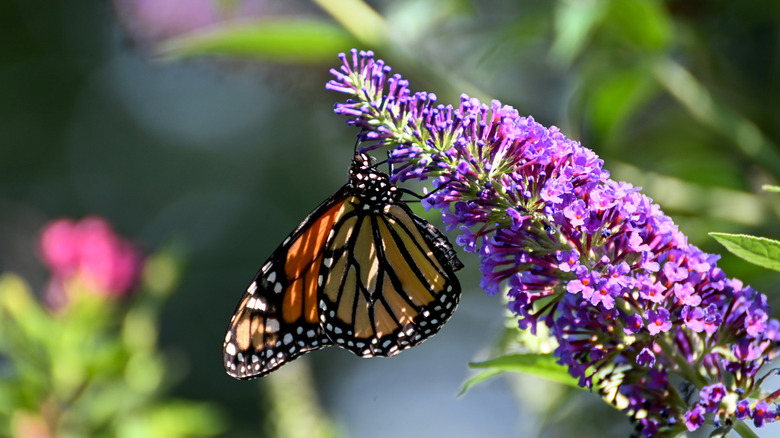
If you're hoping to turn your garden into a veritable wonderland of wildlife and do your bit to support declining populations of pollinators, then the flowers you choose to plant are key. The right choice can encourage not just bees, but also butterflies and even hummingbirds to visit your garden. Once they arrive, not only will they help your chosen flowers to thrive — allowing you to enjoy bountiful blooms of rainbow-colored flowers — but they'll also provide you with endless hours of enjoyment as they go about their daily duties.
Certain flowers offer further benefits beyond attracting pollinators, like pest management. Plants like marigolds, for example, are utterly repellent to insects like aphids. On the other hand, trap crops like nasturtiums actively attract aphids, effectively distracting pests from devouring and damaging your other plants.
The key to knowing which flowers to plant for pollinators, as with all flowers, is understanding your home's weather, soil, and hardiness zone, and the plants that are best adapted to grow within it. Some are exceptionally adaptable, able to grow across an enormous climate range. Others are only really viable in a handful of regions. Don't worry: With this guide to pollinator-friendly flowers — like orange jewelweed or red bird-of-paradise — you can easily arm yourself with everything you need to transform your garden into a bright and happy home for an array of pollinators.
Nasturtiums (Tropaeolum spp.)
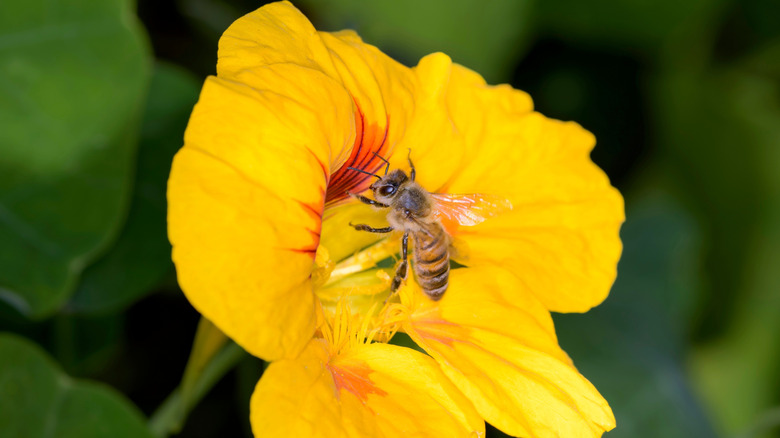
Grown as perennials in hardiness zones 9 to 11, and as annuals elsewhere, nasturtiums (Tropaeolum spp.) are an easy flower to grow for attracting pollinators thanks to the exceptionally sweet nectar that awaits within their gorgeous multi-colored blooms in red, yellow, orange, even a deep burgundy. They're as attractive to hummingbirds as they are to bees, butterflies, and other insects, meaning you can expect a dazzling spectrum of colors as your multi-hued flowers invite an equally iridescent array of creatures into your garden sanctuary.
You can also eat the leaves of nasturtiums, making for a vibrant addition to summer salads, however, it's worth knowing that they are immensely attractive to aphids — especially yellow-flowering varieties. This natural magnetism makes nasturtiums a fantastic "trap crop," meaning that you can plant them next to more precious roses, vegetables, and other plants, effectively distracting the aphids and allowing your other plantings to thrive.
Carolina jessamine (Gelsemium sempervirens)
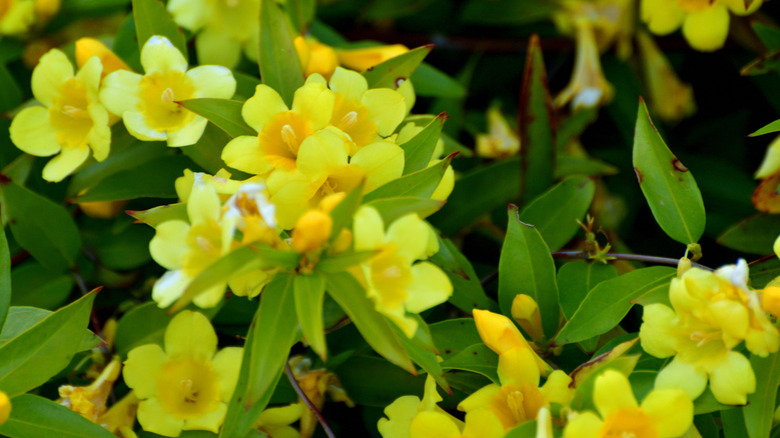
Great for warmer climes, Carolina jessamine (Gelsemium sempervirens), also called yellow jessamine, grows well in hardiness zones 7-10, bringing its gorgeous yellow blooms to your beds with evergreen leaves that provide color in your garden even when not in flower. When it is, this yellow flower attracts an array of pollinators, including butterflies and hummingbirds. It's also relatively low-maintenance once established, is tolerant of drought, and resistant to both deer and pests. The big drawback is that this plant is toxic to humans (fatal in very high doses) and dogs, and reportedly to honey bees, too. This means it's important to keep it out of reach of pets and children, and ideally planted in combination with honey bee-friendly plants, so they have something to distract them.
Depending on which part of your garden is most in need of color, it can be used either as a climber or ground cover, although you should only use it for cover in areas away from dogs and children. As a climber, Carolina jessamine can add vertical visual depth to your planting scheme, effectively decorating a wall or trellis. As a ground cover, it'll help to suppress other nuisance plants like weeds and invasive grasses.
Cheddar pink (Dianthus gratianopolitanus)
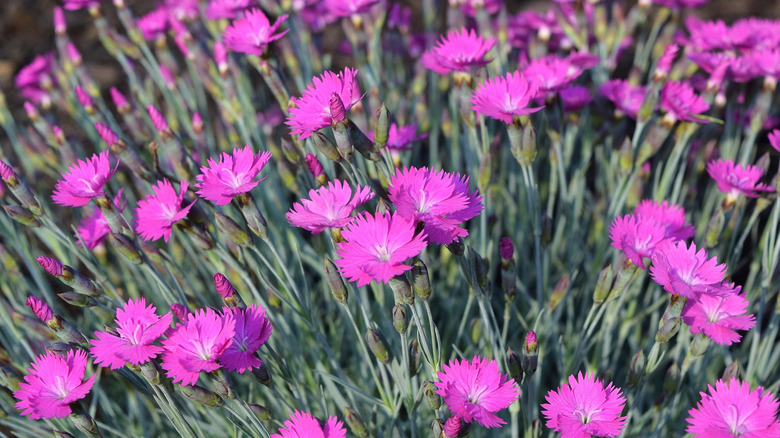
Happy to grow in hardiness zones 3-9, Cheddar pink (Dianthus gratianopolitanus) brings gorgeous pink blooms to any garden it's planted in. For even more vibrant color, you can consider the award-winning cultivar 'firewitch.' It also promises to attract plenty of pollinators like bees, moths, and butterflies, whose unique markings and colorations only add to a yard's visual diversity. Incorporating 'firewitch' dianthus is also a great tip for attracting bees into your garden, allowing you to support local populations and do your bit to promote biodiversity in your local area.
It's also deer resistant and drought tolerant, and provides a sensual feast for humans with its gorgeous blooms and gently spicy fragrance. Use firewitch as ground cover or as an accent in your borders; just keep an eye on it and make sure that it doesn't begin to dominate your other plants. Once established, it's usually very keen to spread, and will quickly encroach on its neighbors regardless of whether or not you want it to. And while you want the soil moist, the plant doesn't do well with wet winter soils, and is prone to crown rot.
Marigolds (Tagetes spp.)
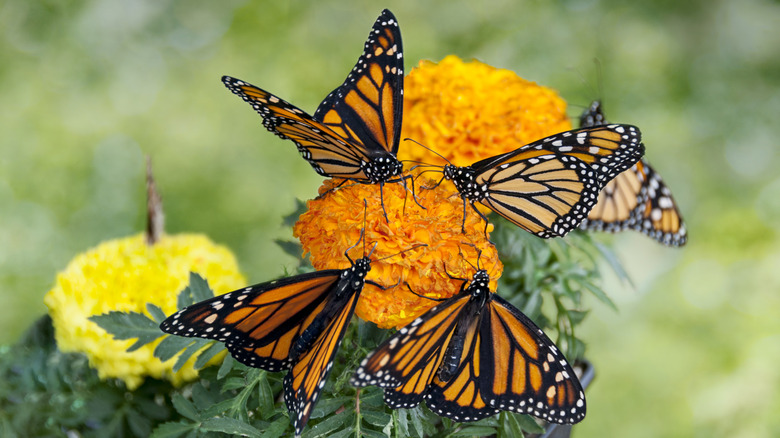
If you live between hardiness zones 2 and 11, then marigolds (Tagetes spp.) are worthy additions to any garden, not least because they can help increase biodiversity. Rich with nectar, marigolds are a boon to butterflies, who will keep on coming back provided that you deadhead spent flowers to encourage more to bloom. Bees, too, love this family of plants, but it's worth choosing a variety with open flowers. Open-centered blooms make it much easier for insects like bees to access the yellow florets within. French marigolds (Tagetes patula) are a good option, loved by bees and butterflies alike while rewarding your efforts with dazzling displays of floral color (bonus: they also attract hungry hummingbirds).
The beauty of planting marigolds for your pollinators is that they're also one of the best plants for naturally repelling garden pests. In fact, when you plant marigolds in your vegetable garden, you effectively turn it into a no-fly zone for unwelcome hungry visitors like aphids. To make doubly sure, you could also add in trap crops like nasturtiums, which will keep any particularly brave invaders busy and away from your gourmet growers.
Trumpet honeysuckle (Lonicera sempervirens)
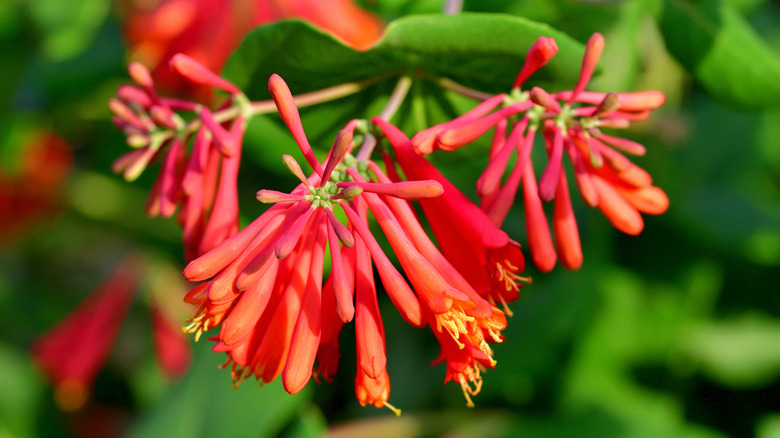
Popular for its color and the gentle fragrance that it seems to leave hanging in the air on still, balmy days, trumpet honeysuckle (Lonicera sempervirens) is one of the sweetest smelling flowers you can add to your garden to make it smell like heaven. It's a natural climber, making it an obvious choice for walls, fences, trellises, and pergolas. What's more, not only does it promise a flourish of gorgeous red flowers each year, but depending on the conditions, it may actually produce two sets!
As well as providing a feast for human senses, trumpet honeysuckle is favored by pollinators, including butterflies, bees, and various types of hummingbirds (the long, downward-facing flowers are ideal for the hovering birds' long beak and tongue). Provided that you give it a spot in full sun — and that you live between hardiness zones 4 and 9, where it grows best — you can expect visits from these happy nectar hunters season after season. What's more, as the plant's red berries appear in fall, it becomes a plant that attracts a diverse variety of birds.
Orange Jewelweed (Impatiens capensis)

Self-seeding and therefore able to easily establish itself in hardiness zones 2-11, this orange flower, also known as spotted touch-me-not, is perfect for attracting pollinators in the fall. Orange jewelweed (Impatiens capensis) especially recommended for those who want to attract native bees and honeybees (its chief pollinators) as well as butterflies and even hummingbirds.
As for why it's called "jewelweed," it seems that there are a couple of possibilities. One is that water tends to bead on the leaves, giving them a "bejewelled" appearance. Another is that it was named for its turquoise-colored seeds. Either way, this fiery-flowered plant is beautiful to behold. However, it's also renowned for being quite an aggressive spreader, so gardeners are advised to plant it with caution in containers or bordered flowerbeds. This is because this flowering plant has not just one, but two modes of seeding itself.
The first method is via pollination, for which it relies upon local populations of pollinators. But it also grows secondary flowers at its base, and while these don't actually open, they nevertheless contain a vital store of seeds, which will be sown into the ground towards the end of the plant's annual cycle. Of course, it's entirely possible — and quite usual — for both types of seeds to spread, meaning it's really no surprise that orange jewelweed can take over an area so quickly.
Black cherry tree (Prunus serotina)

While technically trees rather than flowers, black cherry trees (Prunus serotina) produce clusters of snow-white, daisy-like blooms prior to fruiting which are absolutely gorgeous. Honey bees, miner bees, and other pollinators can't get enough of this tree, and if given the right conditions, it can encourage them to return to your garden for years, even centuries, to come. It's also a larval host plant for certain species of butterflies, so planting black cherries helps expand the pollinator population.
They grow best in hardiness zones 3 to 9, and while the pollinators in your garden are likely to lose interest once the flowers turn to fruit, you'll be rewarded with an abundance of home-grown cherries you can use to indulge your cravings in the kitchen. What's more, when it's time to prune, you'll be left with a home-grown supply of cherry wood, which is perfect for smoking delicacies like beef, pork, and even cheese.
As a fast-growing tree, black cherry is unsurprisingly popular among gardeners who seek a steady supply of fresh fruit and frequent displays of local pollinators. Keep in mind that, at maturity, these trees can reach dizzying heights of 50 to 80 feet, an important consideration for those with smaller gardens. Another issue is that they can be quite messy, often dropping unpicked fruit onto the ground. Finally, everything from the tree (with the exception of the cherries' pulp) is toxic, containing cyanide compounds, making them a potential hazard for dogs, cats, and horses, as well as children who like to explore with their taste buds.
Peacock flower (Caesalpinia pulcherrima)
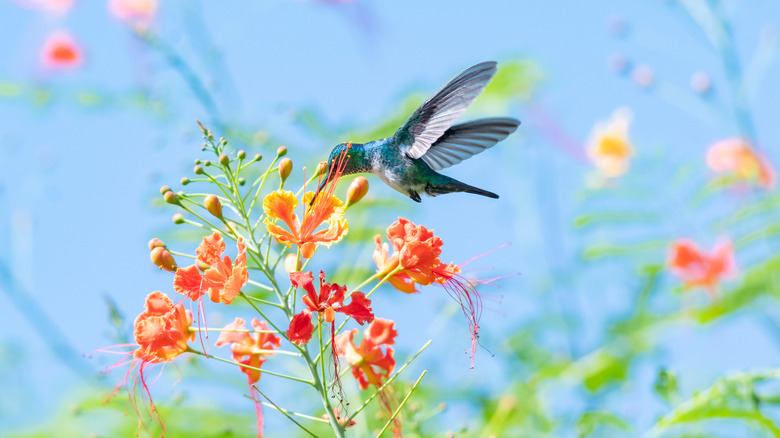
The first thing to note about the peacock flower (Caesalpinia pulcherrima) also known as the red bird of paradise or Barbados pride, is that, while they are attractive to pollinators, its leaves are also toxic to dogs and cats So anybody with pets (or neighbor's pets) frequently spending time in their garden should think twice before planting them. However, provided they're out of harm's way, or that pets are simply not an issue, these plants thrive in hardiness zones 9-11 and bring fiery blooms of red to yards all summer long (or year-round if you're in the tropics).
The flowers grow as clusters, each featuring up to 40 mini-blooms, with long red stamens that create the look that gives the plant its name. Recipient of the Award of Garden Merit from the Royal Horticultural Society, these flowering favorites really are beautiful, helping to add a slice of floral paradise to any garden in which they're planted.
As for the pollinators you can expect to invite into your yard with these beauties, hummingbirds are among the most enthusiastic. Butterflies are also likely to visit, helping to pollinate the plant by brushing their wings on the flowers (thus catching pollen) before spreading it to other blooms.
Maltese cross (Lychnis chalcedonica)
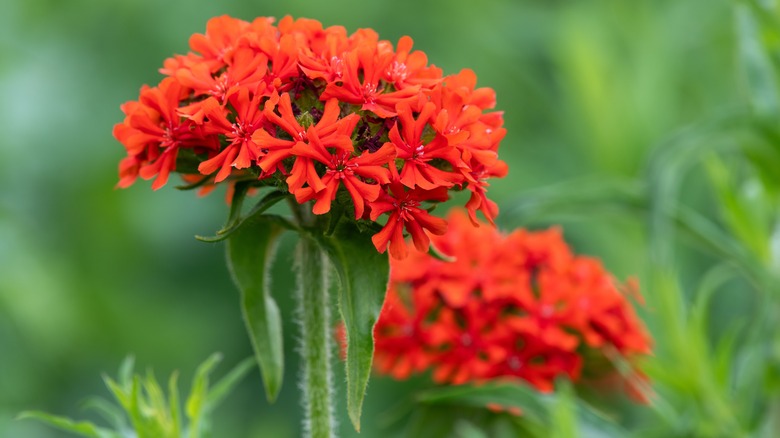
Perfect for gardens in hardiness zones 3-8, this herbaceous perennial thrives in sunny spots, rewarding those who plant them with gorgeous, densely-packed clusters of deep-red flowers over a surprisingly long flowering season. It's also self-sowing, perfect for filling out your flower beds with minimal effort.
Not only is it beautiful, but Maltese cross or Jerusalem cross (Lychnis chalcedonica, now called Silene chalcedonia) is also both rabbit and deer-resistant, meaning you can rest reasonably assured that any local populations will leave your beautiful blooms alone. It's also low maintenance, resistant to disease, and if regularly deadheaded, will continue to provide flourishes of color to your garden throughout the summer months.
Local pollinators like bees and butterflies are sure to thank you for keeping your shears sharp, but that's not all: You can also attract hummingbirds by planting Maltese cross. And since hummingbirds are known to remember a quality feeding ground and return to it season after season, if they find your flower bed once, there's a good chance they'll continue to grace you with their presence for years to come.
Red turtlehead (Chelone obliqua)
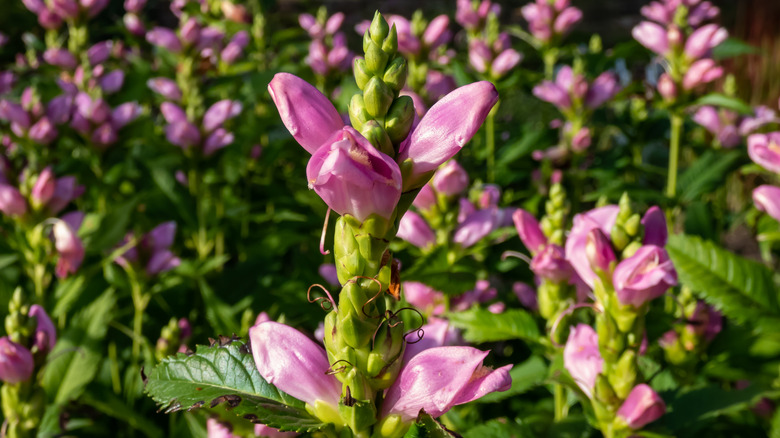
If you're looking for a flower that'll attract pollinators to shady parts of your garden, then red turtlehead (Chelone obliqua) could well be the solution. Thriving in hardiness zones 5 to 9, and blooming each season with the vibrant pink, hooded flowers that earn it its name, this plant is loved by pollinators like hummingbirds, butterflies, and bees.
It's also easy to grow. Not only do turtleheads self-seed, but they also naturalize themselves in shady spots with underground rhizomes — similar to those of other easy-spreaders like running bamboo. But don't worry. Unlike running bamboo, which spreads incredibly quickly and can aggressively take over large expanses of garden, red turtleheads spread slowly, forming clumps of plants. They're also indigenous to North America, so even if they do spread, they're not considered invasive. These, in turn, punctuate the shady spots in your garden with bold pops of pink, bringing a welcome uplift during late-summer and early fall when other flowers are starting to fade.
Goldenrods (Solidago spp.)
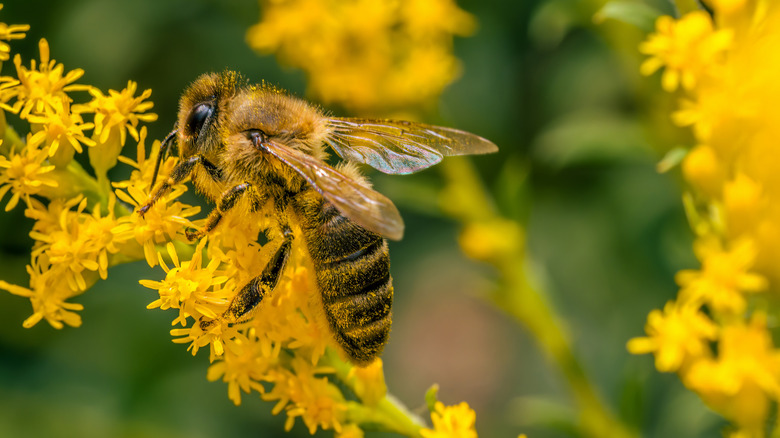
Able to thrive in gardens across hardiness zones 3 to 9, Goldenrods (Solidago spp.) are named for the gorgeous golden "rods" of small, clustered flowers that bloom from mid-to-late summer all the way through to the first frost. They have a bushy, upright growth pattern, forming dense areas of foliage and spreading themselves via underground rhizomes. They're also perennial, and thus can be relied upon to return year after year.
Given the way in which this plant spreads itself, it should be planted with caution. In fact, certain species are considered invasive in some areas, since, in the right conditions, it can — and will — spread aggressively. This is easily managed, either by retaining it in containers or hemming it in a garden bed with barriers to prevent it from out-competing your other flowers. You'll be glad you went to the extra effort; with the right measures in place, it's the perfect flower with which to transform your fall garden.
As for pollinators, Goldenrods are well-favored by butterflies and a raft of other insects who appreciate its seasonal longevity. Beekeepers, too, rely on these flowers for providing their hives with pollen later in the season.
Bee balm (Monarda spp.)
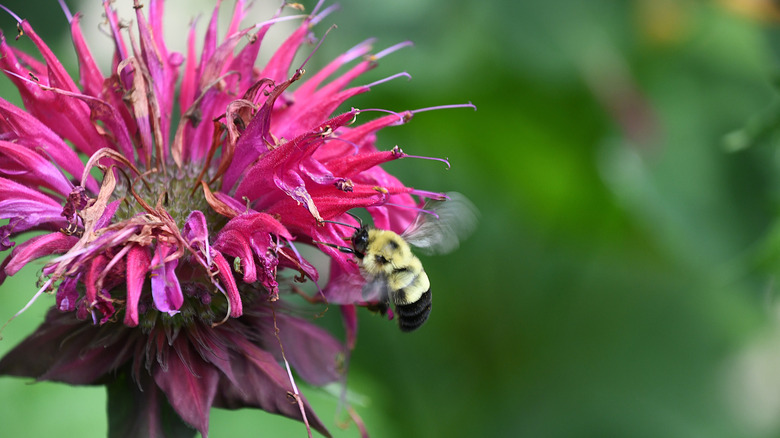
Producing beautiful red, pom-pom like flowers at the tip of upright stems, bee balm (Monarda spp.) is one of the best plants for attracting hummingbirds, especially in gardens between hardiness zones 3 and 9. Its nectar-rich flowers loved by bees, butterflies, hummingbirds, and other pollinators. But, being part of the mint family, it's also a fragrant favorite of humans, releasing a nostril-nurturing scent that's reminiscent of bergamot orange.
The best part, however, is that deer and rabbits absolutely detest the smell. Not only does this mean you can add it to your borders or near wooded areas without fear of it being eaten, but you can also potentially protect other more palatable plants from their sharp, herbivorous appetites. Since it's a perennial, it'll return to do the same job year-after-year in the right conditions, bringing vibrant pops of scarlet red to your borders from late spring to early fall.
Blue cornflower (Centaurea cyanus)
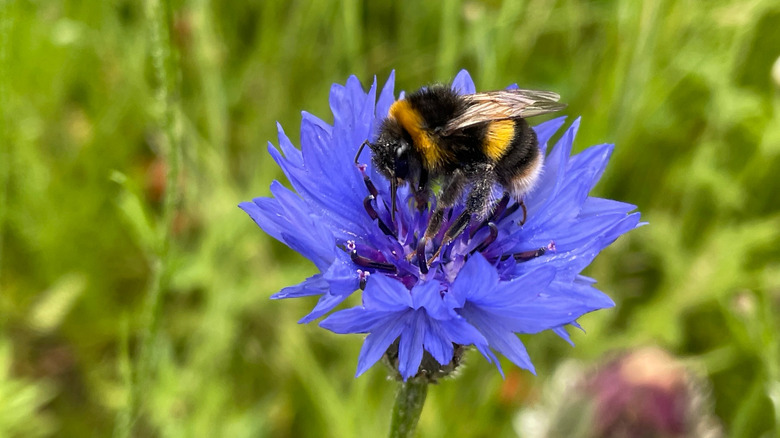
Otherwise known as Bachelor's Button, it's easy to imagine a rich, colorful flower from the gorgeous cornflower plant (Centaurea cyanus) adorning the buttonhole of a best man or a stylish groom at a wedding. While cornflower blue is the shade most commonly associated with this plant, it actually comes with a rainbow of flower colors. Filling borders and flower beds with shades of blue, pink, lavender, white, and even maroon, it's the perfect plant to help your vegetable garden thrive, attracting crucial pollinators like butterflies and bees.
It's also deer and drought tolerant, easy to grow, resistant to pests and disease, and highly adaptable. In fact, it will happily grow in poor quality soil, and can bring color to gardens from hardiness zone 2 all the way to zone 11. What's more, despite being an annual, it will happily self-sow in the right conditions, meaning that while one year's plants will eventually die back through the winter, you could well find yourself with more blue cornflowers than you bargained for the following spring.