

Simple Tricks And Ideas That'll Add More Privacy To Your Balcony
We may receive a commission on purchases made from links.
Balconies are a boon to those who enjoy spending time outdoors but who don't benefit from the sanctuary of a private backyard or garden. However, satisfying your need to get outside for fresh air can feel like a chore, if you're on full display each time you slide open the door. But it doesn't have to be, and honestly, it shouldn't: There are simple ways to give you a little more privacy on that ledge, even if it's a shared one.
Of course, unlike more traditional yards, it's hard to install a tall privacy fence around your balcony, not least because doing so would risk shutting out the natural light. However, that doesn't mean achieving privacy is impossible. Nor does it suggest you need to spend a fortune or be particularly handy at DIY. With a few simple changes, you can make a dramatic difference to your balcony's usability and seclusion.
Everyday items, like blankets, throws, and even towels can be temporarily slung over your railing to shield you from view in a pinch. If you're blessed with a green finger, you can easily train plants to climb up your balustrade, shutting out prying eyes. Alternatively, on railings fitted with solid, but see-through, glass screens, you can easily affix frosted glass or vinyl to hide yourself away while admitting natural light. As always, double-check with your building, landlord, or HOA to ensure your privacy screen of choice doesn't violate any regulations or rules. As you'll see in this guide, with just a little creativity and outside-of-the-box thinking, it's entirely possible to enjoy your balcony without advertising your downtime to the world around you.
Cloak your balcony with climbing plants
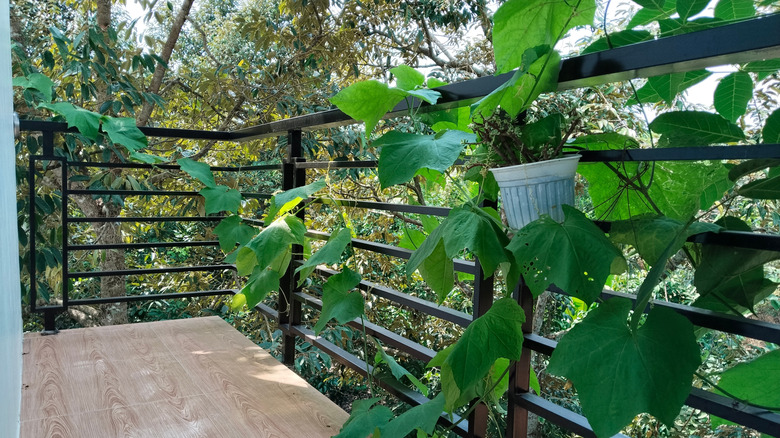
Just because you don't have garden soil to work with, that doesn't mean that you can't use nature to your advantage. With a few choice climbing plants, you may be surprised at just how easy it is to grow a natural privacy screen, which is a simple trick for adding privacy to a backyard, patio, or balcony. These types of plants offer an especially simple solution for balcony railings featuring both posts and several rails, as this provide precisely the kind of climbing trellis that vining plants love. There are plenty of plants to choose from, too. Wisteria (Wisteria spp.) is a great choice, yielding gorgeous purple flowers that are as attractive for pollinators in search of nectar, as they are for humans to look at. Alternatively, Henry's honeysuckle (Lonicera henryi) is another solid solution. Like wisteria, it's attractive to pollinators. It's also evergreen, and is known to grow very quickly.
The key is to find plants that naturally grow dense foliage. Depending on the area you wish to screen, you may need to plant a few along the base of your railing, and you might need a long container to hold the potting soil. Just remember to determine your area's hardiness zone before you choose your plants, and determine whether or not they're considered invasive before you buy the plants. This will help you to narrow down the list of those most likely to grow well on your balcony.
Grow a container garden to block prying eyes
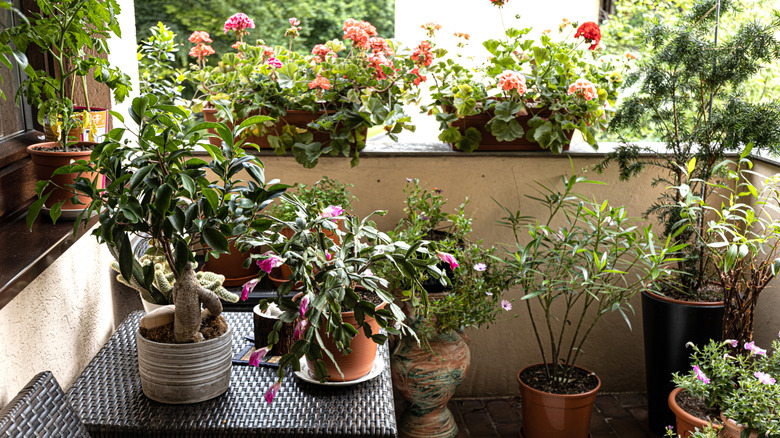
If you have a solid balcony railing — or a see-through one with a single rail — that vining plants are unlikely to climb, don't worry. You can still use plants to your advantage, you'll just need some planters and containers to pot them in. If you have a small balcony, make sure you choose your pots and planters carefully to avoid losing too much precious floorspace.
Similarly, just as you would with climbing plants, it's important to choose container plants carefully. Assess your region's hardiness zones, and consider the microclimate of your balcony. Is it exposed to prevailing winds? Does it receive a lot of direct sunlight? Armed with this information, choose plants that are likely to thrive on your balcony, and ensure that you have a plan in place to water them. Especially if your balcony is a sun trap, you may be surprised by how quickly potted plants dry out. Layer them by placing taller plants, like fruit trees you can grow in pots, to help break up sight lines along the top of your balcony railing. Use shorter, bushier shrubs and plants to fill in the front for extra coverage.
Use hanging planters to interrupt sight lines
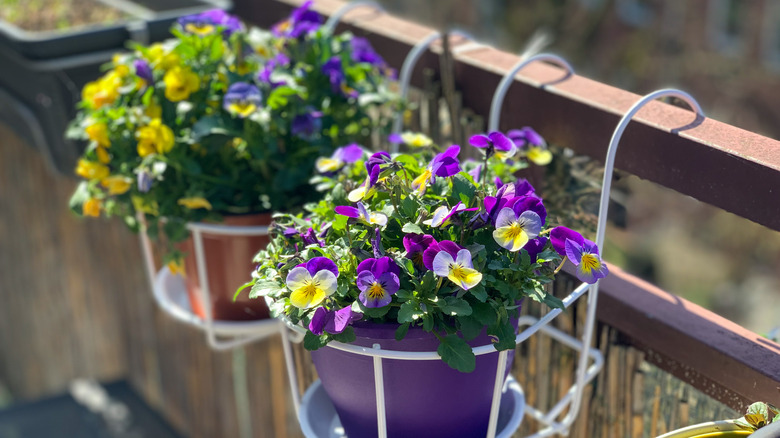
Hanging planters over your balcony railing is perhaps one of the easiest ways to achieve privacy with the help of plants. It requires precisely zero major changes or permanent fixtures, and if you're not especially fond of the view past your balcony, a few choice container plants can seriously improve your sight lines. Regardless of the view, the inclusion of a few plants can also help to reconnect you with nature and bring a little colorful calm to your balcony. Unlike other, more permanent fixtures, plants also allow for plenty of air flow — allowing you to make the most of the gentle summer breeze on warmer days.
Once again, in order for this trick to be effective, it's important to choose the right plants. Evergreen types are a winner for year-round balcony users, and more generally, you should try to use those that grow dense foliage, as these will naturally provide the most privacy. 'Silver Falls' (Dichondra argentea) is a popular choice that fills a basket and hangs down a few feet with soft, blue-tinted "metallic" leaves, and pairs nicely with flowering companion plants. As such, consider hanging planters that provide space for multiple plants, and if you hope to welcome some wildlife onto your balcony, then aim to include at least a few beautiful, pollinator-friendly flowers.
Add a trellis to shield you from view
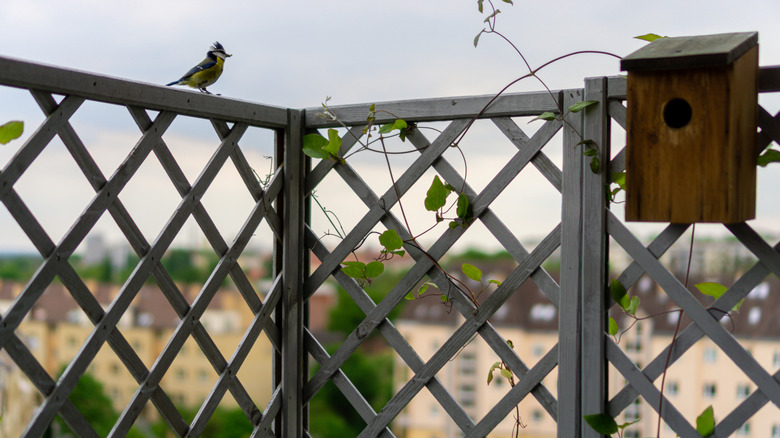
Yet another way to use nature to your advantage is to install a trellis. The nice thing about this idea is that you don't necessarily have to train plants to grow over your trellis in order for it to be effective. In fact, a trellis alone, if installed in the right spot, is a superb way to interrupt your onlookers' sight lines without starving your balcony of light. They are also an excellent medium for hanging decorative items, like mirrors, mosaics, and other accessories. And since trellises are available in myriad materials, shapes and sizes, you can use them to effectively extend the height of your railings.
However, if it's all-out privacy you're after, then a trellis is best paired with a selection of climbing plants. In order to do this, you'll need a planter to house your potting soil. If rules in your apartment complex stipulate against adding fixtures to the walls, consider a wooden raised planter. Your trellis can be attached to it with outdoor-grade wood screws. Once it's filled with soil, it should have enough weight to the trellis and its plants upright, even in strong winds. Finally, choose your plants carefully, taking into account your hardiness zone and your balcony's unique exposure (or lack of) to the elements. Try to source a selection with dense growth habits, and to ensure maximum visual appeal (for you), mix things up with a variety of flower colors.
Use outdoor curtains to screen your balcony
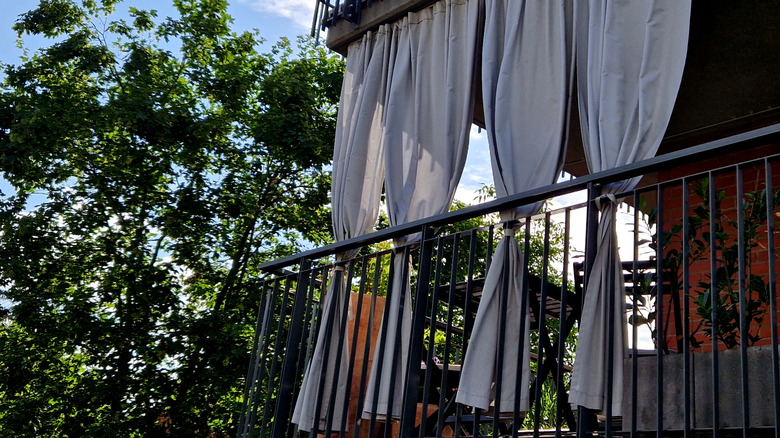
Offering a quick, flexible solution to balcony privacy, curtains are great for blocking out your neighbors' sight lines. They can be tied back when you don't need them, and drawn quickly if you need to shut out the rest of the world. What's more, depending on your fabric choice, they can help you to extend your indoor style outside. You can even use a set of inexpensive canvas drop cloths to DIY curtains for privacy, or opt for gauzy semi-translucent fabric, which will diffuse natural light, but still make a huge difference to your balcony's privacy.
Whatever style you're shooting for, it's important to choose the right fabric. Interior-grade fabrics, while beautiful, are unlikely to last long if exposed to the elements. Instead, consider fabrics like olefin (polypropylene), acrylic, treated canvas, or a polyester blend. Olefin (which is UV resistant) and acrylic are generally the best, and will last longer than cotton or polyester blends. That said, the latter is a good choice for those on a budget and who are happy to replace them from time to time as the material starts to wear or fade.
To hang your preferred curtains, it's easy, especially if your balcony has walls on either side: All you really need to do is fix a curtain pole to them. Don't worry if you're not allowed to add permanent fixtures to the walls. Instead, just buy something like the Haryaers long tension rod. These can be extended to your desired length and locked snugly in place, without the need to screw brackets into the building, particularly if your curtains are lightweight.
Hang outdoor rugs and throws over your railings
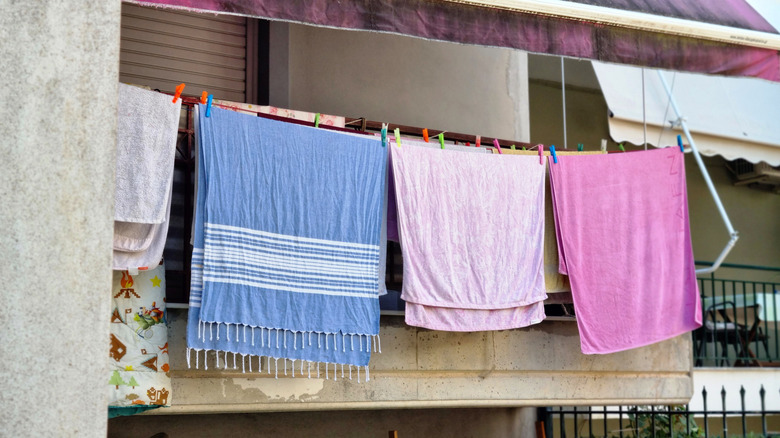
Not only is the use of outdoor rugs one of the best ways to make your outdoor space look more luxurious on a budget, it's also a quick, easy means of adding privacy to your balcony. In fact, assuming you have a rug to-hand, all you actually need to do is drape it over the railing of your balcony. That's really all there is to it!
Dpending on how much of your railing you want to cover, it could take several rugs to achieve your desired level of privacy. This may not be realistic with dedicated outdoor rugs, especially if you're sticking to a tight budget. However, there's nothing to stop you from using a few towels or a couple of throws from your sofa to achieve the same result. Sure, you'll need to bring them inside when you're not using them, especially if the weather turns bad. Plan on this one being a temporary solution anyway: Many buildings, landlords, HOAs, and neighbors frown on stuff draped over the balcony rail as a long-term solution.
Use potted bamboo to screen your seating area
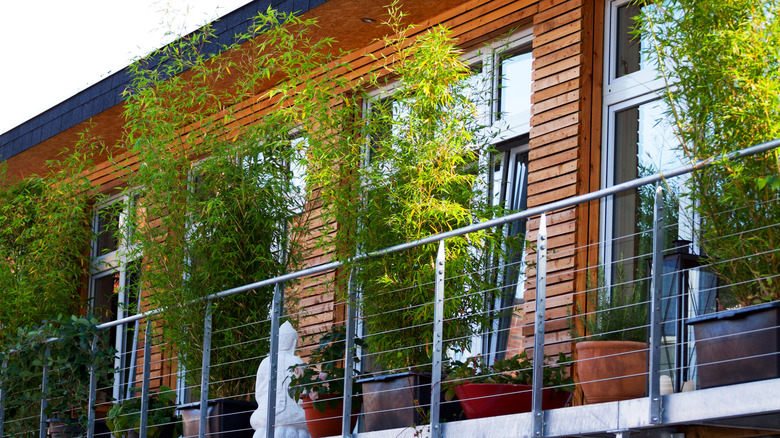
Bamboo is a superb plant for natural screening, however, while it can be planted directly in the ground in traditional gardens and allowed to spread, this isn't usually possible on balconies. However, it can still be planted in pots. Even in containers, bamboo can grows quickly and surprisingly tall, allowing you to screen your balcony on multiple axes. The dense, evergreen foliage brings both color and coverage to your balcony's boundary, while the natural contrast between the vertical canes and horizontal leaves lends a sense of textural interest to your seating area.
There are a couple of ways to use bamboo on your balcony. The first is to use multiple smaller pots, positioning them strategically in the areas you most need to screen. This can also work for wider areas, and may be preferable if you're hoping to mix up your balcony decor with containers of different designs and materials. Alternatively, for a full wall of bamboo, use one or two longer planters, like the 44-inch Hampton Classic wooden planter box from NatraHedge.
Install a privacy screen
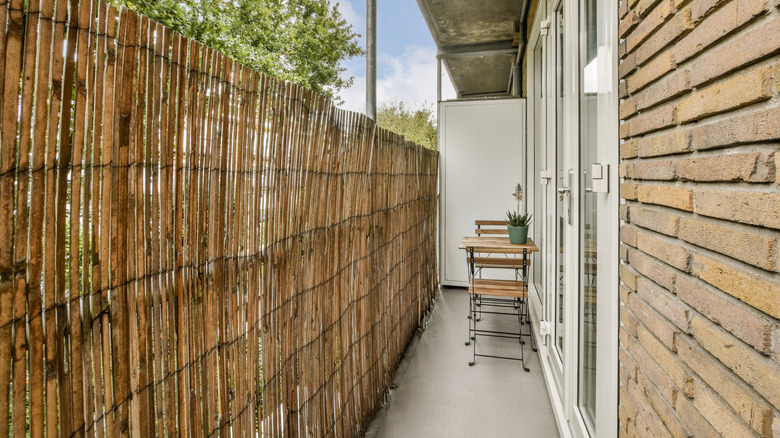
Perhaps the most obvious way to keep prying eyes from your balcony is to install a privacy screen. These come in an array of shapes, sizes, and materials, which is reassuring to those hoping to maintain a certain style. The key things to consider are how permanent you need your screen to be, and how much space you're willing to sacrifice.
Freestanding privacy screens, for example, can be placed to provide privacy where and when you need it most. When you don't need them, they can be stowed away. Perhaps the only drawback is that, when in use, they tend to soak up space. This isn't necessarily an issue for larger balconies, but for areas where space is at a premium, they could quickly become a nuisance.
The alternative is to buy a privacy screen that fixes directly to your railing. Bamboo fencing is a popular privacy solution, and provides an organic, natural vibe. But there are plenty of screens made from durable synthetic materials in a wide array of colors, textures, contours, and styles. Whichever matches your style, they can be used to cover as much or as little of your balcony as desired. And for many privacy walls, you don't necessarily need to drill holes to install them. Instead, you can use adhesive hooks or even zip ties, keeping your screen in place without breaking any tenancy rules around installing permanent fixtures.
Grow a living wall
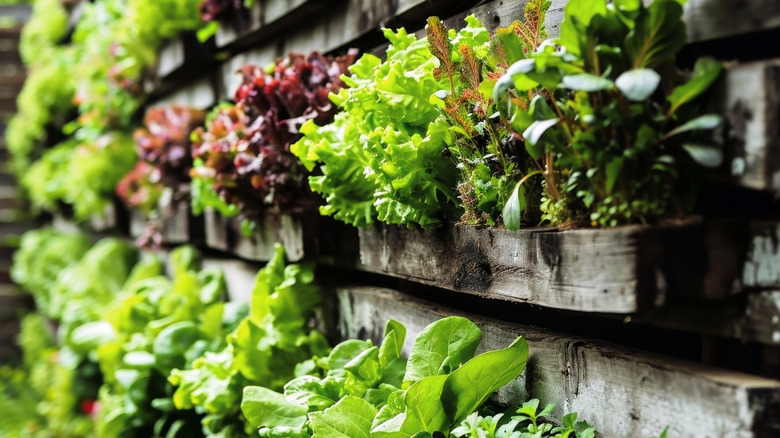
If you're fond of the thought of nature doing the hard work in your campaign for more privacy, then you're sure to love the idea of a living wall. It's one of the most satisfying ways to achieve privacy, especially for those who yearn to sink their fingers into the soil but don't have a garden in which to do it. What's more, with the right equipment, it can be incredibly effective at blocking out the view of your neighbors. Even on a small balcony, you can build a stunning plant wall.
Now, it's possible to build one yourself by hanging multiple pots. However, the easiest way to do it is by buying yourself a living wall kit. The key, in this case, is to find one with hangers so that you can hang it on your balcony railing. This living wall kit from SunVara fits the bill perfectly. A single panel is large enough to cover an area of about 9 square feet, and it features the hangers you need to suspend it. More than that, it's fitted with no fewer than 64 pockets in which to grow an array of gorgeous plants. Mix up your planting scheme with showy flowers and decorative trailers, and if you need to cover a larger area, consider buying more kits.
Apply frosted film to obscure views through glass
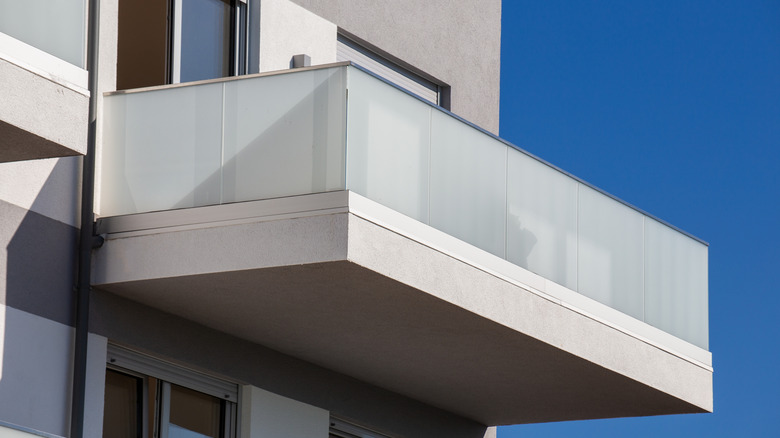
The only potential drawback of using privacy screens, climbing plants, and living walls is that they run the risk of blocking out natural light. In contrast, one of the benefits of a clear glass balcony is that it allows full access to the sun. If your balcony has glass paneling, one way to make things more private without sacrificing the light is to use an adhesive frosted film.
These products can easily be applied to your to the glass panels in your railing. Because they're translucent, they give a measure of privacy, but continue to let the light in a softer, diffuse way. When it comes to installing the film, there are several tricks to help prevent annoying bubbles and crinkles from forming. The first is to cut the vinyl into smaller sections, which are easier to handle than one large sheet. Another trick is to spray your surface with soapy water first. This tip is useful for two reasons. Firstly, by preventing the adhesive from sticking too quickly, it allows you to reposition the film to ensure it's straight. Secondly, once your film is in position, the soapy water underneath makes it possible to iron out any minor imperfections, helping you achieve a professional finish with little more than a stiff squeegee.
A large outdoor umbrella or sail shade blocks views from above
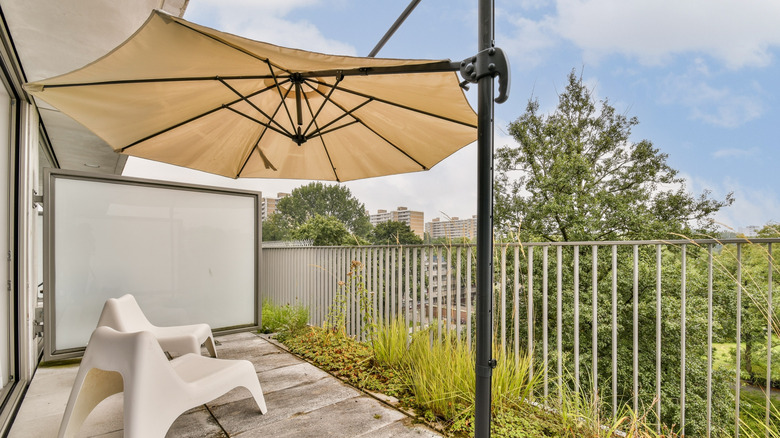
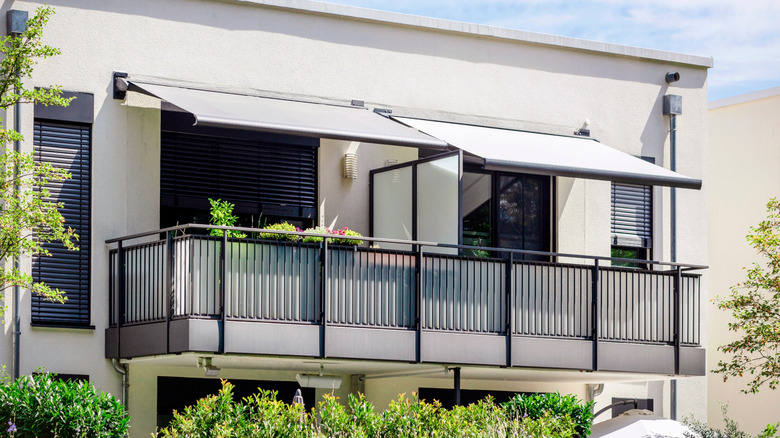
If you've got neighbors in apartments or homes gazing down at your balcony from on high, then railing-mounted screens alone are unlikely to provide enough privacy. It's still possible to prevent staring eyes (or drones) from disturbing your reverie: All you need is space to fit a patio umbrella. This is a great way to block out vertical sight lines, and it's also a useful means of providing some shade in the balmy height of summer.
Another way to achieve top-down privacy is to fix a sail shade over the top of your balcony like a fabric ramada or pergola. These shades will need to be removed frequently in areas prone to high winds, which may not make them the most practical solution, depending on the weather in your area. If allowed, you could add a framework installed with runners that allow you to retract the shade. Alternatively, you could install something like the Outsunny retractable awning., which can be pulled out whenever you need it, and it's much easier than adding a sail shade frame.
Position furniture or storage benches to block the view
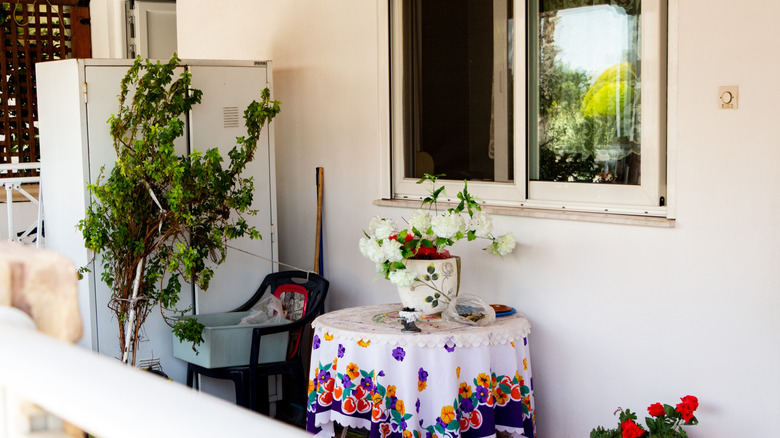
The first thing to say is that, if you're trying to block out views from above your balcony, then this idea may not be the one for you. However, if you have neighbors looking up from below who can peer up into your balcony, then a few choice outdoor cabinets, storage benches, or even strategically placed storage boxes can be an effective way to shut them out. If you opt for a taller cabinet, you'll want to secure it against strong winds, by attaching it to the wall or railing. With storage containers, you'll need one large enough to block the view, but bear in mind that these products are likely to soak up floor space.
This needn't be a problem: If you're tired of tripping over accessories that can't be left outside when not in use, a container could be worth buying regardless of whether or not you need extra privacy. Even better, DIY a sleek storage bench: You can customize the size and length, and it'll satisfy any fussy rules about what sits on your balcony. Box or bench, it provides a handy place to stash outdoor rugs, pillows, and toys in the off season, while adding a bit of privacy from prying eyes downstairs.