

Tools That'll Make Snow Removal During The Winter Months Even Easier
We may receive a commission on purchases made from links.
For most of us, snow is an inevitable part of the winter season. Roughly 38% of the Lower 48 United States will have at least an inch of snow on the ground by Christmas. And whether you live somewhere that sees several feet dropped during the course of the winter, or just the occasional storm, there is one snow chore that many people will need to partake in: Getting rid of it. Snow removal might not be everyone's favorite outdoor activity, but it is necessary in order to keep your property safe and well-maintained (and it's often the law).
That said, snow removal does not have to be an arduous task. In fact, there are certain tools that can make the job of removing snow easier during the winter months. Some are essentials for everyone, while others aren't but still get the job done. For example, everyone who gets snow should have a shovel, but not everyone needs to transform their riding lawn mower into a snow plow.
The idea of this list is to provide you with a guide to the tools and hacks you can use to make snow removal a relative breeze. These tools and tricks offer practicality, economy, and may even have you looking forward to the next time the fluffy white stuff descends from the sky.
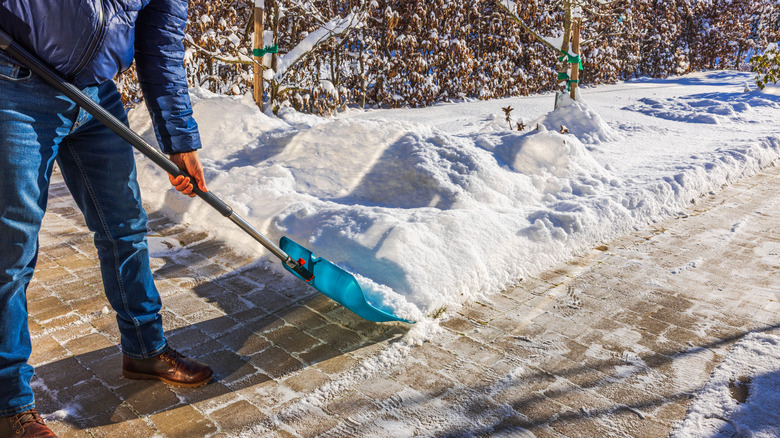
You can't beat a snow shovel
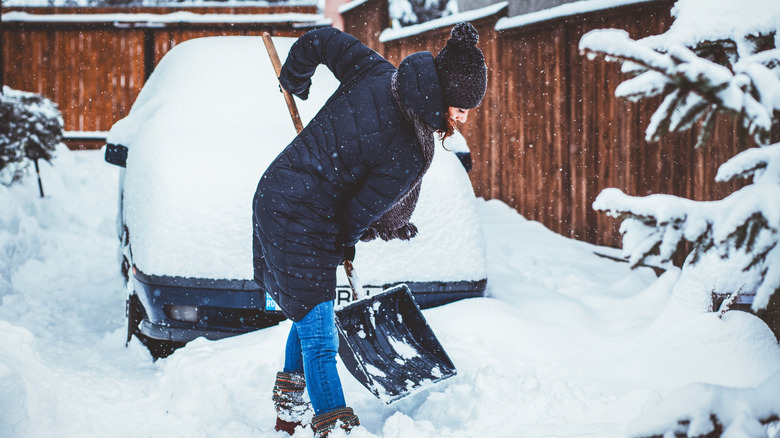
When it comes to the essential tools for snow removal, you cannot beat a shovel. There is no more reliable tool for snow management. Snow shovels are made out of several different kinds of material. Most have wood or plastic handles attached to a metal or heavy duty plastic blade. Snow shovels with smaller, deeper blades are designed for scooping snow, which those with wider, shallower blades are better for pushing the stuff away. There are even some with ergonomically shapes handles to promote better posture.
The great thing about a shovel is that it is operated manually. You do not need to worry about keeping a complicated engine maintained, or a drained battery. All you need is you. And a plan. See, shoveling can potentially cause cardiac issues and serious muscle strains if you aren't careful. Always warm up before shoveling, and take things in smaller loads. Shoveling in layers helps — rather than trying to scoop all the snow that's fallen. Picking the best time to shovel snow — as it's falling — also helps lighten the load. That may mean you have to go out more often, but that's better than injuring yourself.
Shovels are excellent because they offer precision and can get into smaller places that larger machines just can't. They are indispensable tools for clearing driveways, sidewalks, patios, and walkways. You should have several on hand to use throughout the winter, as well as an emergency version to keep in your car, like the collapsible snow shovel from Yukon Charlie's, in case you get in trouble and need to dig yourself out.
A snow blower is essential for heavier storms
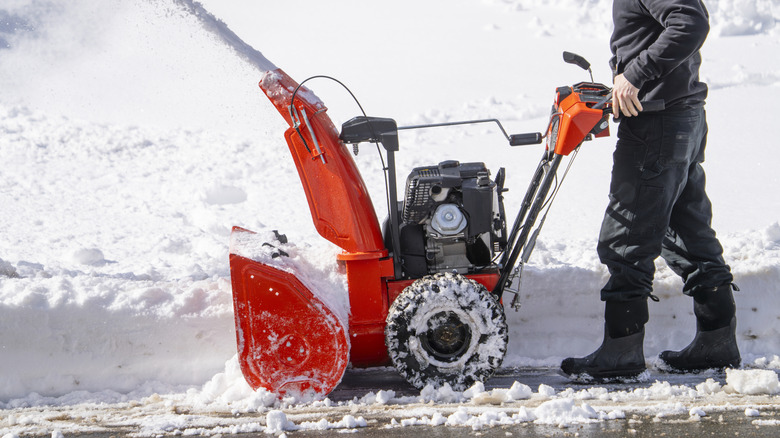
If you live in places like New England or the Midwest, and experience heavy snowstorms throughout the winter, a snow blower is not just beneficial, it's essential. A snow blower is a machine designed to throw snow a considerable distance, taking the pressure off of your body to get the stuff cleaned up. The snow is forced through a large auger, which then propels the snow out through a chute. They are excellent for clearing larger driveways very quickly, and can save you the back-breaking task of shoveling. Of course when it comes to deciding which is better, a snow shovel or a snow blower, it's important to remember each works better in different situations.
There are three main types of snow blowers: single stage, two-stage, and three stage. Single stage blowers are simpler machines that propel snow using only an auger and chute. They are smaller, can be powered by gas or electricity, and are best for handling lighter snow loads. Two-stage blowers are beefier, self-propelled machines with larger engines and the addition of an impeller to get some distance on the blown snow. These are excellent for clearing larger, heavier snow loads. Heavy-duty three-stage blowers add an accelerator, making it the best choice for breaking up large chunks of compacted snow.
Now, if you own a snow blower, don't make the mistake of not keeping it well-maintained. Examine the engine, battery, and moving parts routinely to make sure everything is working as it should. That will go a long way to preventing your blower failing on you in the middle of a blizzard.
Stick an ice scraper/brush in your car
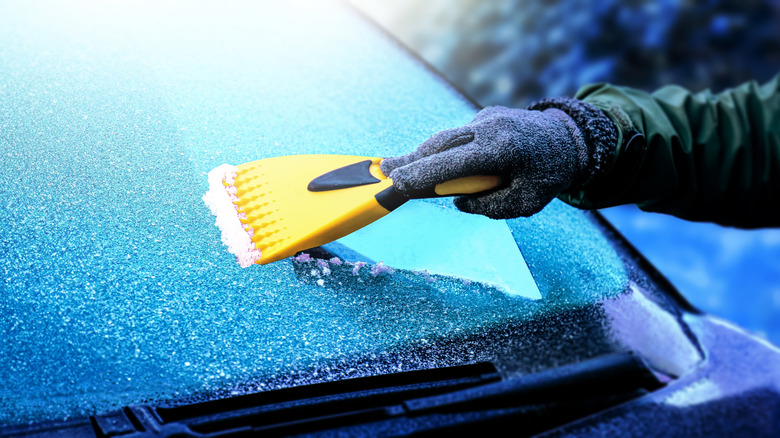
Getting your car cleared of ice and snow is an important part of snow removal. Snow left on a car is dangerous in that it can easily slide forward to obstruct your view, or rocket backwards into the car behind you. But while you can shovel or snow blow around your car in the driveway or parked on the street, you can't exactly use a shovel or a snowblower directly on your car. This is where an ice scraper and brush combo are going to come in handy.
Something like the OXO Good Grips extendable twister snowbrush with ice scraper is two essential tools in one. The brush is used to wipe snow off of the entire car, while the scraper blade is specifically used to remove ice that has collected on the vehicle's glass. You can find these at virtually any hardware or auto parts stores, and they are compact enough to fit in any car, making them essential winter preparation tools for a commute or road trip.
Another great tool to have is something called a SnoBrum. It's basically a mini version of a roof rake, a tool we'll explain in a minute. SnoBrum has an extendable handle and a wide, flat, soft polyethylene foam blade that pushes the snow off of your car without scratching the paint. This is a good thing to have, as the snow can often get caught up in the bristles of a standard brush and be very difficult to remove, and even a plastic snow shovel or ice scraper can scratch up a roof or hood.
Clear your roof with a roof rake
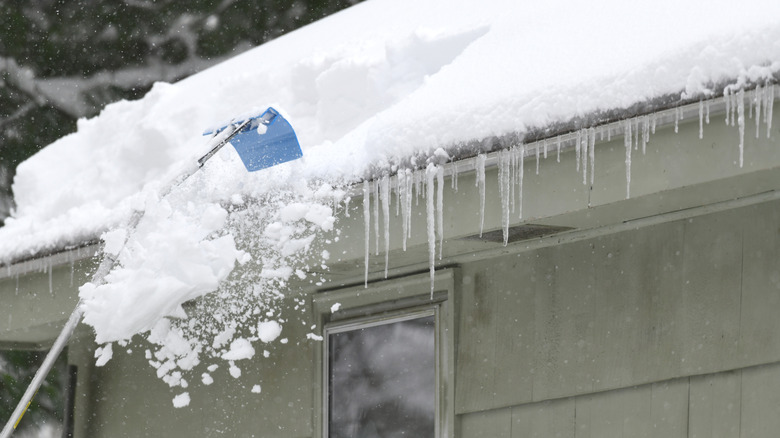
You've likely heard stories on the news of people's homes suffering roof cave-ins due to huge amounts of heavy snow from a single storm. This is a significant risk to life and property. Homes with flat or shallowly pitched roofs or a failing structure are the most likely at risk for winter cave-ins. If you're someone who owns an older home like this in an area prone to significant snowfall, you need to invest in a roof rake for snow removal.
As it sounds, a roof rake is an extendable tool with a wide flat blade that rakes snow off of your roof. From a position on the ground, you can reach numerous spots on your roof to remove a lot of built up. You might not be able to get all the way up depending on your roof rake's extendibility, but the more snow you get removed from your roof the better. Roof rakes are also essential for preventing ice dams.
It is worth noting that there are some safety risks involved with removing snow from a roof top. Ice dams and mounds of heavier snow loads can dropped on or near you, so stay alert and make sure you've got plenty of room between you and your roof. Also, it's important to not make contact with your roof's shingles, as the rake can damage them over time. Instead, leave a couple of inches of snow on the roof, which also acts as an insulation layer.
Use ice melt to prevent slips and falls
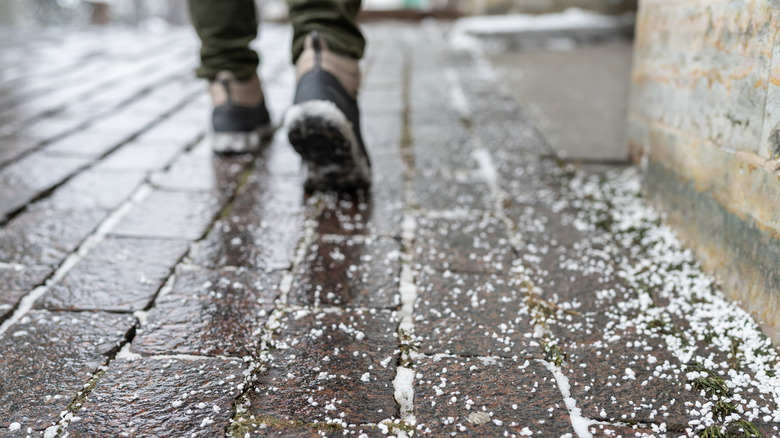
With snow and cold weather comes the potential for slippery ice. Its presence can be very dangerous, because you might not necessarily know that it is there. More than a few people have been wiped out while shoveling because of a hidden patch of ice under the snow. You can get seriously injured if you're not careful: The CDC reports that over a million people each year are injured falling on ice. Which is why it is always important to have ice melt during the winter to prevent slips and falls.
There are lots of different types of ice melt out there. The most common, by far, is rock salt, also known as sodium chloride. It comes in various different crystal sizes, but the principle is the same: Salt lowers the temperature at which water freezes from 32 degrees Fahrenheit to about 14. Once the ice has melted some, you can easily break it up and remove it with a snow shovel.
If you're not one for salts, other ice remedies include sand or grit, although it's important to note there are differences in how salt versus sand help with an icy driveway. Or you can DIY a liquid ice melt from hot water, rubbing alcohol, and dish soap. Just remember, don't ever use this mix on your car's windshield as the heat can crack or break the glass.
Spray your shovel with cooking oil or shop lubricant
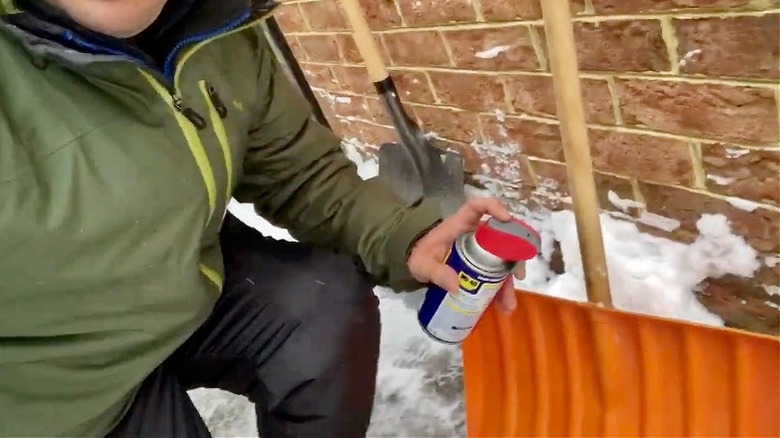
One of the most annoying aspects of snow removal is that it often sticks to the shovel, which you then spend time and energy banging the shovel against something to get the snow off. Snow sticking tends to happen if the shovel blade is warmer than the snow itself. This causes the snow to melt and refreeze forming a sludgy ice barrier that can be difficult to remove. Thankfully, there is an easy remedy for this: Give the shovel a good coating of cooking oil spray or WD-40.
WD-40 has a wide variety of different uses, including as a sort of shield on your snow shovel. WD-40 isn't actually a lubricant, but rather a water displacer. It works by creating a slippery surface that the snow can slide right off of instead of sticking.
In order to get your shovel slippery enough, apply a healthy coating of WD-40 to the blade and let it sit for a few minutes to "cure". You can also use cooking spray or olive oil to similar effect, but make sure it's an oil-based spray. The amazing thing is, it works really well. Compare it for yourself: Shovel up a load of good, sticky "snowball" snow, rotate the shovel head over as if you're dumping the snow, and see how much falls off. Now give the shovel a liberal spray of WD-40 and try it again. This trick will change how you view this annual task.
A tarp is great for lighter snows
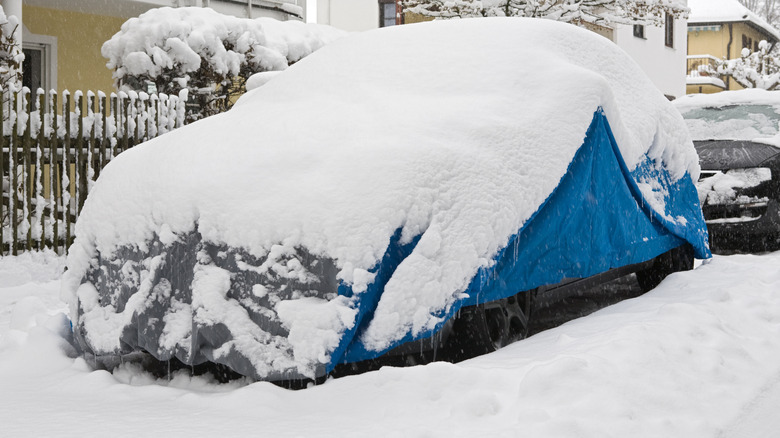
A tarp is unquestionably an excellent item to have on hand. Not only is it one of the supplies that can save your life when camping, but it can serve to protect your woodpile, livestock, and other outdoor features from inclement weather. In recent years, however, tarps have become popular on social media as quick and easy snow removal devices.
This is a rather lazy snow removal hack, but it can be effective. Simply cover your driveway, stairs, or sidewalk with the tarp before a predicted snowstorm. Weigh the edges down with rocks or logs to keep any wind from messing up your plans. Once the weather passes, lift it up and let the snow fall off into a corner. The whole thing should not take more than 5 minutes. If this seems too easy to be true, you should know there is a catch.
See, the tarp method won't really work for major snow storms, where you're getting many inches of snow. Snow gets very heavy, and it could easily break a standard tarp or get too heavy to lift off. Instead, the tarp is best for lighter snow loads. Also, depending on the size of your tarp, it likely won't fit over your whole driveway. Instead, this method is works particularly for porch steps, outdoor stairs, small paths, and your car. A tarp or car cover is an efficient way to protect your vehicle, and remove the snow.
Invest in heat mats

Wouldn't it be nice if you could use a remote control, and suddenly the snow would melt away from your porch steps or driveway? Well, if you invest in heat mats this could very well be a reality. While this option tends to be on the more expensive side (a starter kit for HeatTrak starts at around $500), there is no denying the fact that having an electrically powered heat mat do all the work is a very attractive concept. They can save you a lot of hassle when it comes to getting rid of snow, but are snow melting mats worth the investment? It depends on the size and nature of your outdoor space.
It should be pointed out that heat mats will not work for all kinds of properties. For example, someone with a long winding driveway would have to purchase a whole lot of heat mats to get the job done. This is not economically viable. However, heat mats are excellent for someone with a smaller suburban driveway that needs a quick way to remove snow before their commute in the morning. They also only melt the snow right where they are, so mats won't clear your entire path or driveway, just where they sit. And of course, there are troubleshooting issues that can come up that don't with a snow shovel.
Heated mats are also excellent for porch stairs or walkways. The electrically powered heating coils within the mat will melt away snow and ice while you focus on the larger task of getting your driveway cleaned up. It's not much, but if it keeps you from having to shovel your steps and walk, it could be worth it.
Get an ice chopper for deeper freezes
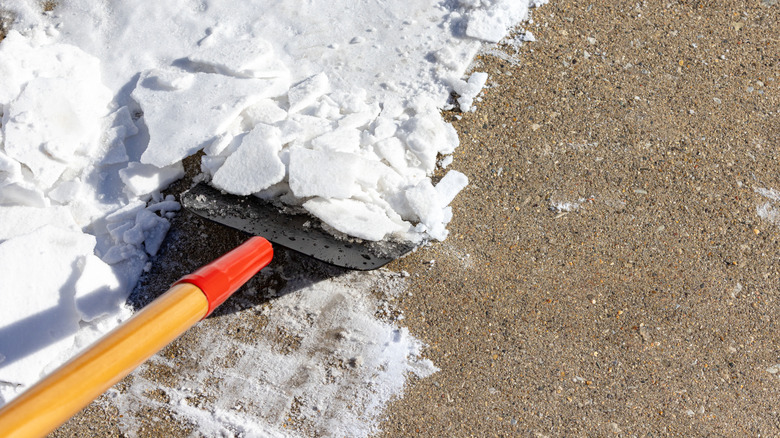
Depending on the severity of the storm and how cold your area is, you might find that sometimes the ice is too thick to melt quickly, even with the aid of ice melts. If this is the case, then having an ice chopper or scraper on hand is really going to help. An ice chopper is a simple tool. It has a long handle like a shovel, but the thin, sharp blade at the bottom is a rounded, half-moon shape, sort of like a lawn edging tool.
The purpose of this thin shaped blade is to get underneath the ice. If you come at the ice at an angle, you can scrape chunks of ice away from the pavement with one pass of the scraper. You can also use the chopper to break up larger pieces of ice that are proving too stubborn to remove. Use ice melt in tandem with an ice scraper, initially "weakening" the ice with ice melt. Thinner patches will melt, breaking up the ice and making it even easier to chop or scrape up.
Transform your riding lawnmower into a plow
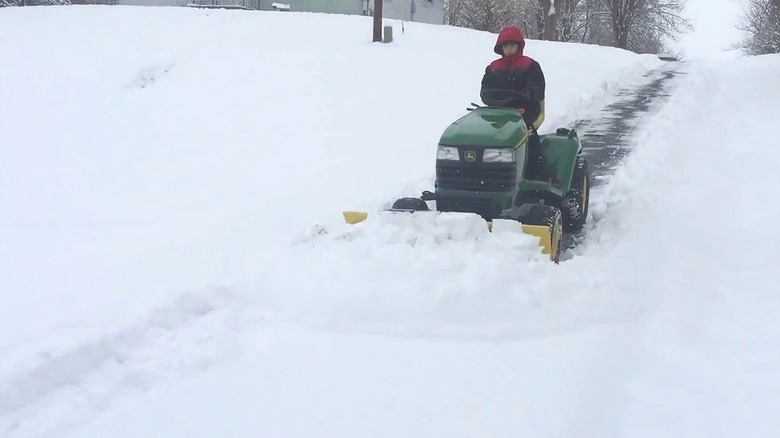
Finally, we have what might be the most fun snow removal tool: the riding lawn mower plow. If you own a riding lawn mower with an engine that produces at least 20 horsepower, you can actually transform it into a snow plow. There are kits available at hardware stores or from the manufacturer that come with a plow attachment for the front of the mower, chains for the wheels, and weights to keep the mower planted when pushing all that snow. Kits can cost over $1,000, so you'll need to make sure your mower is up to the task before using it.
The reason the motor needs to produce at least 20 horsepower is that is the power needed to move snow loads without putting too much strain on the engine. If you have a smaller, lower horsepower engine and try to plow snow with it, you might find yourself bogged down with too little power. In fact, some people feel using your riding tractor as a snow plow isn't a great idea, due to the potential wear and tear. You'll also need to remove the lower mower deck before you plow in order to achieve better ground clearance and keep the blades protected from ice and snow.
While this is certainly not a required tool for most people, it can come in very handy if you have a lot of snow to clear, or live somewhere that consistently experiences heavy snowfalls. It also makes the job a heck of a lot of fun, which is more than we can say for most of the other methods of getting rid of snow.