

Overrated Camping Accessories That Are Total Money-Wasters
We may receive a commission on purchases made from links.
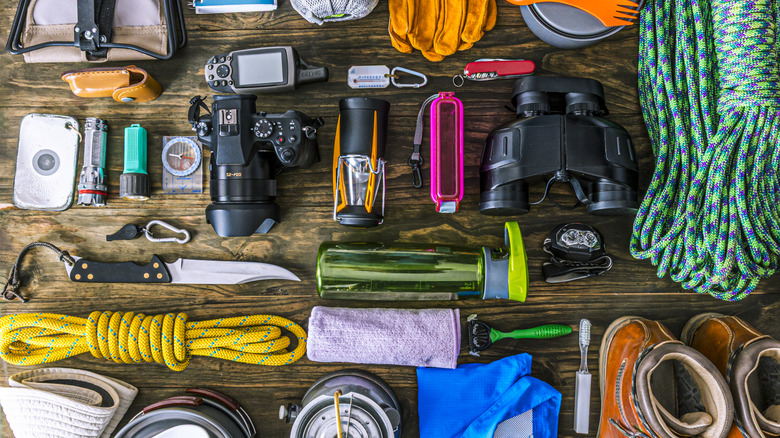
Camping and hiking is an industry in which there is a long, seemingly endless list of products promising to enhance your outdoor experience. Especially in recent years, products like portable power banks have represented breakthroughs, resulting in essential items modern campers simply can't be without. Others, while often serving the function for which they were made, leave much to be desired in terms just how essential they are.
Not all items are strictly "money wasters," although they can be if bought for the wrong reason. For example, a high-quality (and, often, expensive) knife or multi-tool can be necessary for those spending days and nights at a time in the wilderness. But for others, it can be a frivolous, unnecessary expense. Likewise, while you could easily spend a small fortune on a large, premium backpack, it's important to question the necessity of such a purchase if all you need it for is the occasional afternoon outdoors.
If you often find yourself drawn in and sold by romantic product descriptions and impressive technical specifications, then don't worry. This guide will cover some of the camping and hiking accessories that are most likely to waste your money. With a focus on value for money, utility, and (for those who hike long distances) weight, no stone on the trail has been left unturned in a bid to help you balance your camping budget.
A premium survival knife
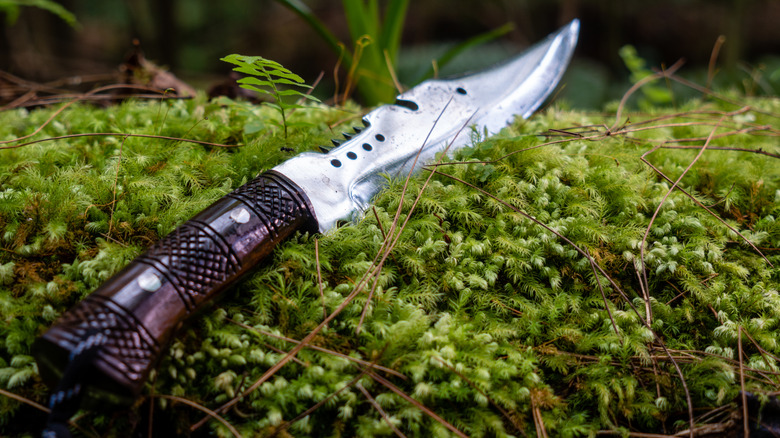
Paying for a premium survival knife, whether a fixed-blade, folding, or even a multi-tool knife, is understandably tempting. Especially for those who envision themselves surviving for days at a time with nothing but themselves and their wits to cope with the machinations of Mother Nature. However, depending on how you use it, it might be one of those pieces of camping gear that are not worth packing.
The cost, first of all, can represent a large chunk of your equipment budget, especially if you want to kit yourself out with a quality tool. Premium fixed-blade knives from leading brand Leatherman cost upwards of $280, with folding options ranging from $40 to $300. Even the brand's more utilitarian multi-tools start at $50, with options topping out at around $250.
Of course, keen and regular hikers could well benefit from shelling out such an eye-watering amount. Those who spend a lot of time in the wilderness and have need for a dedicated, sturdy blade (as well as the additional functionalities that come with multitools) can justify the cost. But even many avid hikers recognize that, if you use a knife just for basic tasks, like shaving a couple of pointed sticks for marshmallows, then any decent sharp knife works.
Expensive hiking backpacks
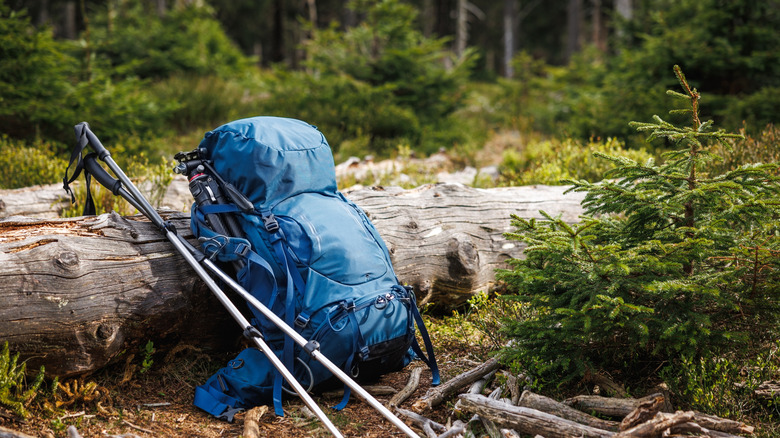
Knowing how to choose the right backpack is key to enjoying your time on the trails. And while a new backpack won't necessarily cost you a fortune, it just might if you invest in top-of-the-line luggage and opt for a size that's bigger than you actually need. Not only that, but the temptation with a larger backpack is to fill it, which, on a multi-day trip in the wilderness, could easily lead you to question whether you really needed all those trousers.
Now, if you're a regular hiker, spending days (and nights) at a time in the great outdoors, then a sturdy, lightweight backpack that's fully adjustable and built for long-distance comfort may be worth the splurge. But even then, whether you need to spend a fortune remains questionable. Bear in mind that, as an example, a premium day-hiking backpack with 21 liters of storage from Osprey could set you back as much as $220. Instead, you could grab a little more storage by buying one of REI's 22-liter Flash backpacks, paying $60 and saving yourself more than $160 in the process.
Ultimately, if all you're storing inside it is a picnic and a change of socks, it's unlikely to be worth spending big, especially if you already have a rucksack that works. Even if you don't, a number of Redditors are inclined to agree that shelling out on an expensive pack is not always worth it. One says, "I've used a variety of day packs, ones that are $20 to ones that are near to $200. They're mostly the same." Another agrees, saying "The truth is a cheap bag will do 95% of the same thing as a $150+ one."
Bulky camping stoves
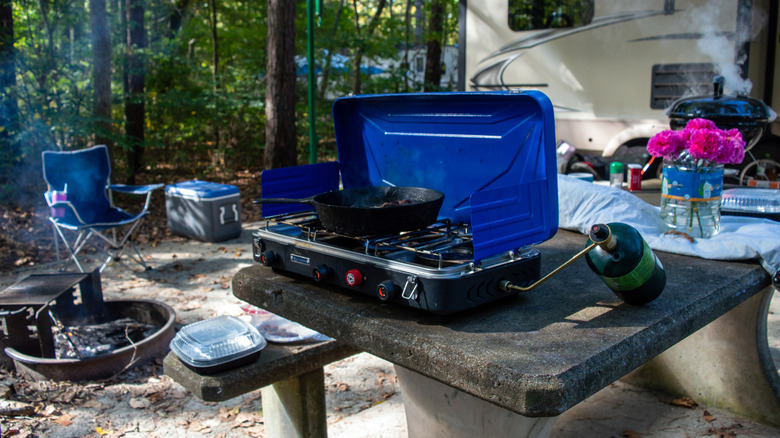
The necessity for hefty cooking equipment really depends on how you're spending your trip. If you have a back-to-basics, on-the-move escape in mind, then bringing a heavy, unwieldy stove with you defeats the point. The main things to consider before deciding on a stove are the cost, weight, and whether it's fit for the job. As an example, Coleman's Cascade 3-in-1 camp stove, priced by the manufacturer at about $275 (available at REI for the same price), weighs almost 15 pounds. It's great for cooking in multiple pots or pans, and is perfect for feeding a crowd. However, it's hardly backpack friendly, especially if you're moving out on foot each morning to find your next campground. As one Redditor says, "I only use it when I'm camping in a group setting, otherwise it's too heavy for my liking."
Of course, you could opt for something lighter, with a little more utility, like the Biolite Campstove 2+. The innovative option allows you to cook food with just a few sticks of wood, while turning the power of combustion into power for your phone. Great! Or is it? Currently retailing at $200 and weighing 2.06 lbs, one Redditor says that while "The device is well made and safe [...] it is too heavy and large for backpacking." They note that "...it's a real 'Master of None' situation," being neither the best camp stove nor the best phone charger for the price and weight.
If portability and packability are your goals, then a single-burner stove is probably the best option. You'll also stand to save a significant buck. For example, you could snag yourself a Glacier Camp Stove from GSI Outdoors for $39.95, adding less than six ounces (plus the separate propane tank) to your pack.
Cookware sets
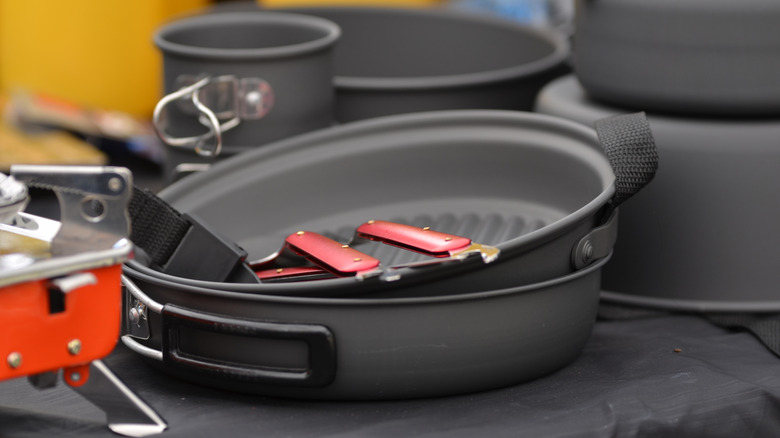
As with stoves, the need for a full set of cookware comes down to how many you need to feed, how likely you are to use every piece of equipment, and how lightweight you need your gear to be between campgrounds. Cost is an inevitable factor, too, especially since premium cookware sets on sites like REI can run over $200.
You'll be amazed by what you can cook with just one or two pans and a simple sharp knife, and frankly, you could well become frustrated with yourself for shelling out on a full, mostly unused set. Besides, there are plenty of one-dish meals for camping that satisfy your cravings without overloading your pack. As one camper on Reddit says, "I started buying sets and ended up not using the majority of what was in the set...I've found that I can cook just about anything with a big [...] skillet." As another in the same thread puts it, "The cooksets always strike me as being more relevant for car campers who may occasionally backpack. I backpack so I [just] need one pot."
Even if you are more of a car camper than a backpacker, that doesn't mean you have to shell out on dedicated camping pans. Instead, take a tip from a thrifty Redditor, who says "I will usually bring old pots and pans that have been retired to car camping cookware. No sense in spending all the $$ on some fancy set."
A dedicated GPS
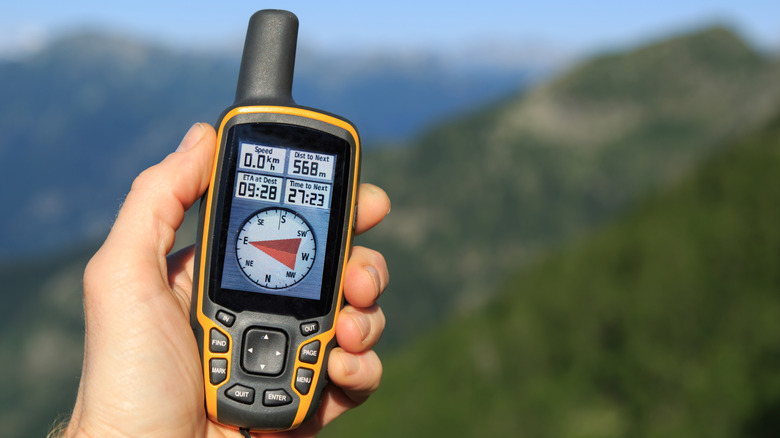
Once upon a time, hikers needed to know how to use a compass in order to ensure they made it safely out of the wilderness. Today, this is no longer the case, although knowing how to read a map never hurts! Today, GPS navigation is accessible to anybody with a smartphone in their pocket. While you can buy dedicated GPS units designed to be more rugged than fragile phones, and which generally have longer battery lives, these differences are easily made up for by purchasing a decent phone case and a portable power bank. Add this to the availability of apps like All Trails that make it easier than ever to find your way around in countries around the world, and it's hard to see the need for a dedicated GPS device.
Breaking down the costs, and it becomes even tougher to justify a dedicated GPS unit. The "Plus" subscription to All Trails costs $36 per year, allowing access to offline maps and over 450,000 trails (the "Peak" option, with additional features, is $80 per year). Assuming you have a smartphone, then the most you'll need to add is a sturdy case. Cost depends on your phone, but as an example, this Sportlink iPhone Pro 17 case costs $31.99 and offers heavy-duty, shock-proof protection.
As for power, BioLite's premium Charge 40 PD power bank, recommended for backpackers, sells currently for about $70 at REI. And there are plenty of similar, even cheaper versions available online or through other retailers. All in? That's roughly $102 for phone protection and power, plus the app subscription, although All Trails and other apps often have a free tier. In comparison, the least expensive premium GPS currently available on REI is the battery-operated Garmin eTrex SE, currently selling for $150.
Anything camouflaged
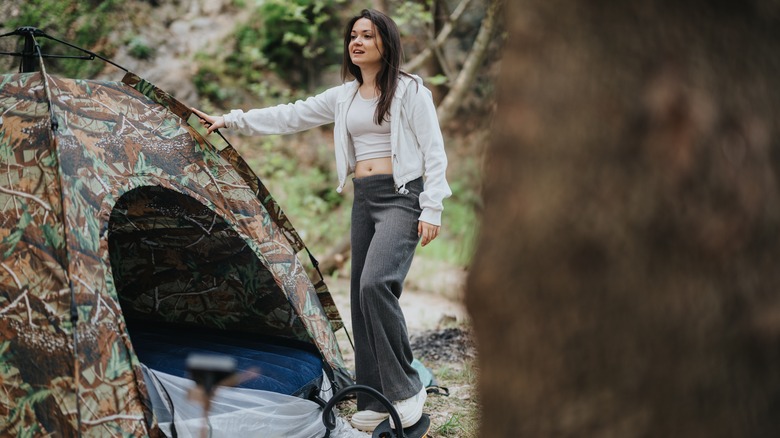
This isn't to say that every product offered in camouflage is a useless money waster. Far from it. Camouflaged clothing is essential if you hope to blend into your surroundings during birding or hunting expeditions. And, if when you're shopping for a new shelter, you need to think twice about buying a brightly colored tent, especially if you want to avoid attracting any bears who happen to be sharing the trail with you. However, if you're camping for leisure (away from bears), spending time with friends and family, and hoping to make it home with the full inventory of equipment with which you arrived, then it might pay to avoid camouflaged clothing and accessories.
The first reason is that smaller accessories bedecked in camouflage are, by definition, easy to lose if dropped or put down anywhere other than inside your tent. The second is that, as one Redditor explains, "From my experience many people prefer to be more visible in case of emergency or poor visibility conditions." Another consideration is that some have found camouflage gear to be more expensive. "In general, I have noticed that camo pattern fabrics cost a bit more than plain color fabrics," says another Redditor in the same thread. "So for basically the same performance you are paying a bit more." They also raise the point that they would "probably never want to wear a camo jacket as a casual piece around town, which would limit its use to just hiking," however, this is more a matter of style than anything else. But if you have, for example, a perfectly fine lightweight jacket for camping or hiking, why would you buy a second one simply because it's camouflaged?
Camping pillows
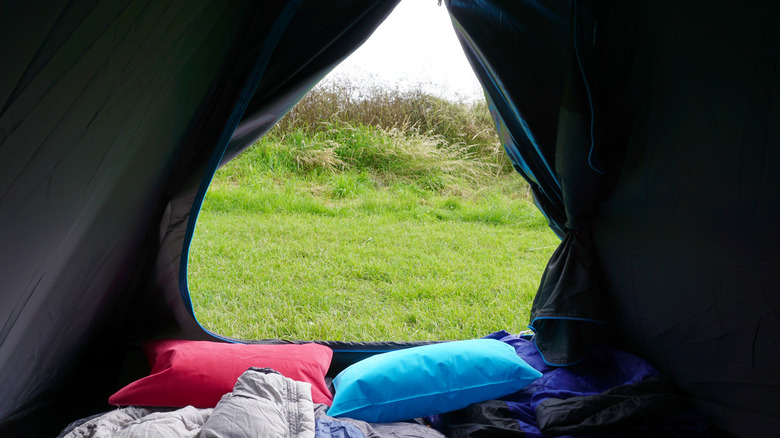
When you're at home, comfort is key. But when you're sleeping in a tent, with a finite amount of backpack storage, and need to carry your bedding from camp to camp, you might be better off omitting pillows from your inventory.
Sure, unlike a triple-burner stove, a pillow is unlikely to weigh you down all that much. But it'll still take up space, especially when you consider you could just as easily roll up a sweater you already have in your bag. Contributors on Reddit agree, with one saying "I just put whatever clothes I'm not wearing in my sleeping bag's stuff sack," and another explaining "I enjoy using my spare clothes as a pillow more than a blowup/foam camping pillow."
However, if comfort is paramount, then there are some other options aside from shelling out for a dedicated camp pillow. For example, you could make a lightweight DIY camping pillow with materials you probably already have at home. If you're camping near the car for a few days and don't need to worry about packability, why not just bring an old pillow from home? While you needn't necessarily spend a fortune on a dedicated solution, some camping pillows can run almost $70, which seems like a frivolous expense for those camping near the car for a night or two.
Electric marshmallow toaster
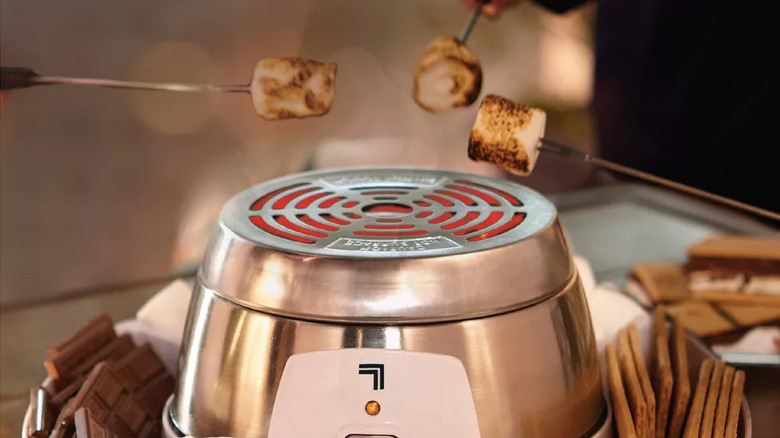
Regardless of mankind's continuous efforts to innovate and find novel new ways to do things, sometimes the old ways are best. Case in point: electric marshmallow toasters. They offer camping enthusiasts the chance to indulge in one of the most popular campfire cooking methods without the need to light a fire. Instead, you'll need an electrical supply, which, if you're camping, might not be the easiest thing to come by.
Of course, if you're at a campground that has an electrical hookup at each site, or you're able to run power from your car or RV, then you've got this covered. What's, perhaps, not fine is that, as one reviewer of an electrical s'mores maker from Target says, it's simply "Not worth the buy. After waiting 15 minutes for it to heat up this did not toast a marshmallow at all!" Another reviewer noted, "This contraption merely warms the marshmallow and barely that. They do not get any hint of toasting beyond a pale beige brown. The inside doesn't get hot enough to melt the chocolate on the graham cracker." That's a pretty damning indictment considering the product failed to achieve the one thing it was designed to do.
Personal water filters
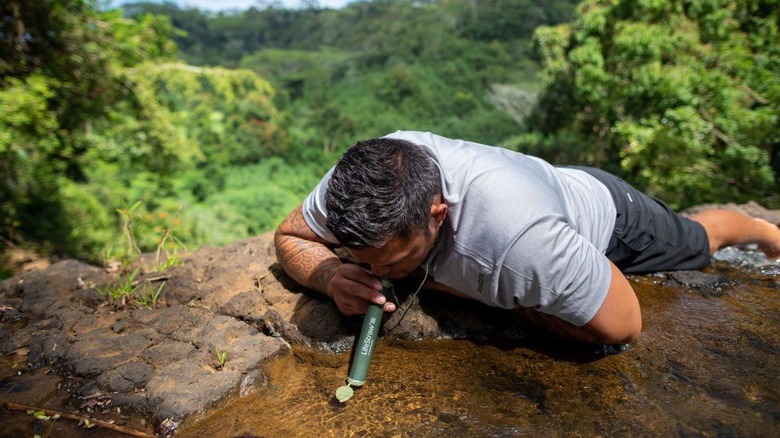
The first thing to say is that reviews favor these products, particularly the Lifestraw filter, for being lightweight, inexpensive, and simple by design. Those are some big ticks in its favor for hikers who want to save on weight and space. It's also great for solo backpacking, although a major downside is that you need to be able to actually find water, since it has zero storage capacity. Another review says that "the Lifestraw is solid, if you are near a consistent water source and can lay on your stomach." It's also important to note that, while these devices filter out bacteria, they can't stop viruses that may be living in the water.
So if you're solo hiking in the wild, in a region where the water is generally virus-free, and you don't mind what one Redditor describes as a requirement for "frequent trips to a natural body of water," then a decent straw filter could be worth the splurge. But if you're hiking and camping as a group, you'll each need one. And if you're staying at a campground with a plentiful supply of drinking water, a filter isn't necessary. Instead, you'll be better off bringing a few jugs of water and filling them as and when you need them.
If you're camping near the car — even if there is no water on site — it makes sense to fill jugs at home, rather than spending over $17 for a straw. Don't forget, these products often don't have much storage capacity, so even if you purchase a bottle with a filter, like the Grayl 24-ounce water purifier bottle, you'll need to keep filling it up.
Inflatable furniture sets

Inflatable furniture is largely a luxury. The one exception is a blow-up sleeping pad, which is considered by many as a must-have sleeping accessory for camping and can often be the difference between a good night's sleep and a stiff start to the next day. However, even these can be a pain to pack. More than that, they are reliant on either your lungs or a pump, the first of which you'll want to rest after a huffy day's hiking, the second of which you'll loathe taking up space in your rucksack.
As for inflatable chairs and sofas, as with any piece of inflatable kit, if it develops a puncture, you'll need to be equipped to fix it, which means another piece of equipment to stow in your rucksack. One Redditor advises bringing a tarp or rug to place underneath inflatables to keep them from puncturing, which adds to the list of stuff to pack. Another says that "If you do go inflatable, it's worth investing a bit more for higher quality." In other words, if you want to minimize the risk of punctures and ensure your purchase lasts.
The consensus among Redditors is, if inflatable furniture is in your future, don't cheap out. You get what you pay for in this case. "If you DO buy," says one Reddit commenter in the same thread, "take good good care of it, and be prepared to laboriously find and patch micro leaks." Another camper recommends inflatable furniture from Bonflag. However, a one-person chair costs $125, and weighs 13 pounds, meaning it's not the most pack-friendly option if you're planning a hike.
Methodology
In order to discern items that offer the least value for the money, several factors were taken into account. Primarily, the writer focused on the price-to-utility ratio of each product. That is, how likely and how often a buyer is to benefit from a product versus its expense. Costs for specific products were taken from the manufacturers' websites, as well as from retailers like REI and Amazon. To assess whether or not products were worth buying for hikers, weight was also taken into consideration, specifically in cases where more lightweight, more easily-packed products might provide a suitable (and, often, cheaper) alternative. Finally, in order to provide a fair assessment of each product, the writer reviewed ratings from consumers who had actually used the products. Sources for these included social media forums like Reddit, as well as review articles written by consumers with real experience using the products.