

Some Of The Different Types Of Hummingbirds That Could Be Visiting Your Yard
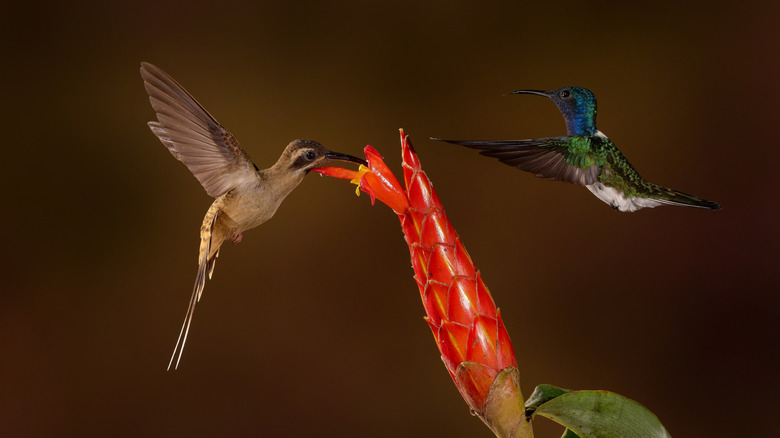
There are 365 different types of hummingbird living across the Americas, of which 15 live in the United States. In some cases, knowing their common names can make them easy to identify, like the blue-throated mountain gem or the white-eared hummingbird. Others, however, like Allen's hummingbird, are harder to pick out of a crowd.
Now, while there are 15 hummingbird species found in the U.S., some of them are extremely rare. The violet-crowned hummingbird and the white-eared hummingbird, for example, both have population estimates here in the United States of less than 200.
With that in mind, this guide will focus on the 13 species more commonly found across the country. You'll learn about the specific regions in which they usually spend time, their distinct and beautiful markings, their favored habitats, any notable behaviors to keep an eye out for, and a few tips to help you encourage more of these winged wonders into your back yard.
Ruby-throated hummingbird
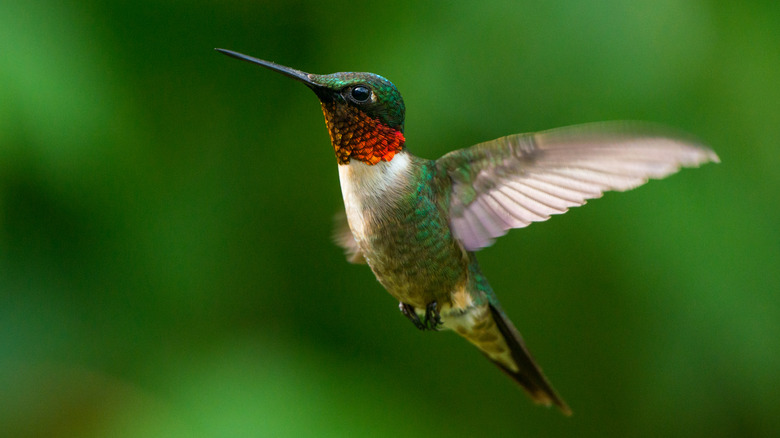
Ruby-throated hummingbirds get their name for the ruby-red gorget (colorful throat feathers) that makes the males easy to spot. They tend to favor deciduous forests, orchards, and gardens, and while they are, like most hummingbirds, quite small, there's a good chance of spotting them in the United States. In fact, these beautiful birds live across the Eastern states during breeding season, before departing up to 600 miles for Mexico and Central America in the winter.
They can travel up to 20 hours non-stop, so don't be surprised to see them one day and find they've vanished the next. Just be sure that you know how to spot a hummingbird nest in your backyard to ensure you don't accidentally disturb it. Ruby-throated hummingbirds have become accustomed to urban environments, and have been known to hunker down and breed in surprising locations like coiled cords or garden hoses.
If you're hoping to attract them into your garden, there are a few flowers worth adding to your planting scheme. This particular type of hummingbird has something of a penchant for tubular-flowered plants, including trumpet creepers, cardinal flowers, and coral honeysuckle.
Anna's hummingbird
Whereas the ruby-throated hummingbird is easy to identify by its name, Anna's hummingbirds represent more of a mystery. They were Christened "Anna's" by French naturalist, René Primevère Lesson in the 19th century, who named them to honor French courtier Anne d'Essling. She was married to François Victor Masséna, the Second Duke of Rivoli and an amateur ornithologist, and amazingly enough, he too had a hummingbird named in his honor (see below).
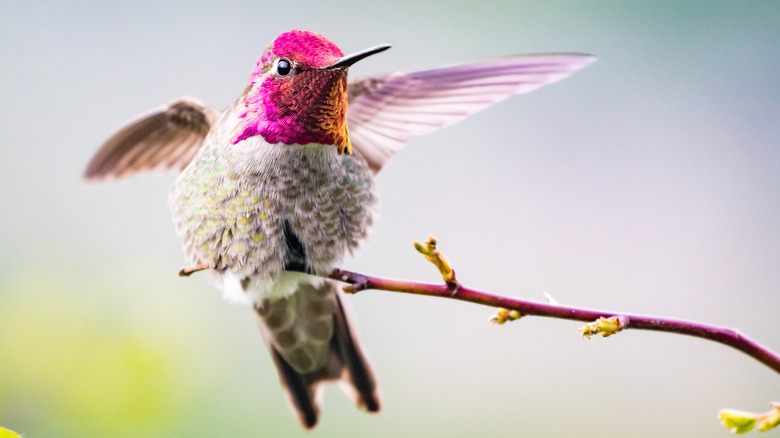
If you've sown plants to attract hummingbirds into your garden, you can identify your visitors as Anna's by looking out for the males, with their iridescent pink-red crowns and gorgets. This is also one of the few types of hummingbirds whose females display similar colors to the males. While they're often less vibrant, you might still notice some red-pink feathers around the females' throats. And if you see a hummingbird and start to hear it sing, that's also a good sign, as Anna's are one of only a few types of hummingbirds that do it.
As for the best flowers to grow, these hungry little hummers are partial to plants like eucalyptus, manzanita, and fuchsia. They favor areas of Pacific coastal sage scrub where these plants can often be found in abundance, making them a good choice for inviting Anna's hummingbirds into gardens and urban areas.
Rufous hummingbird
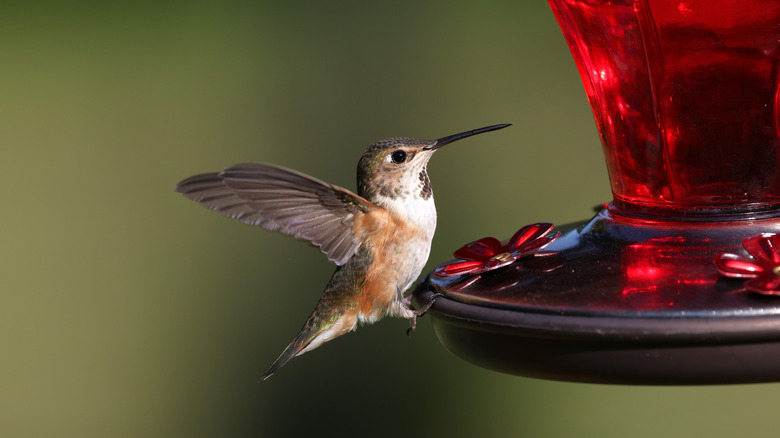
If you look up and see a flash of bright orange and green, there's a good chance it's a rufous hummingbird (and not an Allen's hummingbird, for which they can be mistaken). Whether or not it's embarking on its annual migration depends on the time of year, but if it is, it's quite startling to think that this journey covers a whopping 4,000 miles, from Alaska or Canada to Mexico. And that's just one way; they have to fly the same again when the time comes to migrate for winter.
This incredible annual feat is the longest migration of any bird, at least, considering how small the bird is. And it's not the only record this type of hummingbird is known to break. It's also the northernmost breeder out of all 365 hummingbird species, often venturing as far north as southeastern Alaska. As for the kinds of habitats it's likely to be found in, it's common across the northwestern United States, preferring forest edges, clearings, and mountain meadows, where it can often be seen feeding on red columbine and wild currant.
In their ongoing mission to dazzle and amaze, rufous hummingbirds will happily — and, often, successfully — chase away hummingbirds up to twice their size. This is especially true when there are flowers or feeders at stake.
Black-chinned hummingbird
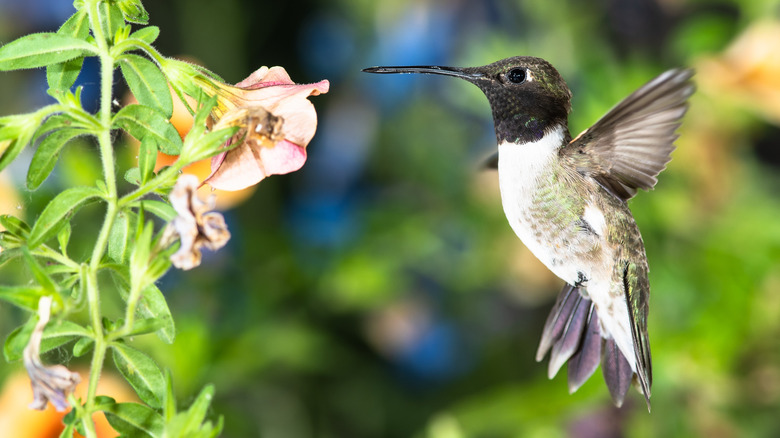
If you see a black chin brushing against your flowers as a greedy beak gets to work harvesting the nectar within, there's a good chance you've spotted a black-chinned hummingbird. Also featuring a green back, with a small purple streak beneath their eponymous black chin, these migratory birds can be found in the Western United States during breeding season, across California, Utah, Nevada, Arizona, and Texas.
That's reassuring for budding birders living in any of these states, but it's important to plant the right flowers if you hope to invite them into your yard. While planting red flowers is usually good for attracting hummingbirds, black-chins are more likely to be attracted to high-quality nectar than a specific color of flower. Having said that, they are partial to red-flowering plants like ocotillo and red yucca, both of which bloom red. These plants are native to Mexico, which is where this type of hummingbird spends the winter, so it's readily accepted as a great source of sustenance.
Now, if you're lucky enough to spot them in your yard, then watch carefully: You might just spot them performing an incredible 100-foot, U-shaped dive. This is a courtship ritual as well as a display of dominance among competitive males. And even if you don't see it, you might hear it, as the display generates a loud buzz from the birds' wings.
Costa's hummingbird
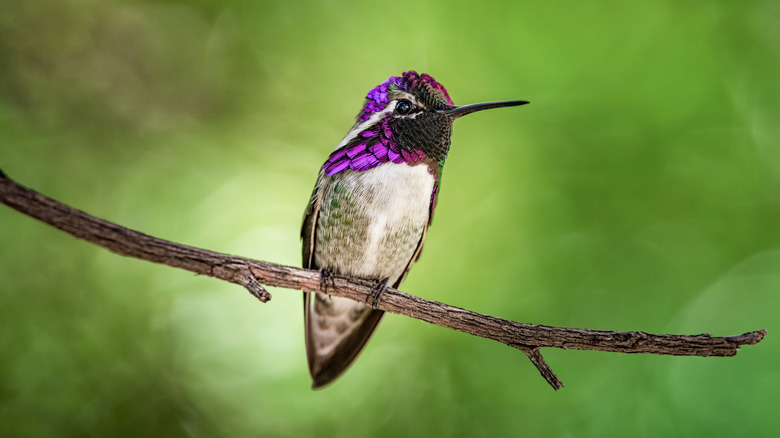
Perhaps one of the most striking of all hummingbirds in the United States, the male Costa's has bright purple feathers that seem to drape across its chest — rather like an overgrown mustache. Typically found in southeastern California and western Arizona during the breeding season, they migrate south for the winter — but not as far as other species. In fact, many only travel as far as northern Mexico.
Their favorite place to spend time is in the desert, where they can survive temperatures as high as 110°F. Indeed, while the Sonoran and Mojave deserts might not sound like suitable places for birds that need so much nectar, the abundance of native plants like red penstemon, chuparosa, ocotillo, and desert lavender actually makes these regions perfect for Costa's hummingbirds. They've also been spotted far afield from their normal ranges, as far north as the Pacific Northwest and even Alaska.
During courtship, the males loop and dive around females in a U-shaped pattern while uttering a high-pitched whistle. This sound lets the females know the speed of a male's dive, and as you might expect, the faster, the better. To give themselves an edge, males have actually been shown to manipulate the sound by carefully diving to the side of prospective partners, rather than straight in front. This tweak to their flight pattern mitigates the doppler effect (the acoustic curve of their sound), thus deceiving the female into thinking they're faster than they are.
Calliope hummingbird

Males of this type of hummingbird are easily identified thanks to the vibrant streaks of magenta running down their throats. They also have iridescent green backs and wings, which makes them one of the most beautiful types of hummingbirds to visit the United States.
And visit they do, but only for the breeding season. They spend the colder months in southwestern Mexico — an unfathomably long migration for a bird that weighs less than a penny. As for where you'll find them in the U.S., they tend to favor mountain meadows in the Rockies and the Cascades, forest edges, and areas of high desert scrub, where they enjoy feeding from the flowers of plants like wild bergamot, beardtongues (Penstemon spp), and fireweed. Their migration pattern is an interesting one: Calliope hummingbirds head north in the spring, following the Pacific coast. But they venture in-land for the return trip, following the Rocky Mountains, often stopping en route in gardens and backyards at higher elevations.
They value their territories and feeding grounds very highly, and will fight tooth and talon to hold onto it. In fact, despite being the smallest bird in the United States, they have been known to chase off much larger birds during the breeding season, including red-tailed hawks.
Broad-tailed hummingbird
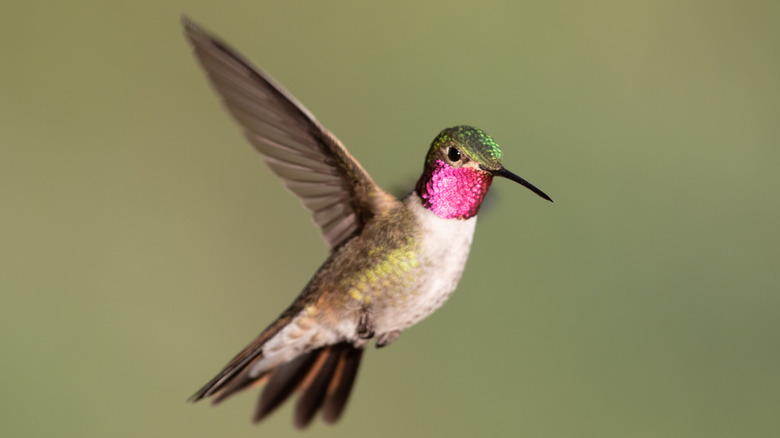
With a wider, longer tail than other types of hummingbirds, this happy hummer's name is something of a giveaway. At least, it is if you know your hummingbirds. If not, then look out for green wings and backs, plus gorgeous magenta markings on the males' throats. As for where to look, broad-tailed hummingbirds typically favor mountain meadows, and open woodlands across the western United States, including Colorado, Utah, Arizona, New Mexico, and Wyoming. They'll gladly stop by higher-elevation gardens in these areas, particularly those with columbine, larkspur, scarlet gilia, and Indian paintbrush growing in their flower beds. Don't hold out much hope in the winter, though, as they usually migrate south for the balmier climes of Mexico.
That's not to say that they can't deal with cooler temperatures. In fact, since they typically breed at higher elevations — up to 10,500 feet — they're well evolved to cope with even the most severe mercurial drop. By deliberately slowing their heart rate and dropping their body temperature, broad-tailed hummingbirds can put themselves into a state of torpor — a kind of deep sleep — which can help them survive bitter, even sub-zero temperatures.
During the breeding season, the males' tail feathers utter a loud, metallic trill that fills the air as they fly. As the season wears on, their feathers wear down, until their whistle eventually mutes. To attract them into your yard, planting native wildflowers can be a good idea. Alternatively, add some homemade DIY hummingbird nectar to your garden feeder, and if you're lucky, you might just get to hear their mesmerizing music for yourself.
Allen's hummingbird
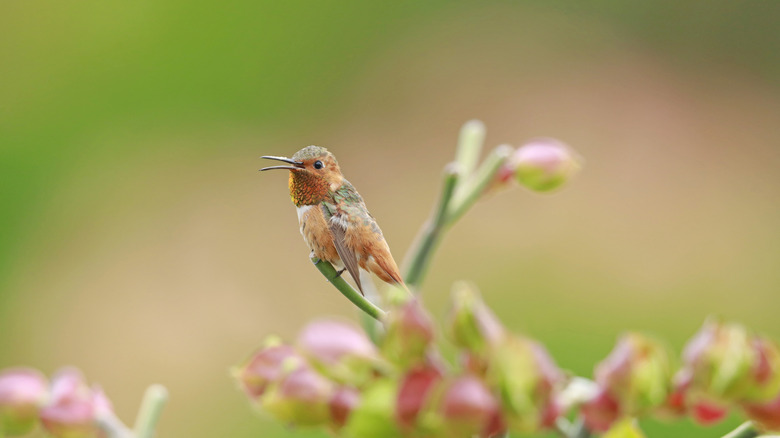
Allen's hummingbird males have vibrant copper and sunset-hues around their throats, which pair strikingly with flashy green plumage. They're easily confused with the similar-looking Roufus hummingbird, and are best distinguished by checking their backs and tailfeathers: Allen's have greener backs, and Roufuses have more black in their tails. Allen's also have very specific ranges they occupy. While not the rarest hummingbird found in the United States, Allen's hummingbirds are usually only found along a narrow strip of coastline from southern Oregon to the south of California. If you live in this area, then take note: they love sage and monkeyflower plants, and if you're hoping to create a hummingbird-friendly container garden, these should definitely be on your planting list. So, too, should other hummingbird-friendly plants like fuchsias and begonias.
As for when you're likely to see them visiting your carefully cultivated flowers, it's hard to say with certainty. Allen's hummingbird is actually a name for two sub-species, one of which migrates to the U.S. much earlier than other types of hummingbirds, sometimes as early as January. The other is actually sedentary, meaning it doesn't migrate, instead choosing to remain year-round in areas between Los Angeles and the Mexican border.
Buff-bellied hummingbird
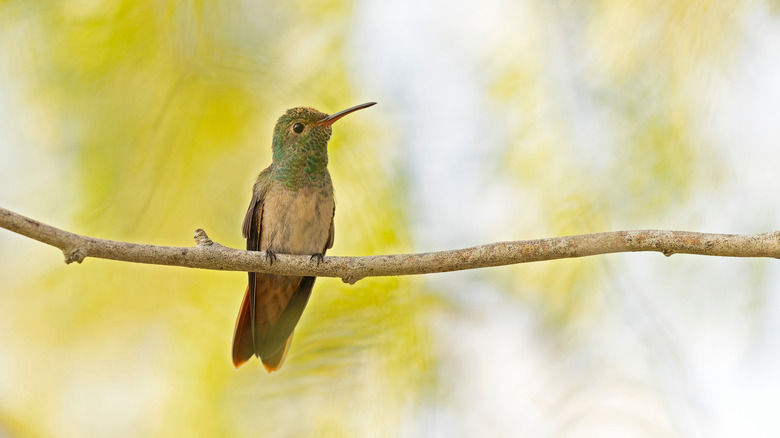
The buff-bellied hummingbird is usually found in coastal woodlands and thickets along the Gulf Coast, often in the Lower Rio Grande Valley of Texas. It's also commonly found in gardens, so if you live in this particular area, then keep your hummingbird feeder clean and consider leaving out materials to help hummingbirds build nests.
It's worth the extra effort; with their earthy, light-brown ("buff") belly, brilliant red bill, and blue-green gorget and breast, this type of hummingbird is both easy to identify and beautiful to behold. To go the extra mile and create the sort of sanctuary that they simply won't want to leave, consider planting their favorite flowers, which include Turk's cap, coral bean, and trumpet creeper. Just don't be too disappointed when they eventually leave. Buff-bellies are one of many types of hummingbirds that migrate, and while some follow other species south to the warmth of Mexico, others make their way northeast into Louisiana and beyond, effectively spending the entire year within U.S. borders.
Lucifer hummingbird
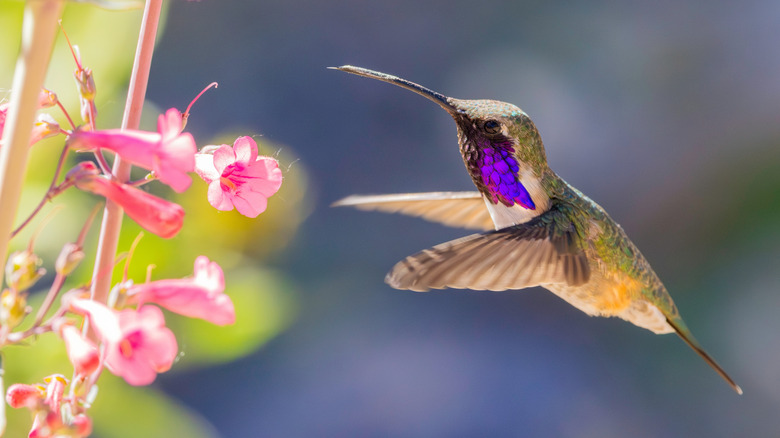
With a vivid purple throat distinguishing this type of hummingbird from others found in the United States, Lucifers also have narrow, well-defined forked tails. They belong to a sub-family of hummingbirds called "sheartails," and are, unsurprisingly, highly sought after by birders.
If that's you, then you have a good chance of spotting them during breeding season, but only if you provide them with the right conditions. They tend to favor areas near desert scrub, canyons, and exposed slopes, particularly in the desert regions of southwestern Texas, southeastern Arizona, and New Mexico. Here, they feed on nectar from plants like ocotillo and desert willow. Sometimes, you'll find them foraging underneath agave, which have adapted to position their pollen for bats, not hummingbirds.
While sightings of Lucifer hummingbirds aren't rare, their courtship behavior is, at least when compared to other hummingbirds. Unlike other types, which tend to woo prospective partners on the wing, Lucifers perform their courtship displays right at a prospective partner's nesting site. And while you should always keep a distance, if you happen across this behavior, that means you'll have a good chance of knowing where baby hummingbirds will be emerging later in the season.
Broad-billed hummingbird
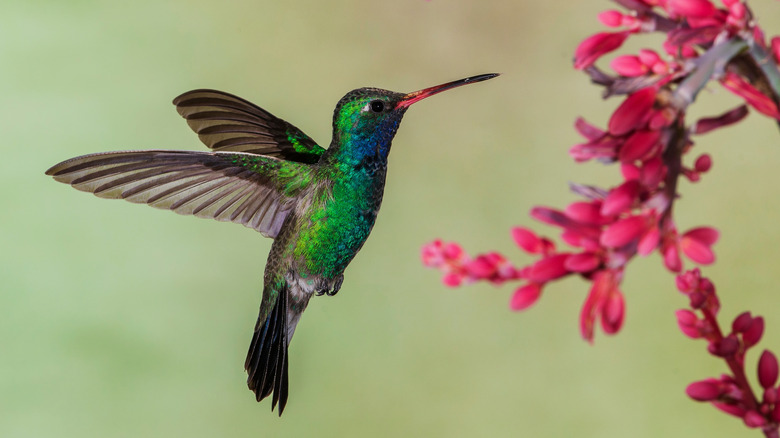
Much like its broad-tailed cousin, broad-billed hummingbirds are named for their unusually large bills. Their markings include emerald-plumed bodies, while their bills are bright red with sharp tips of black. To make doubly sure, you can look for a thin white spot behind their eyes, and if you find one, then you can safely bet that it's a female that's visiting your yard.
You'll need to live in southern Arizona, southwestern New Mexico, or West Texas if you hope to spy this type of hummingbird in the U.S. They favor a range of habitats, from woods along rivers and stream beds to canyons and desert scrub. The most important thing to them — as with all types of hummingbirds — is the presence of food. Specifically, they love plants like hummingbird trumpet, ocotillo, and desert willow.
With a bit of luck — and some of the aforementioned blooms in your borders — you could be lucky enough to witness some of the broad-billed hummingbird's incredible behaviors. One is that groups will often preemptively mob larger birds, like diurnal owls, in order to drive such predators away from their breeding grounds. And speaking of courtship, broad-billed males perform a unique ritual in which they hover closely in front of a female (showing off their vibrant plumage), before flying backwards and forwards repeatedly in a hypnotic arc.
Blue-throated mountain gem
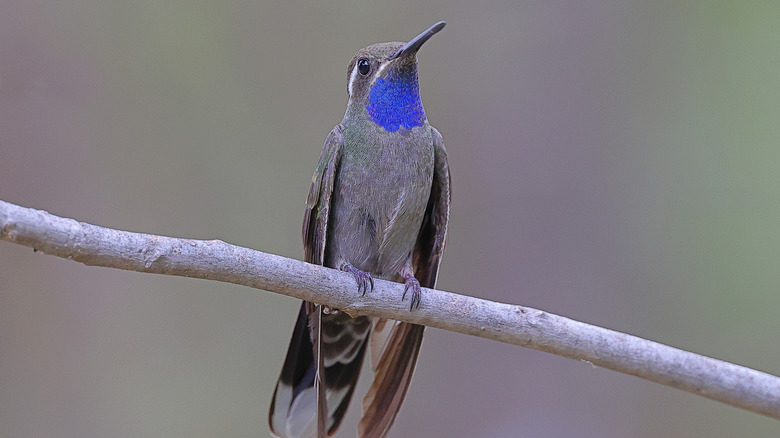
Blue-throated mountain gems are astounding creatures, with colors that you might generally expect to find only in tropical climes like South and Central America. And while they do, indeed, spend their winters in Mexico, they also spend the breeding season in the United States — usually the high elevations of southern Arizona, New Mexico, and the Texan Chisos Mountains. They favor the forests, canyons, and rivers of the mountains. If they find nectar-rich plants like trumpet creepers, beardtongue, agave, or penstemon, they're likely to stick around for as long as the getting's good.
You can tell a male blue-throated mountain gem apart from other types of hummingbirds by its cobalt-colored gorget, although this can only usually be seen from certain angles. In addition, their size is a giveaway to experienced hummingbird watchers: They're three time as heavy as a ruby-throated hummingbird. Both males and females can be identified with white-striped faces and grey underparts. And if you spy a female during breeding season, chances are there are males nearby, too.
Rivoli's hummingbird
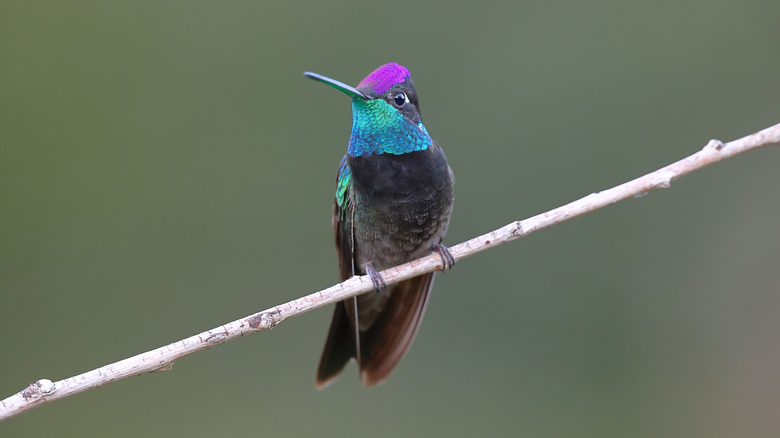
Named after François Victor Masséna, the Second Duke of Rivoli and an amateur ornithologist (whose wife inspired the name of Anna's hummingbirds), Rivoli's hummingbirds are characterized by dark undersides, emerald throats, and purple crowns. At least, they usually are. Hybridizations have been recorded in the wild, between Rivoli's, Violet-crowned, Broad-billed, and Blue-throated hummingbirds, and the results can be very difficult to discern. They're the second largest hummingbird to spend time in the U.S., and are about the size of a sparrow.
Generally speaking, Rivoli's hummingbirds are happy in a range of habitats across Arizona, New Mexico, and even in the Texan Chisos Mountains. They're as likely to be found in pine-oak forests and riparian woodlands as they are on open hillsides and shady canyons. They're also likely to be found in mountain gardens, particularly those located between 5,000 and 10,000 feet, and especially those laden with mistletoe, trumpet creeper, agave, or penstemon.
Finally, for those of you who like an interesting fact, Rivoli's have a heart rate of between 420 and 1,200 beats per minute. That's one of the highest recorded rate of any vertebrate on the planet!