

What To Do If You Find Termites Invading Your Trees
We may receive a commission on purchases made from links.
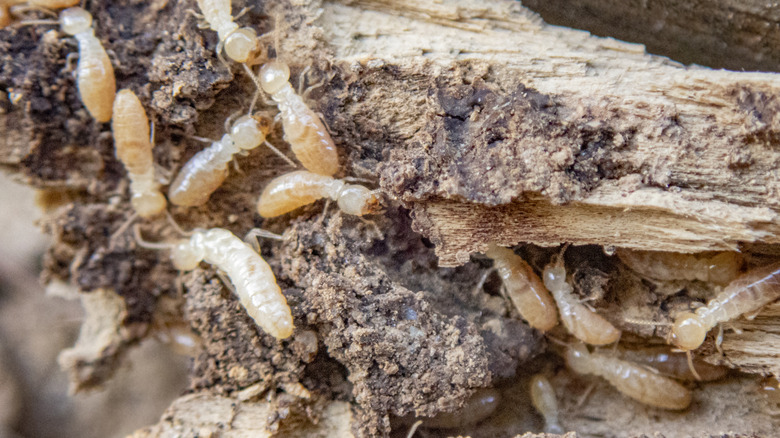
Homeowners typically worry about termites eating away at their house, deck, or shed. However, structures aren't the only place termites may be hard at work on your property. After all, these insects have been gnawing away at wood for millions of years. What did they dine on before 2x4s and fascia boards came along? To answer that question, look to the source of the lumber: Trees have sustained termites since the dinosaurs. If you find termites invading your trees, your best bet is treating the tree promptly with an insecticide, to both get rid of the termites and save the tree.
There are close to four dozen species of termites found in the U.S. alone. The vast majority prefer to dine on dead wood, which is why they are so attracted to lumber in homes, patios, and fences. This is also why you may want to reconsider using wood bark as mulch, as it basically serves as a termite buffet. However, there are a few termite species attracted to living trees. One is the invasive Formosan termite (Coptotermes formosanus), which targets a number of tree species, including oak and ash. As they're one of the most destructive termite species in the U.S., dealing with them quickly is imperative.
When termites invade a living tree, they cause a variety of issues. Termites can weaken the structural integrity of trees to the point they become a safety hazard. If the damage is extensive enough, branches may break off and the tree will likely die. While only a few species attack living trees, so-called drywood termites will go after dead trees, if you happen to be keeping any on your property to create an inviting oasis for owls. Therefore, early detection and prompt treatment are the keys to saving any of your trees from termites.
Early detection of termites is crucial to protecting your trees
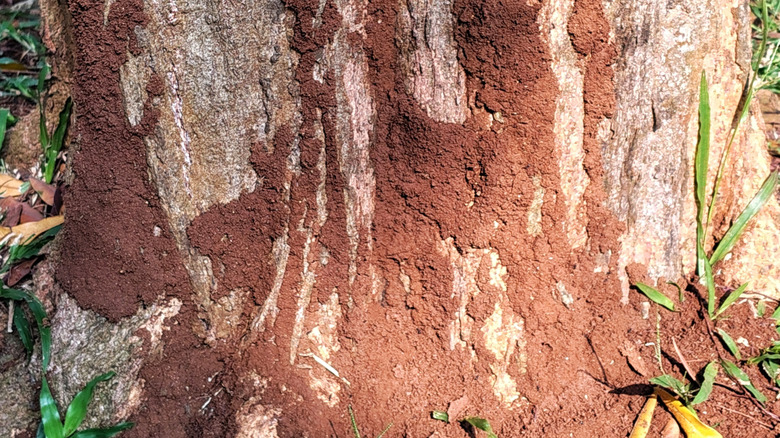
In order to know if termites are invading your trees, you need to recognize the visible signs they leave behind. One of the primary tell-tale indicators is the presence of what are referred to as mud tubes running along tree bark. Termites construct these soil tubes and use them to move up and down a tree without being exposed to sunlight or predators. Another sign is dead, hollow, or soft spots in a tree, especially near the base. Finally, on rare occasions you may actually see termites congregated on a tree or flying around it. These swarms most often happen following a summer shower.
If you see any of these signs, taking immediate action both helps salvage your tree and prevents termites from spreading to your home or other wooden structures. However, it is important to utilize a tree-safe approach unless the tree is beyond saving. For example, boric acid effectively kills termites. However, while a small amount of boric acid is okay for trees, too much can kill them. The best bet is to treat the ground around a tree with a liquid termiticide, such as BioAdvanced carpenter ant & termite killer, to attack the colony. You can also spray a foam termiticide into gaps, cracks, and holes in the tree. Additionally, spraying the base of the tree with helpful nematodes will destroy the termite colony and help prevent future invasions.
Once a tree has been treated, it is advisable to assess the damage and remove any weakened portions. This is especially important if the tree or large limbs are near your house. If it is determined the tree is beyond saving, it should be removed and burned.