

5 Signs You Might Have A Hummingbird Family Living In Your Backyard
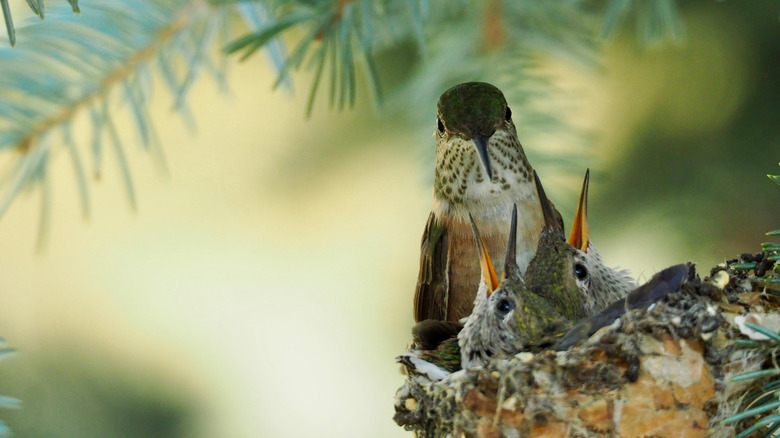
You don't have to be an ardent birder to be fascinated by hummingbirds. These tiny, acrobatic avians are entertaining to watch and very beneficial to your yard and garden. This is why so many people spend so much time attempting to attract more hummingbirds. Depending on where you live in North America, there are different types of hummingbirds visiting your yard. But, regardless of species, at some point they will mate, nest, and have chicks. So, how to you know if you have a hummingbird family living in your backyard? There will be signs ranging from pint-sized nests to changes in the female bird's behavior to let you know your yard has become a hummingbird household.
That said, it is worth noting that seeing hummingbirds zipping around your yard, siphoning nectar from your flowers, or gathering around your feeders does not necessarily mean a family is living there or a female is intending to raise her brood there. In fact, these tiny pollinators may fly 20 miles or more in a day searching for food. When it comes to nesting, hummingbirds seek out areas of dense foliage as opposed to well-manicured trees. This is because the shroud of limbs and leaves offer shelter from the elements and protection from predators. Many species, such as ruby-throated hummingbirds, seek out deciduous hardwoods for their nesting sites. Trees such as oak, maple, hackberry, and sweetgum are some common examples of their preferred tree types.
If your yard does not have suitable nesting habitat, it's unlikely there is a hummingbird family living in your yard. On the other hand, if your yard provides the features hummingbirds prefer, you may have homesteading hummers. In that case, it's not only useful to know the signs pointing towards nesting broods, it is important you avoid trimming the trees and bushes until they have completed their nesting activities.
Birds disappear for long stretches
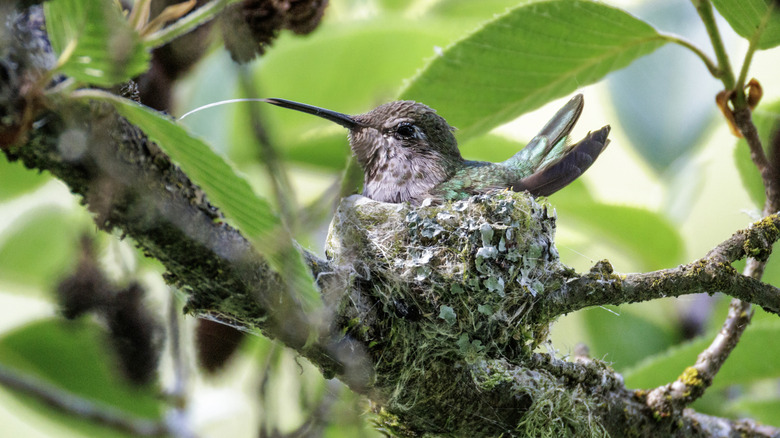
One of the most enjoyable aspects of having hummingbirds in your yard is getting to watch them zip and flit about in their erratic, acrobatic fashion. Well-placed feeders often provide hours of such enjoyment, as hummers will buzz about nectar-filled wells for hours on end within sight of windows, patios, and porches. If you've grown accustomed to watching such a spectacle on a regular basis, it may be concerning when you notice the birds disappearing for long stretches of time. However, this could actually indicate they are attending to family matters elsewhere.
Odds are if a female hummingbird is MIA for long stretches, but regularly reappears to grab a quick snack, she is sitting on a nest somewhere. When a female hummer has a nest brimming with eggs, they tend to spend most of their time tending to them. She will only appear when necessary to secure food or water, making such forays as brief as possible. Given that hummingbird nests are usually well-hidden, it may feel like they've vanished when they return to their nest.
You spot a nest
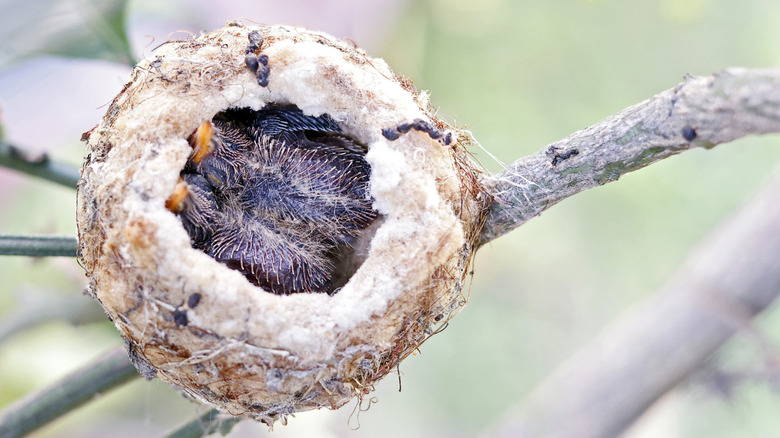
A nest is one sure, but rarely spotted, sign a hummingbird family has taken up residence in your yard, as females build these tiny shelters for the purpose of laying eggs and raising their hatchlings. However, while that may seem like an obvious sign, hummingbird nests typically aren't that obvious. So, you need to know how to spot a hummingbird nest in your backyard in order to know whether one is actually there.
Hummingbird nests are notoriously difficult to spot for a few reasons. One, as might be expected from birds that average about 3 inches in height, their nests are diminutive. Typically, they are about the size of a golf ball, with eggs the size of many pills. Secondly, they are made from natural materials, like spider silk intended to blend with the surrounding foliage. Additionally, they are often made to look like a bump or knot on the branch, camouflaged with moss or plant fibers. Making their nests inconspicuous — hiding in plain sight — is one of the hummingbird's best defenses. Finally, nests are often built as high up in the trees as possible — as high as 90 feet.
If you do happen to spot a nest, it's a good sign that a hummingbird family is living in your backyard. That said, it is important to leave the nest undisturbed. Not only will this help ensure the survival of the chicks, the Migratory Bird Act makes it illegal to touch, move, or destroy a nest with eggs or chicks.
Birds exhibit aggressive or defensive behavior
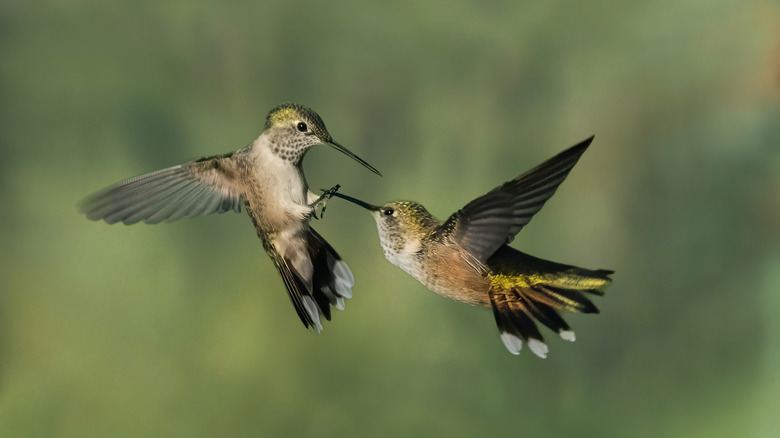
Anyone who spends much time observing hummingbirds around a nectar feeder or patch of blooming flowers has likely witnessed hummingbirds battling with one another. These miniature mid-air dogfights aren't that uncommon. In many instances, males (especially) are fighting over a food source; hummingbirds are notoriously territorial when it comes to nectar.
These little dive-bombers also become aggressive when are protecting their nests. In the western portion of the continent, Rufous hummingbirds are known to not just battle with other birds, but also challenge small mammals such as squirrels in order to keep their nests safe. Besides actual fighting, you may hear an angry hummingbird making a series of loud chirps or buzzing sounds. An aggressive hummingbird may also dive at or chase creatures it views as a threat, including passing humans, zipping loudly past our heads again and again on mini-sorties.
Again, seeing such aggressive or defensive behavior doesn't guarantee a nest is nearby, as hummers are frequently aggressive for other reasons as well. But, it is an additional clue. Should this aggressive behavior you witness routinely take place in an area away from food sources and near possible nesting sites, it is even a stronger indicator you may have a family of hummingbirds in your yard.
You find fledglings
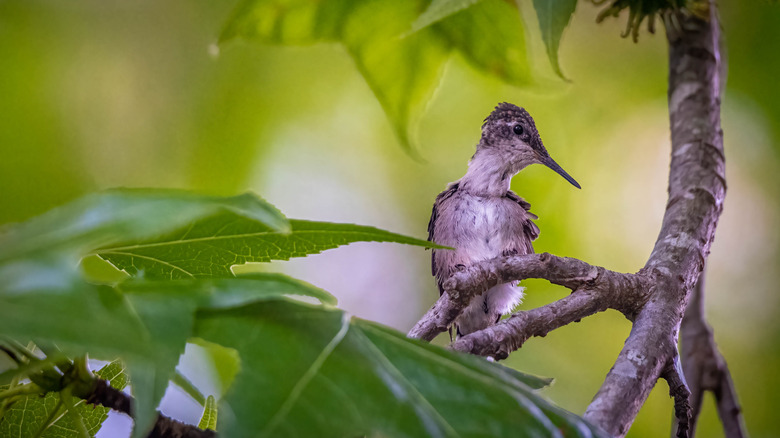
There is no surer sign that a family of hummingbirds is living in your backyard than finding the kids. If you see fledglings in the limbs of your trees, the nest is likely nearby. This is because fledglings are still not self-sufficient for a time after leaving the nest. Instead, they stick nearby so they can quickly return when mom rings the dinner bell. While they are out of the nest, it is often possible to spot these fledgling hummingbirds looking like haggard beggars on the limbs near the nest.
Given that even mature hummingbirds are incredibly small, you may be wondering how to tell if a hummer is full grown or still a fledgling. The most accurate way to tell the difference is by looking at their feathers. Adults tend to have sleek, colorful, iridescent feathering, while the youngsters have a dull, puffy, fluffy look to them (the kids don't inherit their parents' brightly colored feathers until their first full molt). Juveniles also tend to spend a good deal of time attempting to forage whatever happens to be nearby rather than flying farther afield. It's also worth noting that since hummingbirds usually lay two eggs, it's not uncommon to see fledglings in pairs.
Repeated, purposeful flight
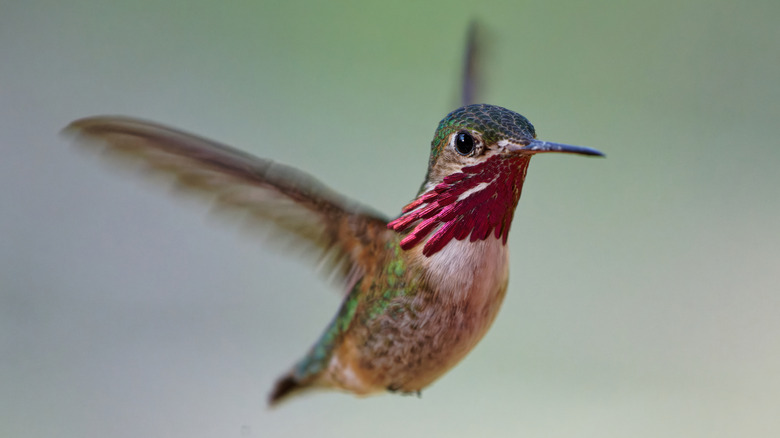
Erratic flying with a heavy dose of zig-zag maneuvering is a trademark of hummingbirds. If you notice a hummingbird flying in a purposeful, straight-line manner, it could indicate something. If they are making these same flight patterns on a regular, repeated basis, it almost certainly has something to do with nest building or child rearing. In either instance, it is a strong indication there is a family of hummingbirds living, or preparing to live, in your backyard.
When female hummingbirds are building nests, they are on a mission. They gather materials and return to put them in place at the nest-building site. Even though their nests are tiny, it can take a lot of trips to procure all the necessary supplies. So, you may see the same bird going back and forth repeatedly in a short amount of time. Once the eggs hatch and she has chicks to feed, the mother hummingbird will once again make quick, short jaunts away from the nesting site. In this instance, she is gathering food to take back to her chicks. But again, these trips are purposeful, so she won't display a lot of acrobatics. Instead, she will fly straight for the food source then return to the nest as quickly as possible.
While building a nest and tending to her chicks, female hummingbirds following a predictable flight pattern may actually tip you off to the location of her nest. Should you see such behavior, you can quietly follow her as she disappears into the brush. Doing so will often lead you to the nest. Of course, keep your distance so as not to spook the mom or disturb the nest.