

Plant Honeysuckle To Invite These Two Colorful Birds To Your Yard
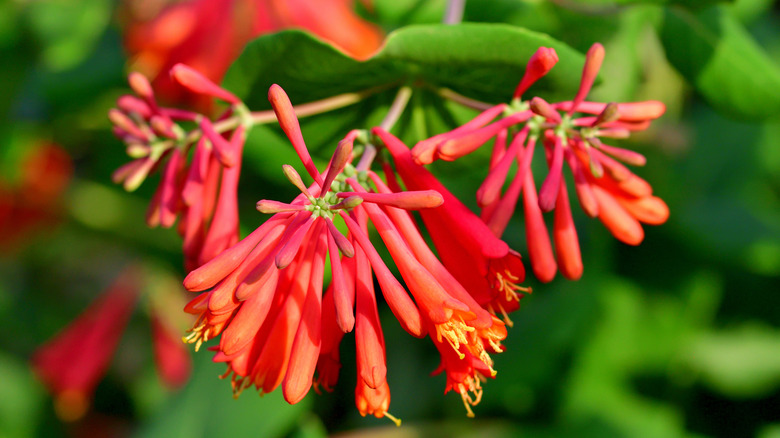
Flowering plants are a wonderful way to add a splash of color to your lawn and garden. They also attract pollinators such as bees, butterflies, and birds. Planting trumpet honeysuckle (Lonicera sempervirens) is a great way to do both. The vivid red and yellow flowers accent your yard's color palette, while the elongated blooms are among the best flowers to attract helpful pollinators and other creatures. In particular, trumpet honeysuckle can attract colorful birds such as hummingbirds and orioles to your yard, albeit for slightly different reasons.
Trumpet honeysuckle — also known as coral honeysuckle — yields large quantities of nectar. This, combined with its colorful blooms, makes it a go-to plant for those wishing to create a pollinator-friendly garden. However, nectar isn't the only food source it produces, as the plant puts out berries in the fall that birds love. Its thick foliage and climbing nature makes it ideal for growing on pergolas for shade, as well as providing nesting sites for birds. This combination is alluring for a variety of birds like thrushes and robins, but it is particularly enticing to hummingbirds for the color and shape of its flowers, and to orioles for both the nectar and possibly chemicals in the flower itself.
What makes trumpet honeysuckle an even more enticing option for planting in your yard is the fact it is low maintenance and versatile. Additionally, although it is indigenous to the Southeastern U.S., it can be grown in USDA hardiness zones 4-9, which is virtually the entirety of the Lower 48, as well as parts of Alaska.
The allure of honeysuckle for hummingbirds and orioles
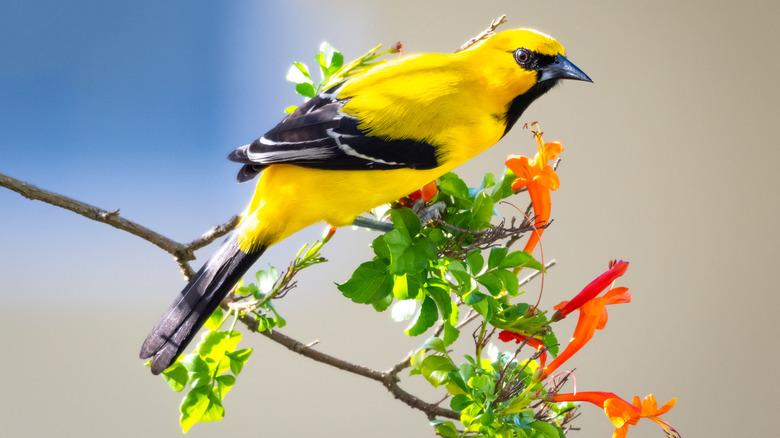
When it comes to bird species attracted to trumpet honeysuckle, hummingbirds are at the top of the list. In many ways, it is the ideal plant for hummers. Not only does it produce an impressive quantity of high-calorie nectar, which hummingbirds relish, its tube-shaped flowers are the perfect dinnerware for these tiny flyers. Furthermore, the red blooms are a color that is particularly attractive to hummingbirds. They also feed on the various insects that are drawn to honeysuckle flowers. This is critically important, as insects actually make up the vast majority of the hummingbird diet for their protein.
Orioles of all varieties are also drawn to honeysuckle. Although they are not equipped with the long beak and tongue used by hummingbirds to siphon nectar from the elongated florets, they still find a way to consume it. They accomplish this by biting off the flowers near the base, giving them easy access to the nectar. Additionally, like hummingbirds, they will eat the insects found around honeysuckle and are also drawn to the bright colors. Some gardeners speculate that orioles, who love the color orange, eat the flowers (rich in carotene) to help brighten and refresh their striking plumage following a long migration.
In addition to hummingbirds and orioles, a wide variety of birds are attracted to honeysuckle for either the nectar, the berries, or both. With that in mind, it's also worth noting that trumpet honeysuckle is a native, non-invasive plant and, therefore, is a valuable food source for these birds. However, there are other, invasive, species of honeysuckle do not provide near the same nutritional value, particularly for songbirds eating the berries. Because of this, many experts advice against using non-native honeysuckles as bird attractants.