

The Natural Winter-Safety Option HGTV's Mike Holmes Prefers Over Salt
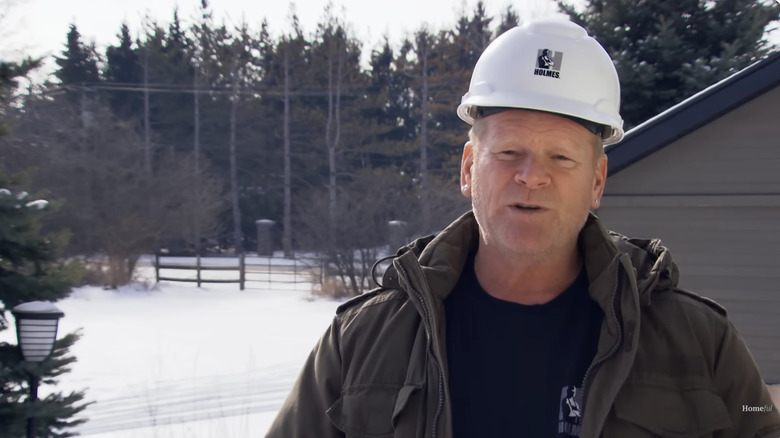
Throughout the winter months, homeowners know whenever a freeze warning is issued, they need to be prepared for a few things. For one, they have to protect outdoor plumbing from freezing conditions. Secondly, they have to be ready to deal with ice and snow on their driveways and sidewalks. For most, that means stocking up on rock salt, which is the traditional solution for melting snow and ice in driveways. It is also cheap. However, it can cause damage to your driveway as well as your lawn. HGTV's Mike Holmes says he prefers gravel to ensure safety on driveways and sidewalks during winter. There is a caveat — it's not a complete replacement for salt.
"I'm not a big fan of salt — it destroys your grass and eats away at the brick mortar," Holmes states in his 10 Tasks For Your Winter Home Maintenance Checklist. "It can also make your pets sick. I'd rather use a generous amount of gravel as a natural alternative."
However, before relying solely on gravel for your winter driveway maintenance needs, it is important to note that gravel does not melt ice or snow, the way rock salt does. For that, Holmes suggests shoveling or using a deicer: Most use calcium chloride or magnesium chloride, which is a clever de-icing solution. However, as he notes, there are times when "shoveling the snow may not be enough". Additionally, deicers have their limitations as well: They work best when as much snow and ice as possible is removed first, and they have temperature thresholds. Gravel, on the other hand, does its thing in all temperatures. "Whatever [method] you use," Holmes notes, "read and follow the instructions carefully."
Gravel gives you grip on icy surfaces
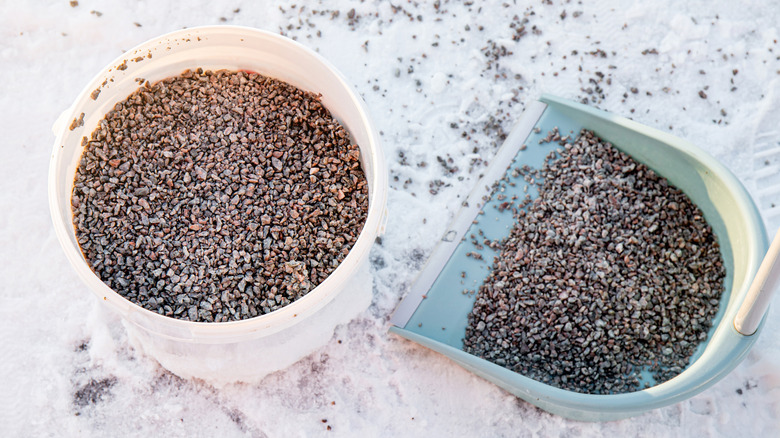
The reason to use gravel on icy surfaces is to get traction or grip, whether you're walking or driving. It's particularly useful when there is a thick layer of ice that stubbornly refuses to melt or temperatures are below the effective range of the ice melt product you are using. In this situation, providing maximum grip or traction, rather than trying to melt the ice, is the best-case scenario. This can be accomplished with sand as well as gravel, but gravel stays put longer and is more durable under foot and tire traffic. It even provides a measure of traction when covered by a thin layer of fresh snow or ice.
When it comes to choosing gravel for the purpose of gaining traction on your driveway, the best choice is small pieces with sharp angles and edges, as opposed to rounded or circular shapes. As for applying gravel to your driveway, it's ideal if you pre-treat your driveway with ice melt before it's covered with snow and ice. With that done, you can spread a layer of gravel over your driveway before the snow storm or blizzard or other freezing conditions arrive. If, for whatever reason, you end up with an accumulation of snow, shovel or plow it before putting out the gravel. Freely toss more gravel on each time you need to clear snow. If you do find yourself with a layer of ice that just won't budge, spread a liberal amount of gravel on top of it, reapplying as necessary.
One other perk with gravel: It is reusable. Once the snow and ice have melted, simply sweep up the remaining gravel and put in a bag or bucket until it is needed again. Or if you have a gravel driveway or walkway, you can just blend it into the existing surface.