

What To Expect At National Park Campgrounds With Minimal Amenities
We may receive a commission on purchases made from links.
Camping is a popular activity at national parks across the United States. However, not all of these national park campgrounds are set up the same, nor do they offer the same level of amenities. Although for some travelers the term "amenities" refer to perks such as swimming pools and room service, in campground parlance it's more likely to cover things like running water and electricity. Very few national park campsites offer a full array of amenities such as water, electrical, and sewer. So, as you go through the process of booking the perfect campsite for your next adventure, it is important to know what to expect at national park campgrounds offering minimal amenities.
Dry camping is trending among RVers, while wild camping is becoming more popular as well. In fact, many campers are now seeking so-called off-grid sites, with little to no services at all. However, such a sparse campsite may come as a shock to those accustomed to full RV hookups and campgrounds with amenities like tent pads, picnic tables, or flushing bathrooms. That's why it's so important to read the specific campsite descriptions before booking — even within the same national park, options can vary from site to site.
Whether you're planning to rough it or just happen to end up in a site with minimal access, knowing what to expect will help you stay prepared. That's especially true if anyone in your group needs enhanced accessibility. While a number of national park campgrounds and campsites offer enhancements and accommodations such as wheelchair accessible trails and chairlifts, not all do. So, again, it's important to check what amenities and options are available not just for the national park as a whole, but the specific campsite you are looking to book.
What amenities campsites may or may not have
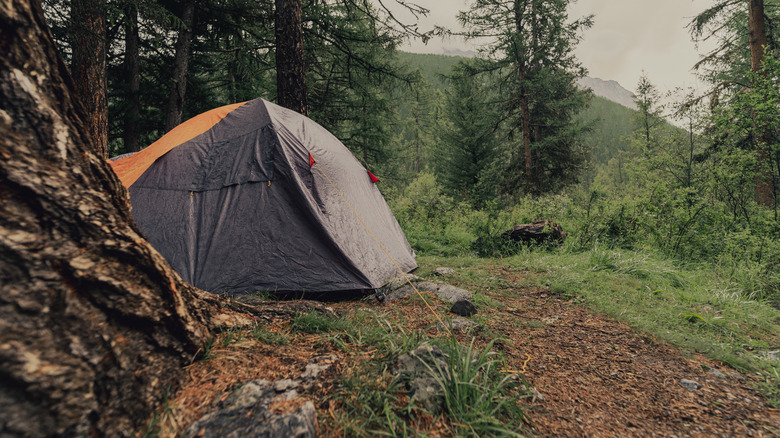
The National Park Service tends to categorize their campsites into two broad categories: frontcountry and backcountry. Tent camping sites are typically available in each. The biggest difference between these two categories is frontcountry sites can generally be accessed with a vehicle, while backcountry sites typically cannot. As a result, with very few exceptions, RV camping is not allowed in the backcountry. However, there is a wide variance in the types of sites available even within those two categories.
Many frontcountry sites are full hookup sites, with water, electricity, tables, grills, even showers and other amenities. However, not all are. So, while most RVers are initially excited to hear that their favorite national park can accommodate an RV, they may need to readjust their expectations. Although some national parks offer full service sites, by far the majority of the RV campgrounds in national parks offer no or partial hookups, including many of the top national parks for RV camping. What exactly they have, however, varies tremendously, even among various campgrounds within a single national park. Some may have pads but no hookups, while others have hookups but not pads. Some offer water but no electricity or vice-versa. A great many, like Devil's Garden Campground in Arches National Park, offer little more than a space to park.
The only way to know for sure what a specific campsite offers is to put in a little legwork. The simplest way is to do your research online, utilizing the website for each national park. There are basically two ways to go about this: Utilize the individual park's website or visit Recreation.gov. Each park website lists campsite information beneath the Plan Your Visit tab. Recreation.gov allows you to search campsites from various national parks.
Tips for staying at campsites with limited amenities
How to adjust to campsites with limited amenities differs for tent and RV campers. For tent campers driving to or near frontcountry campsites means bringing extra supplies, such as water jugs where there's no running water, isn't all that difficult as long as you are aware it's needed ahead of time. The same holds true for items such as grills and firepits, which are sometimes provide at frontcountry sites, but can be easily transported in your vehicle if they are not.
Backcountry campsites, on the other hand, require campers to pack or carry everything in. Although some backcountry areas have designated camping areas, even those are generally no more than a clearing and perhaps a fire ring. With the vast majority of backcountry camping, you can expect zero provided amenities beyond a beautiful view. Given you have to pack in your gear and supplies, you will also need to be much more selective when choosing what to take. For example, utilizing gear like the LifeStraw water filter instead of packing in gallons of water can make a huge difference.
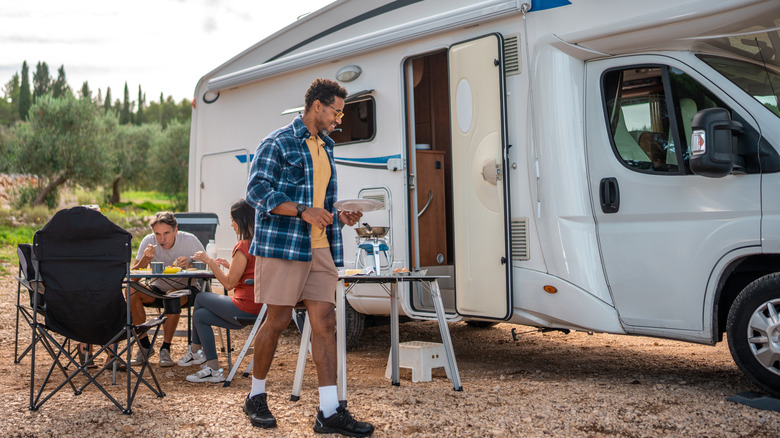
RVers who are not familiar with dry camping need to be prepared for various scenarios. No electrical hookups means you will need a generator, solar panels, or a combination of the two. You will also need fuel for your generator. It can also be handy to use alternate solar or battery-operated light sources, along with a camp stove or grill for cooking. Both will help save your batteries. No water hookup means you'll need to fill your freshwater tanks and conserve water. You will also need to hold all your waste water in your tanks until you get to a pump out station, which may or may not be located on park grounds.