

5 Flowers That Were Invented By Total Accident
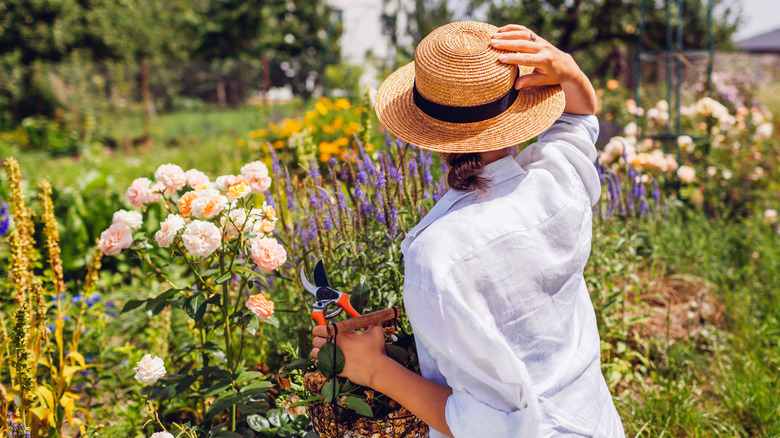
Did you know that some of the world's most important inventions were created by complete accident? Penicillin, for example, was discovered because Alexander Fleming left some of his petri dishes to get moldy, and found that the fungus growing inside actually ate harmful bacteria. These kinds of accidental discoveries extend to flowers as well. While we wager most of you are mainly concerned with which flowers will make your yard smell and look like heaven, it's possible that at least one flower in your garden was created by complete accident.
But how, you ask, can a flower be created by accident? There are actually a few different ways that a new type of flower can emerge. They can be a result of some kind of mutation, as might have been the case with the daffodahlia from a farm in Washington state. Like the damask or bourbon roses, they could be the result of natural hybridization in which two different plants of the same family interbreed to create a new variation. Or they could be like 'Fairchild's Mule', which was created artificially by a nurseryman brushing pollen between two different types of Dianthus, creating new variety.
In this list, we're highlighting five flowers that were created completely by accident. Each comes with a fascinating story, one that's filled with botanical intrigue and history. Like the ones mentioned above, some of these happy accidents have explanations. And some just remain a mystery.
Euryops 'Silver Sunshine'
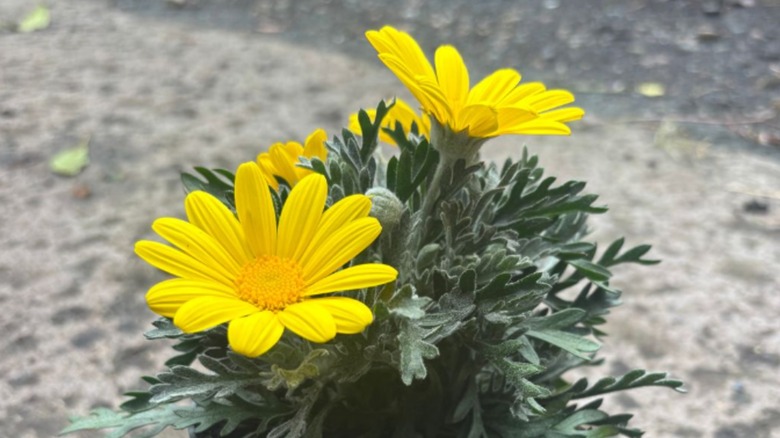
Euryops 'Silver Sunshine' is a member of the Asteraceae family, which includes pest-repellent pyrethrum daisies. It was discovered accidentally on the grounds of the Kirstenbosch National Botanical Garden in Cape Town, South Africa. According to the South African National Biodiversity Institute, this free-flowering, cheerful little hybrid was created by chance, thanks to pollinators transferring pollen between different Euryops species.
The resulting 'Silver Sunshine' is a low-growing shrub with skinny, comb-shaped leaves, and tall, bright yellow daisy flowers that basically blanket the bush in the height of bloom. The institute notes that while the hybrid is now available to gardeners, it has yet to achieve any kind of major renown or popularity. However, 'Silver Sunshine' is now available in certain European nurseries. It's well adapted to tolerate drought, and prefers being in full sun. The bright yellow flowers make it a very popular plant for pollinators like bees and butterflies, who are the reason the cultivar exists in the first place.
Damask roses
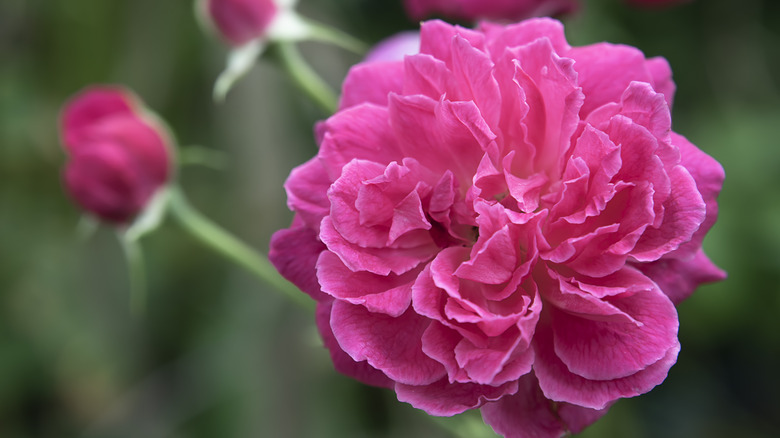
Owing to the fact that roses bloom at different times throughout the year, you can fill your garden with multiple different species and expect to have tremendous color for most of the growing season. Damask roses (Rosa damascena) are a highly common variety known for their intense fragrance and multiple blooming periods. But did you know that their existence is an accident?
All garden roses can be traced back to the original wild roses that flourished throughout Europe and Asia. It was originally not known exactly how these Damask roses came to be. They are said to have first appeared in the Middle Ages in Damascus, Syria, before making their way over to Europe. Now, recent DNA tests have revealed that the damask rose is a result of the natural hybridization of three different types of ancient rose: The French rose (Rosa gallica), the musk rose (Rosa moschata), and the Rosa fedtschenkoana.
Though it is not certain precisely when this hybridization occurred, the damask rose nevertheless gained immense popularity for its fragrant and edible qualities. Damask roses are split into summer and autumn categories. Summer damask roses bloom once a year, while the autumn damasks offer repeat blooming. Historic cultivars include 'La Ville de Bruxelles' and 'Celsiana', and several others that you might have in your own garden.
Bourbon roses
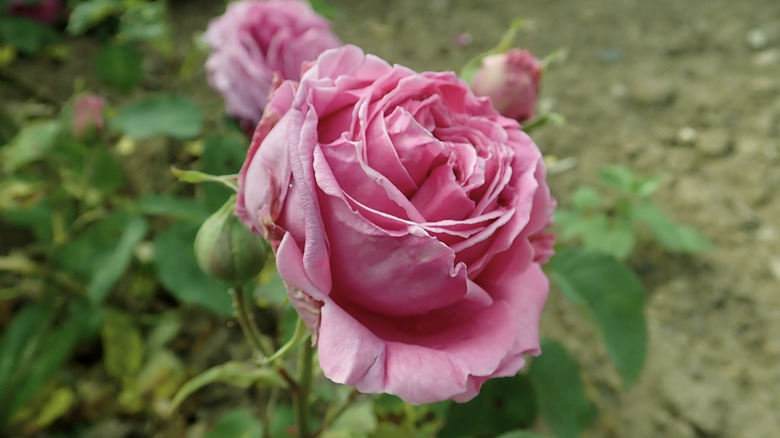
The heritage of the damask rose doesn't end with that journey to Europe, however. It continued on to the Île Bourbon, today called La Réunion. This is an island in the Indian Ocean that has been French territory since the 17th century. In the early 1800s, French settlers were planting hedges made up of 'Old Blush' China roses (Rosa chinensis 'Old Blush') and autumn damask roses. Being planted directly next to one another, natural hybridization occurred, creating a brand new type of rose that was dubbed 'Rose Edouard.'
This was the first official bourbon rose (Rosa bourboniana) and was brought to Europe by French nurserymen, where it became an icon. The multilayered blooms combined the great fragrance and color of the damask roses with the repeat blooming of the Chinese roses.
The original bourbon rose produced numerous cultivar offspring, including the 'Queen of Sweden', 'Zephirine Drouhin', and 'Louise Odier'. Today, bourbon roses are highly beloved for their intense fragrance and dense petal structure. And all because two roses were planted next to each other over 200 years ago on a small island in the Indian Ocean.
'Fairchild's Mule'
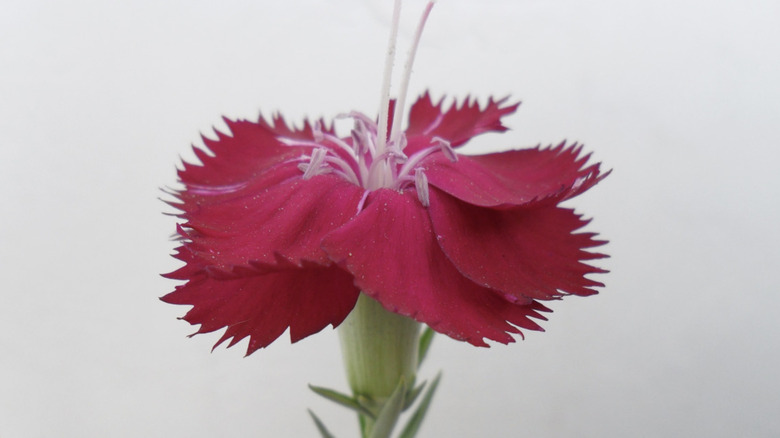
Before we dive into the fascinating history surrounding 'Fairchild's Mule', we need to disclose that the photo above is as close a representation as we could find to the proper historic flower, though it is from the same family of Dianthus. Thomas Fairchild was a British horticulturalist who lived in the late 1600s and early 1700s. His trade was to cultivate and sell plants, which gave him a unique insight into how plants grow and reproduce. Fairchild's experiments would help establish cross-pollination, (which was not yet a widely accepted concept) as fact.
However, Fairchild would be truly remembered in floral history books when, in 1716, he took pollen from a sweet William (Dianthus barbatus) and brushed it onto the stigma of carnation flower (Dianthus caryophyllus). The resulting "mule", which was parlance at the time for horticultural oddities, became the world's first successfully bred artificial hybrid plant.
However Fairchild maintained that the creation of his mule was an accident. He was concerned with the religious establishment finding fault with his meddling in God's design, and, realistically, he had no way of knowing what would stem from this cross-pollination attempt. Only two of Fairchild's specimens have survived and are currently held in the herbaria at Oxford University and in the Museum of Natural History in London.
Daffodahlia
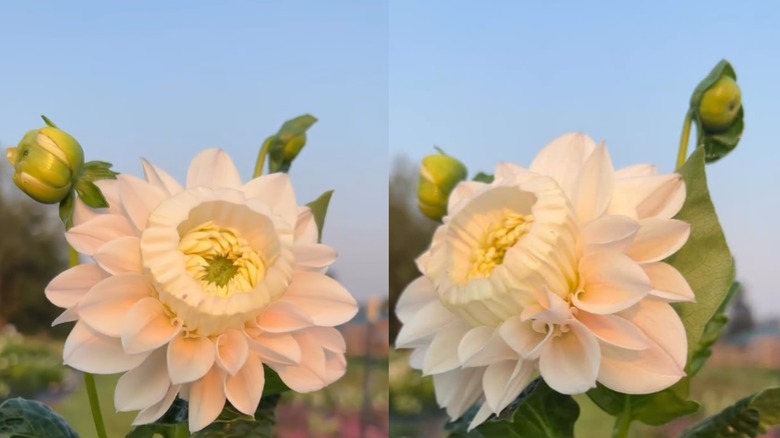
While you might think that the flower you're looking at is the product of someone typing "make a daffodil and dahlia hybrid flower" into ChatGPT, we can assure you that this flower was, in fact, quite real. Known as the daffodahlia, the flower was discovered in September 2024 by farmer Kelsey Hall, owner of Cattle and Cut Flowers farm in Washington state. Hall had been growing numerous different varieties of dahlias for years, but in her 2024 season, flowers on six of her dahlia plants kept their petals rolled forward, making half of the flower appear more like a daffodil.
Hall sent the flower off to scientists at Washington State University, who confirmed that the mutation was not caused by any specific disease. As such, there is no concrete reasoning behind why the flower ended up looking this way, but the running theory is that it is seemingly a result of accidental mutation.
The daffodahlia went viral almost immediately, catching the attention of news outlets and even the likes of Martha Stewart. Hall decided to save seeds from the mutations, as well as sell a select amount of pre-orders to farm patrons. In an Instagram post, she explained that she turned down offers from breeders and wholesale markets because she believed it was not her place to control something that was "wild and unexpected." So, all that remains to be seen is whether the daffodahlia will remain a one-off accident, or if it could become the next official dahlia variety.