

The 5 Best Ways To Remove Anthills In Your Yard Without Pesticides
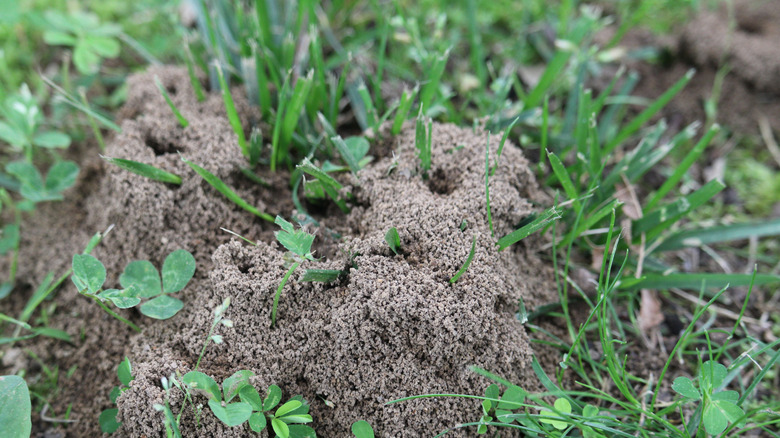
For many homeowners, few things are worse than spending countless hours meticulously caring for their lawn only to see mounds of soil pop up, crawling with ants. Although there are some surprising ways ant colonies may benefit your garden, the reality is most people would rather their yard and garden remain ant-free. As an ongoing measure, proper lawn care can help keep ants from building hills in your yard. But, sometimes the inevitable happens even when you are maintaining best practices. What do you do if ants are infesting your yard? Synthetic pesticides might be the obvious solution, but you don't need to resort to harsh chemicals. There are actually a number of simple solutions to remove anthills from your yard without pesticides.
In many instances, these pesticide-free methods involve items you already have around the house, such as water, soap, vinegar, and baking soda. Other remedies call for purchasing a few readily available, inexpensive products. In either case, the end result is that you should be able to rid your yard of anthills without exposing your family or pets to dangerous chemicals. While some of these solutions have a bit of science to back up their efficacy, all of the methods presented here have significant anecdotal support and evidence that they work, though individual applications vary and may have different results. Even better, none of these remedies require much time, nor any specialized skill or equipment. With just a handful of ingredients, basic tools, and a few minutes of free time, you can do away with unsightly anthills and stop worrying about dangerous types of ants in your yard.
Diatomaceous earth
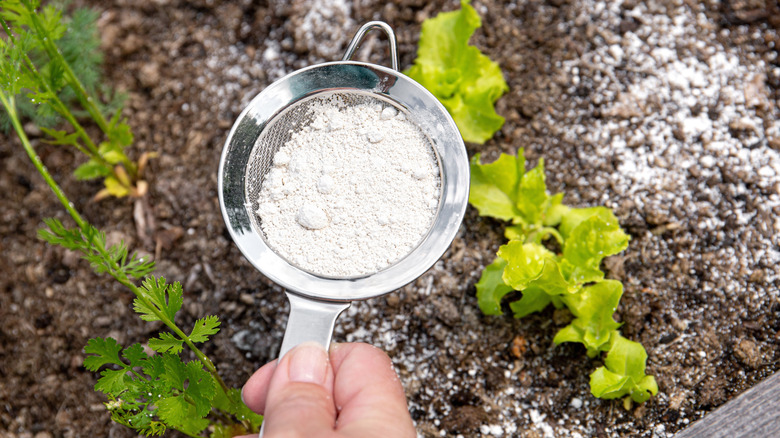
One of the quickest and most effective methods for ridding your yard of anthills without pesticides is diatomaceous earth (DE). This white, powdery substance is actually comprised of microscopic diatom fossils. Diatomaceous earth owes its effectiveness to silica, a mineral found in these fossilized skeletons, which is very effective at absorbing moisture within the ants' bodies, essentially drying them out. Additionally, the coarse nature of DE abrades the ants' protective exoskeletons. This combination is lethal for ants.
Diatomaceous earth isn't just effective, it is also easy to use. All the treatment entails is sprinkling a liberal amount of food-grade diatomaceous earth (as opposed to pool grade) on and around mounds and tunnel entrances. Pool-grade DE should not be used, as it consists of crystalline silica which is hazardous to human and pet lungs. Although food-grade diatomaceous earth is not toxic, wearing a mask while applying it in order to prevent inhaling the silicate-laden powder is advised. Wearing gloves will protect your hands from the abrasive nature of the powder, which can irritate sensitive skin. As a bonus, diatomaceous earth does more than just get rid of the anthills in your yard. It is also a natural way to say goodbye to cockroaches and many other pesky insects.
Boiling water and dish soap
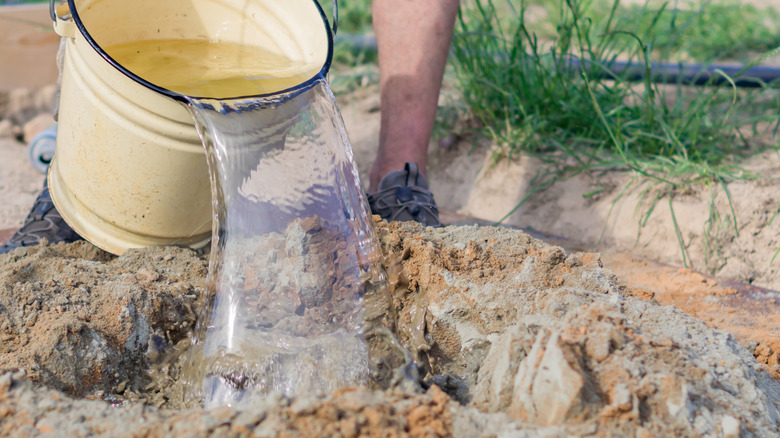
While not everyone has a container of diatomaceous earth just laying around, your kitchen has everything needed to get rid of anthills. Believe or not, it's the very same combination used to wash dishes — soap and hot water. This method involves boiling water, then adding a few drops of dish soap before pouring the scalding concoction over ant-infested soil.
A couple of gallons of boiling water will actually kill a good portion, if not all, of the colony upon contact even without soap. The addition of soap adds to the lethality, as the surfactant clings to and suffocates the ants, again breaking down the protective layer over their exoskeleton. According to the University of Florida IFAS Extension site, slowly pouring boiling water down as many ant tunnels as you can find, has a 20% to 60% success rate when it comes to eliminating the colony (you may need to do it a few times). Many people swear by the method, though some who've tried it says the colony just ends up moving to another location.
The downside is that boiling water can damage or kill grass and ornamental plants, which is why it also keeps your gravel driveway weed-free. To avoid harming grass or plants, you can opt for soap and room temperature water. While it won't kill ants instantly like boiling water does, the soap still works fairly quickly to suffocate the ants it contacts.
Borax and sugar
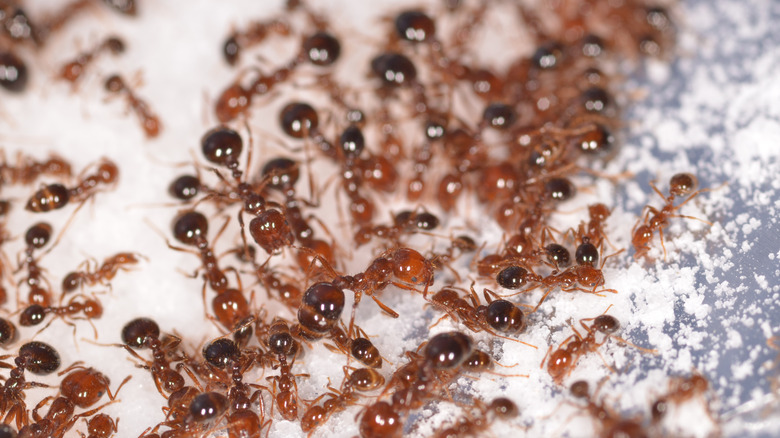
Borax is used for a variety of household cleaning purposes. It is non-toxic and actually made from ground sodium borate, a naturally occurring mineral. In addition to tackling household chores, borax is also quite effective as a natural insecticide. Borax is lethal to insects such as ants and cockroaches in a couple of ways. For one, when ingested, it harms their digestive system and disrupts their ability to absorb nutrients. Secondly, it erodes their protective exoskeleton, desiccating their bodies. One big advantage to this method is that workers may bring borax crystals back to the nest and the queen, eventually destroying the colony.
In order to ensure ants ingest borax so that both lethal methods are engaged, many people suggest mixing it with sugar. There are actually a couple of ways in which this can be done. One is very simple — mix equal parts of borax and powdered sugar in a container, then sprinkle it over and around the mound or along existing ant trails. Some suggest that using a 1:3 ratio of borax to sugar as opposed to 50-50 will result in ants carrying it back to their colony. Essentially, just about any ratio of borax and sugar should work, so long as there is an ample amount of borax included. However some sites and users claim that different ant species are impacted by different ratios or delivery methods, so you may need to experiment a bit.
Borax and sugar can also be used as a wet mix or paste. For this method, simply add some water to your borax and powdered sugar mix. Pour this slurry into and around the anthill.
Vinegar
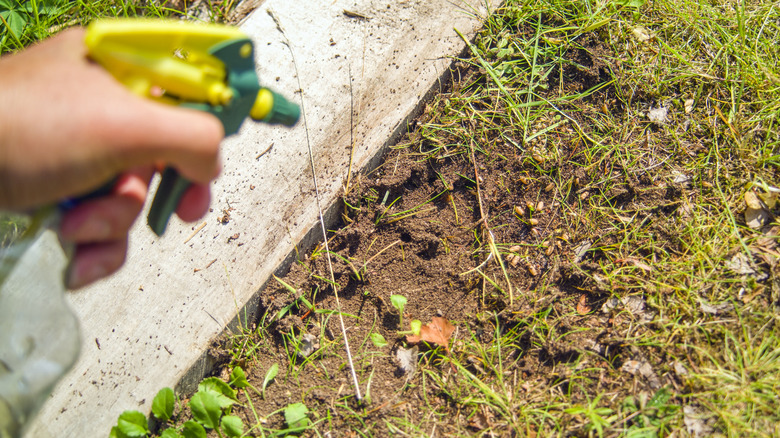
Vinegar has long been touted as a solution to a number of outdoor tasks, from cleaning patio furniture to killing weeds. Adding to the list of unexpected uses for vinegar around your lawn and garden: Using it to get rid of anthills. Unlike most of the other natural methods on this list, vinegar does not work as a pesticide. Aside from perhaps drowning a few ants on contact, vinegar does not kill them. Instead, it disrupts the scent trails that ants use to find their way from their colony to food sources and back. Although it is a non-lethal substance, it can nonetheless be an effective solution, as it can cause them to relocate elsewhere.
When applying vinegar to anthills in your yard, the best method is to use a diluted white vinegar solution. Straight vinegar is certainly effective, but it may also damage your lawn and plants. Instead, mix one part vinegar to three parts water. Put the solution into a mister bottle or handheld pump sprayer and apply a liberal amount to mounds, trails, and tunnel entrances. It's also a good idea to spray near any access points and food sources ants may be attracted to. You may need to reapply the solution every couple of days, as the vinegar scent dissipates.
Baking soda
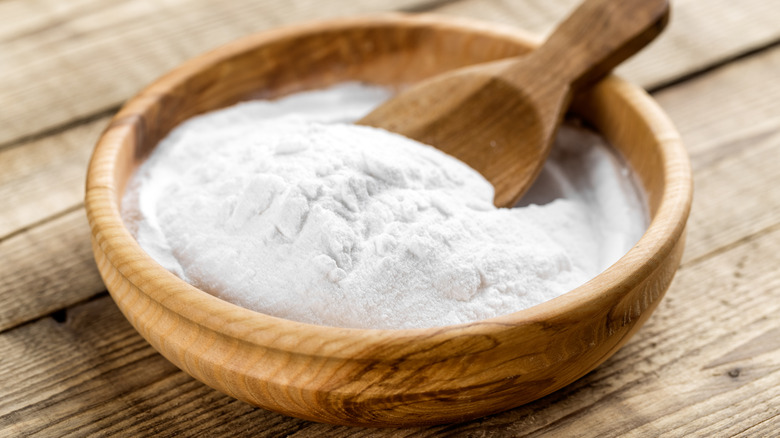
Although it looks nearly identical to borax, baking soda is not the same substance. Baking soda is sodium bicarbonate, whereas borax is sodium borate. While both substances can be used for cleaning the house and killing ants, they accomplish these things in a different way. Many sites and pest control specialists report that baking soda kills ants by forming gas bubbles that become trapped inside their digestive tract. There seems to be no real science backing this method, but people swear it works. One big drawback is that ants aren't really attracted to baking soda as a food source.
With that in mind, most people employ the same trick used in the dry mix method of borax. That means mixing some powdered sugar with the baking soda to work as an attractant, then placing the mixture around the hill and on ant trails. In general, however, it seems this tactic is a short-term fix that doesn't eliminate the colony.
There is an entirely different method that involves mixing baking soda and vinegar on top of the mound to create a foam. However, baking soda is a base or alkaline, and vinegar is an acid. While mixing them together creates an impressive chemical reaction (think grade school volcanoes), that very reaction essentially neutralizes the properties of each. This is true whether using these two substances as a cleaner or to kill ants.