

What Is A Yellow Lantern Used For?
We may receive a commission on purchases made from links.
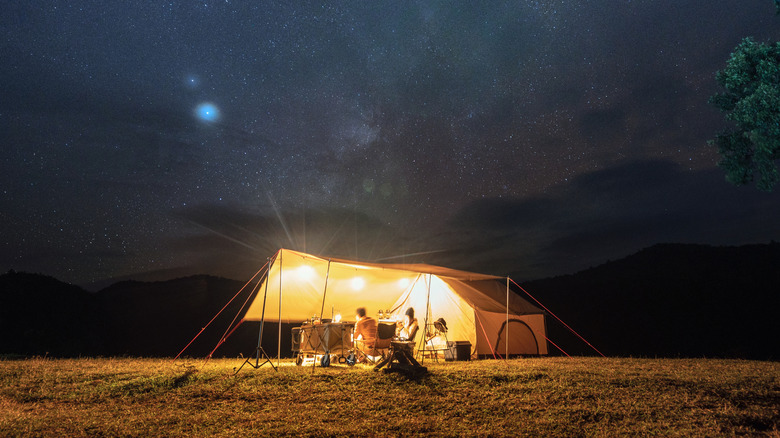
Lanterns, like flashlights and headlamps, are essential pieces of camping gear. However, when choosing a lantern for your outdoor adventures, there is more to consider than just size, weight, and range. You should also consider the color of the light. While bright white may seem like the natural choice to illuminate an area, other shades and colors serve specific purposes. For example, red flashlights are used to preserve night vision and prevent spooking animals. Yellow lanterns, on the other hand, are primarily used to avoid insects and other unwanted guests at night, provide a calming ambience, and even avoid annoying your fellow campers.
White light certainly has its place on camping trips and other outdoor excursions. It is sometimes referred to as task lighting, because the brightness makes it much easier to complete certain activities as the sun sets. However, white light also has its drawbacks. Cool white light — which is the brightest to us — attracts insects, causes light pollution, and refracts off of fog and mist, actually reducing visibility. In fact, in terms of perceived color temperature, cool white light measures about 4,000 Kelvin, and is something you might find in a sterile office. Great when you're cleaning dishes after dinner, but not so much if you don't want to attract every mosquito and moth in the area. So, if you're just trying to relax and enjoy the evening, a yellow light could be just the ticket.
Yellow light lanterns offer several advantages
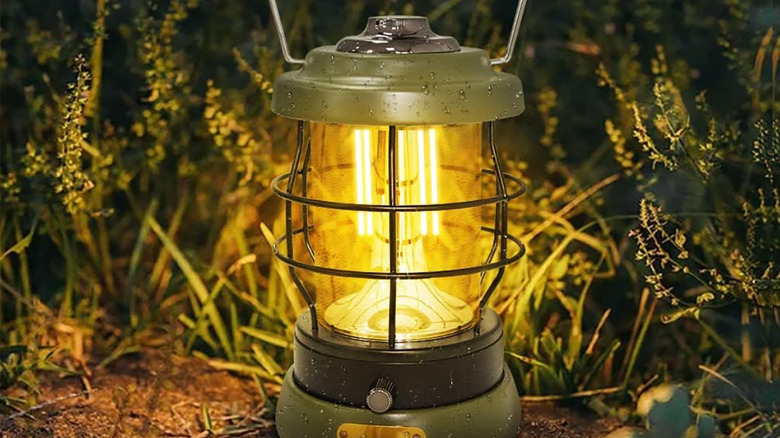
Warm white includes longer wavelengths than cool white light (which has a blue cast). Because of this, it casts a yellow hue and comes off as less bright. These traits become even more distinct as you move further down the wavelength spectrum into the true yellow light range. With that in mind, many campers use a yellow lantern because it attracts fewer insects, much like homeowners use a yellow light bulb on their porch. Yellow LED lighting is even less inviting, as it doesn't emit much UV radiation that many insects are drawn to. However, bug deterrence isn't the only advantage or use for a yellow light lantern — it also helps reduce light pollution. The mellow illumination creates a cozier atmosphere in a campsite. Additionally, while not as effective as red light at preserving night vision, yellow light helps when you shift your gaze from lantern to map, trail, or stars without those several seconds of blindness you endure looking into a cool white light.
In a crowded campground, yellow lights are a welcome sight for tired eyes. Just as noise from a neighbors' party can ruin the woodsy vibe, so too can what feels like a spotlight coming from their campsite blocking your view of the stars. Many RV campers use yellow string lights to adorn awnings and yellow bulbs as their exterior nightlight for just this reason.
The drawback to yellow light, of course, is the same characteristic that provides so many benefits — its diminished brightness. Specific evening tasks or social events may require more stark lighting than a yellow lantern provides. For those situations, a dual-color lantern like the UniqueFire Hurricane camping lantern — which toggles between warm yellow and cool white light — is an ideal solution.