

Boomers Grew Up With These Camping Items That Almost No One Uses Anymore
We may receive a commission on purchases made from links.
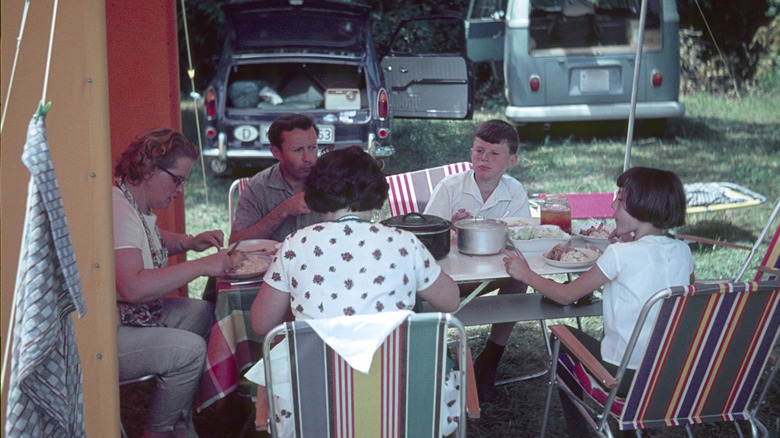
Recreational camping has been popular in the United States since at least the 1860s. Nearly a century later, as the Baby Boomer generation was coming of age, they and their families often did so equipped with what was then the most modern of camping gear. Of course, the evolution of recreational camping gear did not stop, with the introduction of lightweight materials, innovative design, and even tech-savvy camping essentials. As a result, hardly anyone uses much of the gear these kids grew up with in the 1950s and '60s, such as bulky camp boxes, pump-style propane lanterns, and incredibly heavy canvas tents.
Although much of the gear from this era has become obsolete, some items are still in regular use. One example is the venerable Coleman two-burner propane cook stove. With the exception of transitioning from a refillable, hand-pumped tank to a propane canister, these stoves have changed very little since being introduced in 1923.
While use of the propane stove has endured, one example of '60s-era camping has not: Massive, take-everything-but-the-kitchen-sink chuck boxes. In fact, today overpacking is seen as one of the biggest camping mistakes to avoid. These boxes, typically made of plywood, were heavy and cumbersome, especially when you had to hike into camp. The chuck box hasn't completely gone away, but modern versions are typically smaller, lighter, and weatherproof. Additionally, many models integrate kitchen elements — including sink, prep area, and stove platform — in one convenient, highly-portable camp kitchen unit.
Modern lanterns and lights hardly resemble what boomers used

Good lighting has long been considered a must-have for camping trips. That has not changed, but it has evolved considerably. Where most boomers grew up with two essential pieces of gear for providing light — a lantern and flashlight — today it is quite common for one item, like the Everbrite 2-in-1 mini lantern and flashlight, to serve both functions. Even when they're distinct tools, flashlights and lanterns bear little resemblance to what campers in the mid-20th century grew up using.
Then, as now, lanterns were the go-to gear for lighting a tent or campsite. During the 1950s, '60s, and '70s, the Coleman lanterns used by campers were fuel-powered, utilizing Coleman Camp Fuel, both single- and double-mantle models. These devices used refillable tanks, meaning a separate, dedicated fuel canister was vital, and the lantern itself was hand-pumped to pressurize the fuel tank. Furthermore, the mantles were essentially fragile mesh fabric "socks" set on fire. If they got damaged (which was annoyingly easy to do) or burnt out, the lantern was rendered useless until the mantles were replaced. Not to mention, you also needed matches to light the lantern. Today's battery-operated or rechargeable LED lanterns remove almost all the potential headaches.
When it came to a focused beam of light for navigating trails in the dark, boomers typically relied on bulky, heavy flashlights. Though some plastic models were introduced by the 1960s, most campers at that time carried steel-bodied models such as the Eveready Captain. Known for its durability, the Captain used a pair of C batteries — each of which themselves weighed more than many modern LED flashlights. What's more, despite the heft and size of those older torches, modern versions are capable of producing a far stronger, brighter light.
Boomers grew up sleeping in bulky tents and army cots
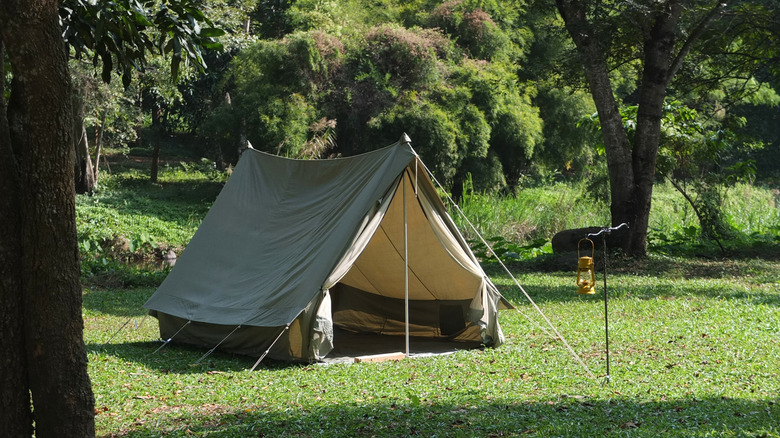
If you're looking for a new tent, odds are you have something lightweight, packable, and easy to set up in mind. Those really weren't options when boomers were growing up — at least not in the way we know them today. During the 1950s, "wall" tents were still made of heavy cotton canvas. The supports were cumbersome poles of wood or steel. These were still very much in use during the 60s, though lighter-weight synthetic fabrics and external aluminum alloy poles were the high-tech options. These poles, however, were, multi-piece metal supports, still heavy, and required a separate carrying case.
Not only were these tents bulky, they took a lot of time — and often multiple people — to erect. By contrast, most tents today are lightweight, pack into a small drawstring bag, and can be set up by one person in a matter of minutes. In fact, some models, such as the Londtren 4-person easy pop-up tent, weigh only a few ounces and automatically erect themselves when removed from the carrying bag. Additionally, modern tents are typically waterproof upon purchase. Those cotton canvas and early nylon and polyester versions had to be treated with wax or oil to repel water.
What boomers slept on in those bulky tents was also very different. Back then, it was either a flannel sleeping bag (or blankets) directly on the ground, or a military surplus folding cot with a wooden frame and canvas cover. Like the tents, these cots were complex, heavy, and difficult to pack. By contrast, a modern sleeping pad weighs mere ounces and fits easily into your backpack. Even cots that work for your camping style have become lighter (weighing only a couple pounds) and easier to pack.