

Boomers Grew Up Playing On Them — Now Experts Say They're A Safety Hazard

Modern playgrounds at elementary schools and public parks feature a kaleidoscope of colorful equipment made of plastic and protectively coated steel. This was not always the case. Back in the mid-1900s, play areas designed for children more closely resembled an industrial site — an expanse of galvanized pipes and shiny sheet metal. Although boomers (born 1946 to 1964) and gen X (1965 to 1980) grew up playing on these exposed-metal structures, experts today say this kind of playground equipment is hazardous.
Undoubtedly, most boomers who spent any time on these metal contraptions will agree with the negative safety assessment. One would be hard-pressed to find anyone who was not a victim of, or witness to, a major playground injury during that era. So, while there is plenty of boomer advice millennials can't stand, it's unlikely any boomer would recommend their grandkids use the playground equipment from their youth. Such equipment typically consisted of slides, monkey bars, swings, teeter-totters, merry-go-rounds, and an endless array of climbing contraptions known as jungle gyms. With the exception of rubber or wood swing seats and wood teeter-totters, every bit of these playground pieces were made from metal, usually unpainted.
There are a myriad of reasons this equipment was so dangerous. First and foremost was the heat radiating from metal bars and surfaces. According to the U.S. Consumer Product Safety Commission's Public Playground Safety Handbook, bare metal, when exposed to direct sunlight, can become hot enough to cause serious burns in less than a minute. Given that virtually no playgrounds were shaded when boomers were kids, it's little wonder that an all-metal slide surface felt like a skillet by recess time. Ditto for the exposed metal on jungle gyms, monkey bars, and other playground equipment.
Boomer-era playgrounds were accidents waiting to happen
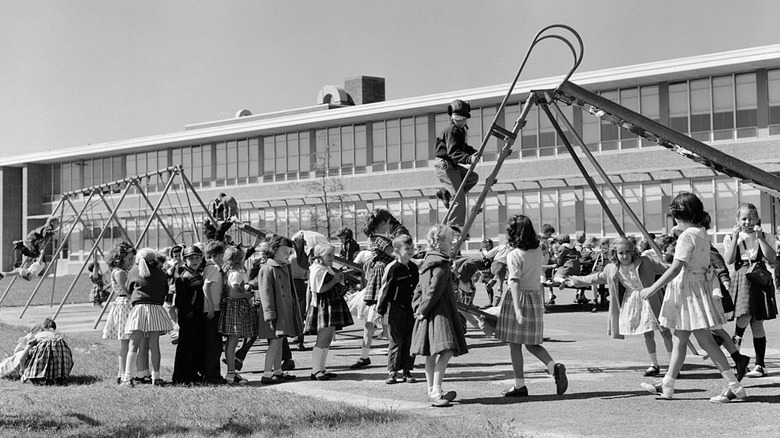
Hot surfaces were hardly the only hazard presented by boomer-era playground equipment. In addition to being an excellent heat conductor, exposed metal is hard and sometimes sharp. Unsurprisingly, cuts, bruises, and more serious injuries were commonplace, even for kids using the more mundane pieces of playground equipment. Adding speed and movement, such as with merry-go-rounds, only amplified the incident rate.
Height was another issue that led to injuries. Kids are naturally good at climbing, which is one reason why monkey bars and jungle gyms were playground mainstays. Climbing such structures can be a healthy way to play, but not if they're not properly set up. Some climbing apparatuses from that era were as much as 20 feet high — falling from that distance almost guaranteed injury. Given that bare metal pipes are scalding hot when grabbed, falls were inevitable. If a kid didn't hit the ground when dropping from a jungle gym, it only meant their fall had been broken by another metal bar, or several, on the way down.
Height also contributed to accidents on swings, which were basically steel chains dangling from a metal pipe frame with a patch of rubber for a seat. They're often not that different in design today, but the height is much lower. The high frames with exceedingly long chains meant boomer-era kids could swing very high. Were you to use a swing set from the mid-20th century to transform your narrow backyard into a play space for your kids, they likely would swing beyond the fence. Kids swinging that high and far often led to falls or out-of-control situations in which kids crashed into one another or against the metal pipes of the swing set.