

The Difference Between Blue And Pink Hydrangeas Is Easily Explained By Science
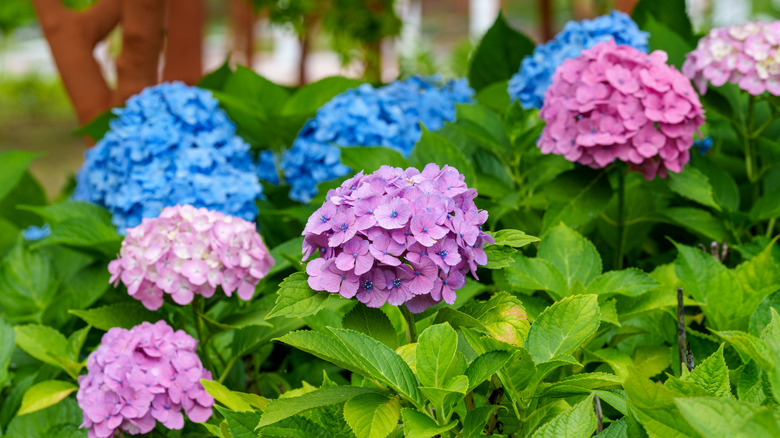
Hydrangeas of all sorts are extremely popular garden plants in the United States largely because they feature showy, colorful blooms. Pink and blue are among the most popular colors, but which color emerges — and if blooms remain that color the following season — can vary based on soil conditions for specific types of hydrangeas. While this may seem like some sort of mysticism, the difference between blue and pink hydrangeas is easily explained by science. In short, the acidity and mineral composition of the soil can influence a hydrangea's blooms, depending on the variety.
The blooms of both bigleaf (Hydrangea macrophylla) and mountain hydrangea (Hydrangea serrata) can change colors based on the pH level of the soil. They are not the only types of hydrangeas offering differently colored flowers, but they are the only types that change color based on soil chemistry. For example, panicle hydrangeas (Hydrangea paniculata) provide colorful blooms all summer long and those blooms change colors through the season. However, the shifts are dictated by air temperatures and sun exposure as opposed to soil pH levels. Meanwhile, the 'Limelight' cultivar is genetically coded to change throughout the blooming season from bright green to white, to a warm pink by fall.
Bigleaf and mountain hydrangea are also the types that feature those massive mophead blooms that are so popular, emerging in shades of blue, pink, or purple depending on the soil in which they are growing. Because this phenomenon has a straightforward, scientific answer, gardeners have learned they can also manipulate the soil pH artificially in order to determine the color of blooms they'll get.
Why pH affects color on certain hydrangea types
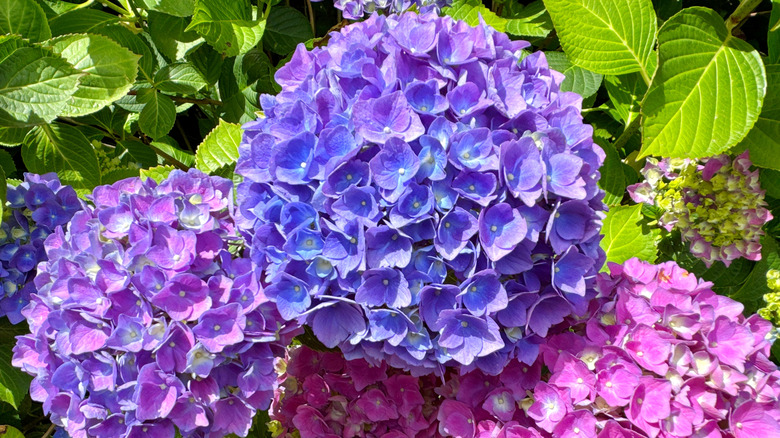
There are a couple of reasons why pH levels can change the color of hydrangeas. The first part of this puzzle has to do with the blooms themselves. Hydrangea blooms are not singular, true flowers like a carnation or magnolia flower. Instead, the actual flower is relatively small. The big, colorful, showy petals which make hydrangea blooms so stunning are not true flower petals — they are a specialized type of leaf.
Secondly, these leaves are not colored by pigments. Instead, they reveal colors as part of a chemical reaction based on the level of proton (hydrogen ion) donors or acceptors they absorb, functioning like a natural litmus paper. Absorbing acidic proton donors turns blooms blue, while absorbing basic proton acceptors shifts the blooms to pink. As a rule, a soil pH under 5.5 results in blue blooms — the lower the pH, the deeper the blue. A pH level between 6.5 and 7.0 gives pink blooms, while a pH between 5.5 and 6.5 produces purplish blooms. You can even get both blue and pink blooms on the same bush.
Therein lies the potential for gardeners to adjust a hydrangea's blossom color by changing the soil's pH using amendments. However, these take time — at least a full season's cycle and sometimes years — to have an effect, depending on the strength of the amendment, which is one of the reasons used coffee grounds won't change the color of your hydrangea blooms. Additionally, for blooms to reach peak blue, the soil must have a sufficient amount of aluminum to allow the acidic process to take place. This aluminum must be absorbed into the plant, which is why the aluminum foil hydrangea color-changing hack is a bust. But adding aluminum sulfate to your spring fertilizing routine can aid in the color-changing process.