

The Best Time To Deadhead Hydrangeas For Bigger, More Vibrant Blooms

If you want a thriving garden, it's important to know how to correctly deadhead flowers. The process prevents fading, wilting, or dying flowers from going to seed and, depending on the plant, convinces it to bloom an additional time (or continuously) in a single season. When it comes to hydrangeas — among the more popular flowering plants for gardening and landscaping across the country — part of that equation involves when to deadhead as well. Turns out that, since there is a myriad of hydrangea varieties, there is no unified time frame for deadheading. Instead, the best time to deadhead hydrangeas is determined by whether they are an old wood or new wood blooming type, or one of the relatively new reblooming cultivars.
Reblooming hydrangeas are the only type which will produce additional flowers during the same growing season when deadheaded. There are actually only a handful of hydrangeas that fall into the reblooming, or remontant, category. Among them are cultivars such as 'Endless Summer' and 'Pop Star.' If you have a reblooming variety, deadhead them early and often during the summer season in order to encourage more blooms. In fact, it is best to start with this type of hydrangea as early as possible so that it is prepared for the reblooming period. If you wait too long to deadhead rebloomers, they may not produce an additional set of flowers in a single season.
Deadheading old wood vs new wood hydrangeas
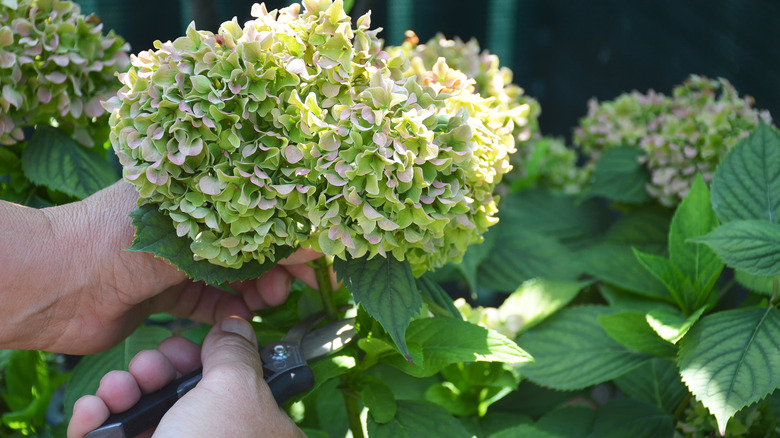
Old wood hydrangeas are shrubs that form blooms on the growth from the previous season. New wood hydrangeas, on the other hand, form buds and blooms on new stems as they appear during the current season. Technically, you don't need to deadhead either type. However, many gardeners do so to encourage new stem growth or give their garden a tidier appearance. It is possible to deadhead either type throughout the blooming season. However, there is a point when it is best to stop in order to ensure the most blooms the following year, and that the plant is fully prepared for the winter season.
For old wood blooming hydrangeas, which include bigleaf, oakleaf, climbing, and the lesser known mountain hydrangea, it is best to stop deadheading before August. This is because by late summer and fall, new buds will already be forming for next year's blooms. Deadheading too late means you may cut off next year's flowers just as buds are forming. If you choose to prune old wood hydrangeas, this should be done as part of your fall hydrangea care routine. Be sure to only prune back to healthy buds on the stems that you are leaving in place for the following year.
When deadheading new wood hydrangeas, such as panicle and smooth varieties, you can continue a few weeks longer, but you should still stop snipping by the middle of August. In the case of new wood hydrangeas, you don't need to worry about cutting off the buds for next year's blooms. Rather it's to avoid stimulating new growth right before the winter dormancy period. For that same reason, these are hydrangeas you should prune in late winter or early spring, rather than late fall or early winter.