

This Is How Far You Should Hang Your Owl Box From Your House
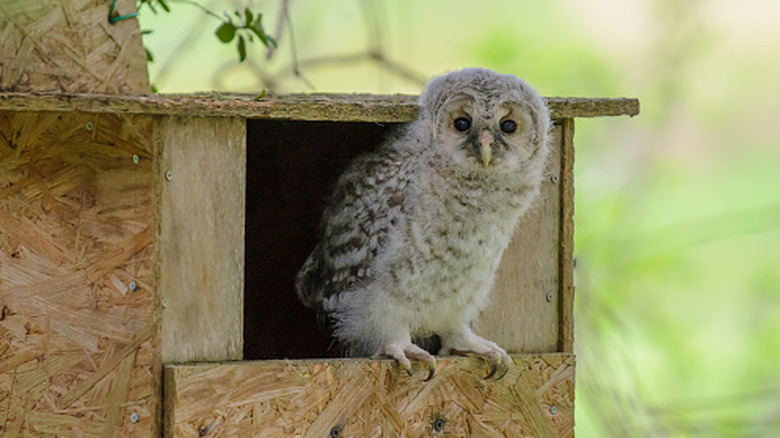
Whether you're interested in attracting owls to your yard just to catch a glimpse of their stunning glides, or you're trying to encourage their inexpensive pest control services, you'll want to start with an owl box. These nesting shelters are ideal for attracting and housing barn owls, who usually don't mind cozying up to manmade structures. Still, it's important to give owls their space, since they tend to be anxious about settling down in places where they may be exposed to predators.
For instance, if you've tried hanging an owl box on the side of your house, you've probably learned that most owls don't tend to make use of them. This is because the quiet, watchful birds of prey can be highly sensitive to noise, light pollution, and the threat of direct human intervention. If you're hoping to drive more winged traffic to your backyard, and maintaining the healthy ecosystem needed for owl populations to thrive, begin by placing your owl box roughly 50 to 100 feet from your home, and 15 to 20 feet off the ground. From there, you can protect your owl nesting boxes with a variety of weatherproofing techniques.
Even with these general guidelines, hanging an owl box is a delicate process. Doing so properly might require some trial and error to arrive at the perfect distance. Still, installing an owl box at this height and distance should offer you visual access to your feathery friends, while giving them enough space to remain at peace throughout the day. Of course, if you're struggling to catch a glimpse of your neighborhood owls, you could always mount a trail camera nearby. Just be sure to equip the camera with night vision, as owls are nocturnal hunters.
Find the perfect place for your owl box
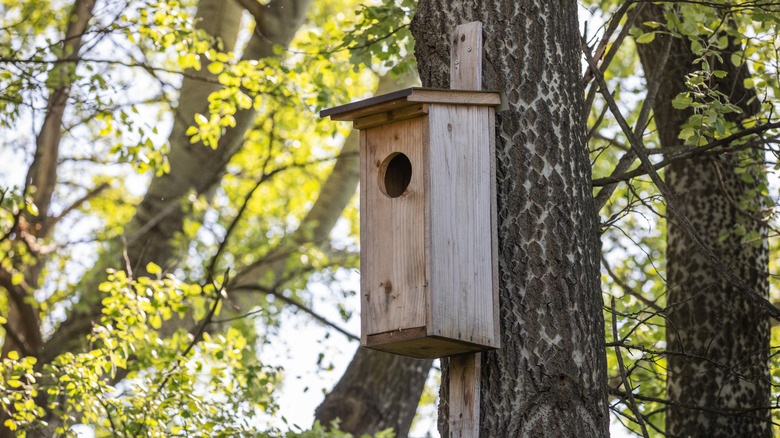
When it comes to installing an owl nesting box, the distance from your home can be one of the most significant factors. Generally speaking, experts recommend a bare minimum distance of 50 feet from your house. Even with that in mind, you're probably going to get better results if you stray further than 100 feet from busy human-accessible zones, to ensure that your owls have plenty of buffer space. Larger, more rural properties are often ideal for supporting these nesting boxes, while urban homeowners might struggle to find the space. You'll also want to know what kind of owls you're attracting. Barn owls, as their name implies, love living inside structures, and if there are no good nesting nooks inside a large building, you can set a box inside or outside the building for them. If you live next to a busy road, it may be best not to try and attract owls at all, as that can put them at increased risk while they hunt (they may end up spending time on the road).
If you're finding it impossible to situate a box over 50 feet from your home, you can still give it the old college try by placing a box in a quiet, tree-lined area. You'll want to provide a perch where the owls can watch for any prey, though the box doesn't necessarily have to be right on top of their hunting grounds. Owls have a very sophisticated sense of sight, particularly when hunting in the darkness, so they'll be quite adept at spotting mice or voles from long distances.
Finally, try to minimize any noise or light pollution coming from your home, especially after the sun sets. These common household features aren't just a frustrating distraction to local owl populations, they can be downright hazardous.