

Quickly Remove Ice From Your Driveway With A Simple Rock Salt Trick
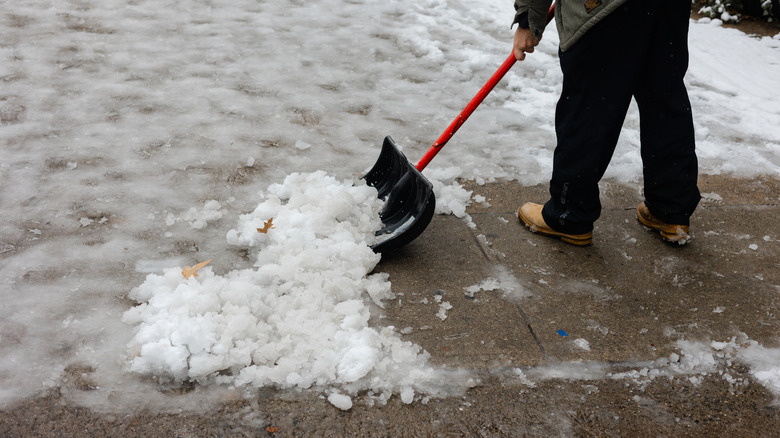
Removing ice from your driveway is an inevitable task for anyone living where freezing conditions regularly occur. For most, it is not a pleasant undertaking, so the goal is to get it done as quickly as possible. To that end, there are a number of ice melt and deicing products on the market, each of which have their pros and cons. However, the old-school options of sand or rock salt are still the most often used to gain traction and melt ice and snow on driveways. If you happen to be among those who still rely on rock salt for your ice melting needs, you can clear your driveway much more quickly by simply adding a bit of warm water.
The reason warm water expedites the effectiveness of rock salt has to do with how salt works as a deicing agent. Essentially, rock salt lowers the freezing point or temperature at which water turns to ice. As it mixes with the accumulated ice, it begins to make a brine solution or slush, which freezes at a much lower temperature than plain water. Once it gets started, this becomes something of a perpetuating process. Making a salty solution using warm water, instead of sprinkling solid salt, creeps into cracks, divots, and openings in the ice, creating more briny slush as that ice melts. Adding warm (not hot) water dissolves the salt and kickstarts the melting of ice, speeding up the whole slush-creating process.
Using warm water to jump start the melting process
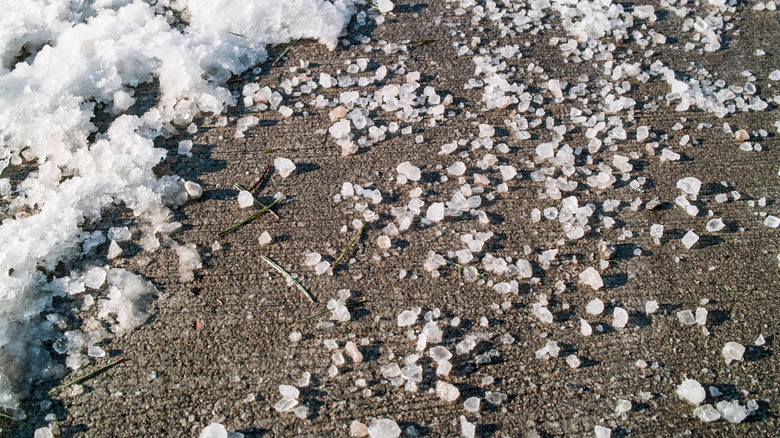
When attempting to remove ice more quickly with warm water and salt, the process still begins much the same. Shovel the excess snow first, or at least a good portion of it, then sprinkle a liberal layer of salt across your driveway, just as you typically would. However, rather than waiting for the salt to do its thing, at this point begin pouring warm water over the salt and ice. These steps can also be reversed — pour warm water across the ice, then toss some salt over the area as the ice begins to melt. When going in this order, timing is key, as you need to add salt to the melted ice before it refreezes.
When it comes to the ideal water temperature, most sources suggest using warm to mildly hot water. While others do suggest using boiling water, there are some drawbacks. Although it sounds counterintuitive, the hotter the water is, the faster it will refreeze. If it refreezes too rapidly, it can actually form a dangerous layer of black ice you'll need to remove from your driveway. Additionally, tossing boiling water onto frozen concrete can cause it to crack or spall due to the rapid contrast in temperatures, known as thermal shock. Furthermore, traversing icy terrain with a pot of boiling hot water is a scalding accident waiting to happen.