

Avoid Rock Salt Damage With An Easier-On-Your-Driveway Alternative
For those living in areas prone to freezing temperatures, deicing driveways is a frequent chore during winter. Traditionally, many people have used rock salt to melt ice on driveways and sidewalks. While rock salt does work, and is relatively cheap, it also has some drawbacks, especially with frequent use. Rock salt can not only harm pets and plants, it can also severely damage concrete. One option with rock salt is to avoid the common mistake of not clearing it up immediately as temperatures rise. However, you can avoid rock salt damage altogether by using urea, an easier-on-your-driveway alternative.
Today there are actually a number of alternatives to rock salt, ranging from natural solutions to chemical compounds. These alternatives come at a range of price points and vary in effectiveness. However, some rock salt alternatives do more harm than good to concrete driveways. Urea, on the other hand, is often considered among the safest option for use on your driveway, as it does not damage concrete or asphalt. Urea, which is a natural compound rich in nitrogen, is commonly used as fertilizer. It's also considered to be a pet-safe way to melt ice on your driveway. That said, there are reasons beyond your yard you want to be careful with it: Urea can negatively impact local waters if it washes off through the drains to streams and lakes.
Using urea is concrete-safe but may not be eco-friendly
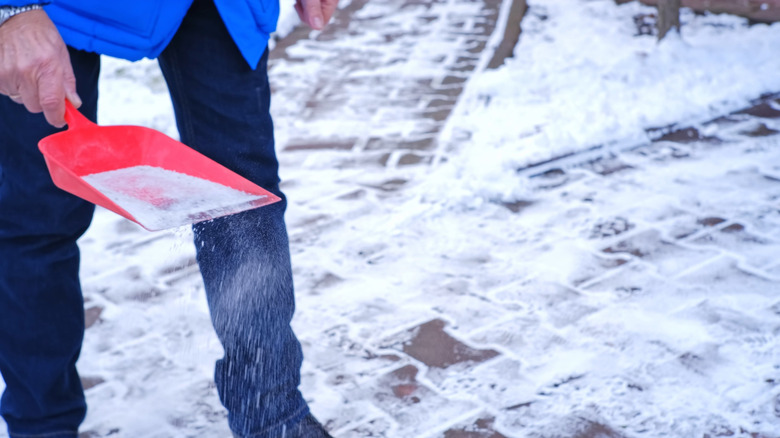
Urea is applied to driveways in pretty much the same manner as rock salt or other granule or pellet ice melts. That is to say you just spread the granules of urea over the surface of your icy driveway. Whenever possible, salt your driveway before you have to shovel snow. When using urea, you should apply at a rate of about 10 pounds per 100 square feet. Alternatively, you can spray liquid urea over the driveway.
While urea is the least damaging of all ice melts on concrete driveways, it does have some drawbacks. For starters, it is substantially more expensive than rock salt and even some alternative ice melts. Additionally, other traditional ice melts tend to be more effective at lower temperatures than urea, which loses its ability to melt ice around 15 degrees Fahrenheit, though some report it starts losing effectiveness by 25 degrees F.
However, the biggest threat of using urea as an ice melt has to do with the environment. Urea is often touted as an eco-friendly alternative because it is a natural compound. Although that is true, it can actually cause severe damage to your lawn and plants, as well as the surrounding eco-system if overused or used improperly. That is because urea is high in nitrogen. While nitrogen is a necessary for plant growth, too much can harm those same plants. Additionally, excess urea can wash into storm drains and gutters, eventually making its way into local waterways and causing additional harm. With that in mind, if you do use urea as an ice melt, it's a good idea to clean up excess granules as soon as the freeze is over.