

Attract Owls To Your Yard With A Simple Yard Feature You Can DIY
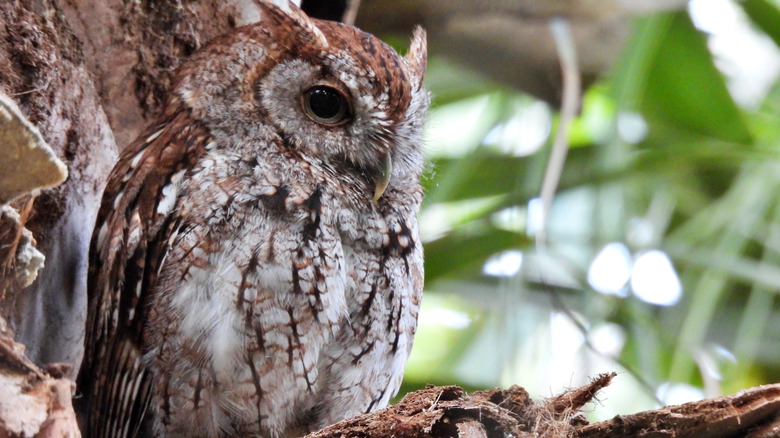
If you build it, they will come. In this case, the "they" in question is owls. There are a number of things you can do to attract owls to your yard, such creating an owl-friendly birdbath and turning lights off in at least some parts of your yard. But what's really going to get them to stick around is offering some real estate: Owls particularly enjoy having somewhere private to nest. Many species use cavities within trees as desirable nesting places, but if your trees don't feature owl-worthy spaces, you can help your large feathered friends by offering homemade nesting boxes.
Just as you want the perfect birdhouse size for various birds, an owl box should be built to suit the owl species you want to have take up residence. The opening into the owl box needs to be a size that's well suited to the owl variety, allowing adult owls in and out, but not larger predators. This is especially true with smaller species like screech owls. For the safety of the owls, build the box out of .75-inch-thick untreated wood such as pine, cedar, or redwood. There's no need to paint it, and despite tradition, you don't want to add a perch. It's a popular birdhouse addition you'll want to avoid: Owls don't need perches to access their nests, and they only make it easier for predators. Instead, add a small block inside the box to help young owlets leave the nest when it's time.
Making an owl-worthy nesting box
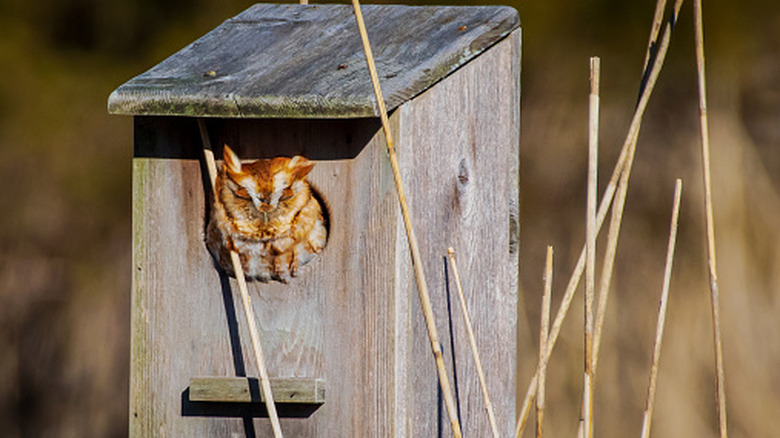
To make a nesting box to attract owls to your yard, first decide which local owl species you'd like to help, as not all of them will use a nest box. Large species such as great horned owls and long-eared owls sleep in open nests rather than cavities. Smaller species such as saw-whet, screech, and boreal owls, will use a DIY nest box. Cornell Lab's NestWatch has a wonderful resource for pairing the right box with the right owl, including online plans for each.
For screech owls and other small species, The box should be about 16 inches tall in back, 14 inches tall in front, 10 inches from front to back, and 11.75 inches wide. Any owl box you make benefit from a sloped roof to let run off. Make a 3-inch round hole near the top of the front board. The bottom board needs narrow drainage holes so moisture can escape. If you don't add a perch, you can carve or slice horizontal grooves beneath the hole, both inside the box and out, so owlets can enter and exit with ease.
Make at least one of the side panels hinged, and add a small nail or pin near the front to keep that door from flapping open. That's an access panel for you, not for wildlife, so you can clean it between broods. Alternatively, you can hinge the roof on the back side.
Add about 2 inches of dried leaves or untreated wood chips to the inside of the box for warm bedding. Hang the owl box in the shade, about 10 feet up and with the entrance facing south or east so the owls can sun themselves in the morning.