

What Is A Bomb Cyclone And How Does It Differ From A Normal Blizzard?

We may receive a commission on purchases made from links.
If you live in a portion of the country susceptible to severe winter weather, you are likely familiar with both snowstorms and blizzards (there's a difference). However, there is another extreme winter weather event you ought be aware of: the bomb cyclone. As the name suggests, it's a particularly powerful and dangerous storm that technically can happen anywhere in the United States. However, they are far more common in some states and regions, including Alaska, the Pacific Northwest, Great Lakes Region, and the Northeast. But, what is a bomb cyclone and how does it differ from a normal blizzard?
Part of what defines a bomb cyclone is in the name. This particular type of winter storm is cyclonic in nature, much like a hurricane or the infamous Nor'easters along the East Coast. However, unlike those storms, a bomb cyclone forms over land and draws its energy from clashing warm and cold air masses along a frontal boundary. Additionally, even though they are cyclonic, they are not as well-formed as those storms in the sense they typically have an asymmetrical shape and lack a clearly formed storm eye.
The second part of what defines a bomb cyclone is the speed with which it forms. In that sense, it is similar to rapidly forming snow squalls, although a bomb cyclone is much larger and more powerful. To that end, the bomb in bomb cyclone does not refer to its ability to inflict damage, although that, too, is significant. Rather, it is a shortened version of the meteorological term bombogenesis, which refers to rapidly falling central atmospheric pressure. To qualify as a bomb cyclone, a storm system must drop 24 or more millibars of pressure in less than 24 hours.
Bomb cyclone versus blizzard
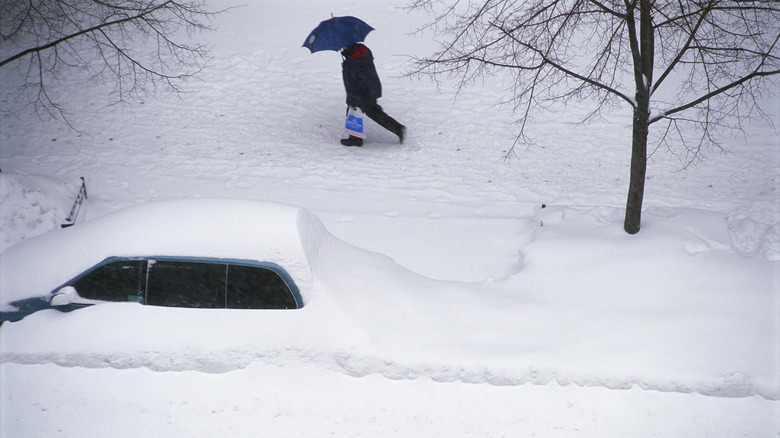
Is there a difference between a normal blizzard and a bomb cyclone? The answer is yes ... and no. The term blizzard applies to snowstorms with winds in excess of 35 mph, accompanied by heavy snow, windblown snow, and reduced visibility. To qualify as a blizzard, visibility must be less than ¼-mile for at least 3 hours. A bomb cyclone very well can cause, and be accompanied by, blizzard conditions. However, while high winds and heavy precipitation are key characteristics of a bomb cyclone, sometimes that precipitation is in the form of rain, meaning not all bomb cyclones are blizzards. This phenomenon is sometimes referred to as an atmospheric river.
By the same token, not all blizzards are caused by or part of a bomb cyclone. There is no criteria for how fast a storm must form to be a blizzard. In fact, often times blizzards are forecast quite some time in advance, with the National Weather Service typically issuing a number of Winter Storm and/or Blizzard Warnings in advance of a blizzard's arrival. As a result, when a normal blizzard is coming, you may have time to prepare and stock up on supplies.
Because they form so rapidly, bomb cyclones can take those who are unprepared for winter weather off guard. Meteorologists will often say a storm has a chance to bomb out or that conditions are present for the formation of a bomb cyclone. If you hear any of this language in the forecast, you need to make sure both your home and car are stocked with supplies and an emergency preparedness kit, secure loose items around your yard, charge all phones, and monitor your NOAA emergency weather radio.