

Protect Your Outdoor Faucets During Winter With These DIY Ideas
We may receive a commission on purchases made from links.
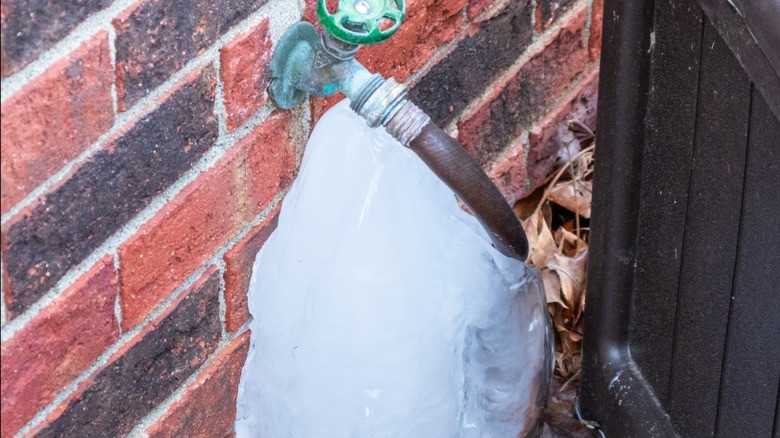
It's no secret that outdoor faucets are susceptible to damage when winter weather sets in and temperature plunge below freezing. With that in mind, many homeowners take steps prepare outdoor faucets and plumbing for winter weather at the beginning of the season. Even then, when freezing winter weather is on the way, you need to protect your outdoor faucets. At that point, if you haven't already secured a supply of faucet covers and foam pipe sleeves, you may find yourself in a situation where either time or availability makes it impossible for you to secure them. However, there are plenty of DIY ideas designed to protect your faucets without faucet covers.
Before implementing your DIY faucet protection, you need to do a couple of things (which have to happen even with store-bought supplies). First, disconnect garden hoses and other attachments from the faucets. If you have a separate water supply valve for your outdoor faucets, turn that off and open the faucets. This allows all of the water to drain from the pipes. In this situation, leave the faucets open so any remaining water in the pipe room has room to expand if things freeze.
If you do not have a separate water supply valve, you will need to do whatever you can to keep the faucets and pipes warm enough to remain above freezing. If those pipes burst, it will impact your entire house. One simple solution for outdoor faucets, or hose bibs, protruding from a wall is to utilize a sock and plastic bag. To do this, take a thick, preferably wool, sock and double it back on itself. Then, slip this double-thick sock over the faucet. Cover the sock with a plastic bag and secure it with zip ties, rubber bands, or waterproof tape.
Use foam cups for a makeshift faucet cover
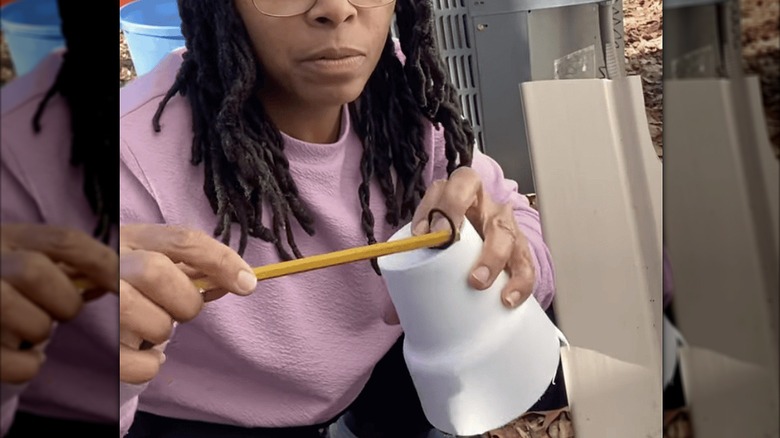
You can also use a foam drinking cup to create a makeshift faucet cover. In some areas, it has become popular to use extra-large soft drink cups from fast-food chains. However, any Styrofoam-style cup will work, so long as it is large enough to cover the outdoor faucet. Begin by poking a small hole in the bottom of the cup. Next, slide a rubber band through the hole. Then, place a pencil, pen, or small stick through the rubber band on the outside of the cup to secure it in place. When you are ready to install it, stretch the rubber band from the inside of the cup and place it over the faucet nozzle or handle. Slowly allow the rubber band to relax while guiding the cup in place. You want the rubber band large enough and strong enough to not snap, but not so long there's no tension.
While those are the basic steps, there are variations on the hack. One is to stack multiple cups together to provide extra strength and durability, as well as added insulation. Others advise wrapping the faucet with a dish towel or sock before placing the foam cup over it. This will provide extra insulation, although keep in mind you still need to be able to latch the rubber band over some part of the faucet to hold the cup in place. For added protection, add the plastic cup as the final layer, provided you can find one large enough to fit over the towel.
Insulate with whatever you have handy
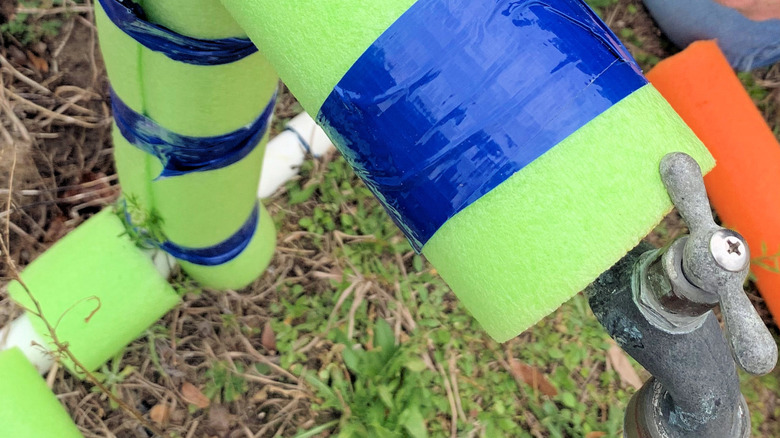
Given that the goal is to keep your faucets warm, you can actually insulate them with whatever you have handy. This includes towels, rags, T-shirts, and pretty much anything you can wrap around the faucet. You can even use small pieces of foam pool noodles, bubble wrap, even newspaper. Whatever you choose to place over the faucet, wrap it tightly around the faucet several times. Then, to protect against wind and rain, place a layer of sturdy plastic over the cloth wrappings. Finally, thoroughly wrap it in 3M duct tape, or other weatherproof tape, to give it a final layer or protection and to secure everything in place.
Free-standing faucets, such as those near gardens, as well as any faucets with exposed pipes running alongside of buildings, require an extra step. This is because any metal piping leading to the faucet needs to be insulated as well. So, as you go about winterizing your shed, garage, and garden, be sure to take note of any exposed pipes and faucets. When the time comes to shield them from freezing conditions, you will need to extend the insulation over every bit of exposed pipe, as well as the faucet. This is easily done with pool noodles, in lieu of foam pipe insulators. Otherwise, you can also wrap them in the same type of materials you used for the faucets (towels, newspaper, etc) — about an inch or more thick — and use tape or zip ties to secure the insulating material in place.