

Why Your Lawn Mower Blades Are Reverse Threaded And What It Means
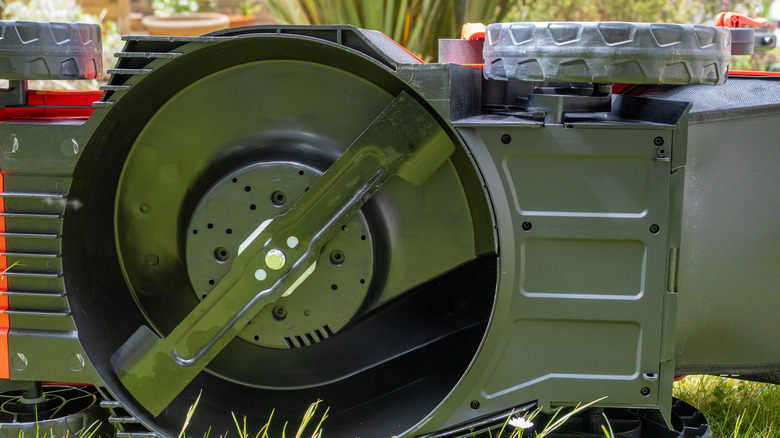
Many people aren't really interested in the mechanics of their lawn mower. They might change the oil using the best method or replace a spark plug, As long as the engine fires up when you pull the cord, you probably don't really think about your mower at all. But if you've ever hit a large rock and needed to replace your lawn mower blade, you probably noticed something peculiar about this component: The bolt holding the blade in place is reverse threaded.
Typically, bolts are threaded so they tighten when you turn them clockwise and loosen when you turn them counterclockwise (lefty loosey, righty tighty). Reverse threaded lawnmower bolts function in the opposite way. This feature is specific to the rotary mower because its blade is positioned horizontally and spins clockwise. So, to ensure the blade stays tight, the bolts go the other way.
Most people use rotary-style mowers nowadays, but there was a time when reel mowers were the go-to. These consist of a cylindrical reel of blades, each "twisted" like a Red Vines. The classic reel mowers don't even have combustion engines; instead, blades were propelled by the turning of the wheels and human effort. Commercially viable rotary mowers were introduced in the 1950s, but they didn't begin to take off in the U.S. until the 1970s and '80s. Their current market dominance can be attributed to low-maintenance design, ease of use, and ability to handle various grass types and lengths. Knowing what to expect when you need to change a mower blade, after you've taken this important safety step, is why it's worth understanding that reverse-threaded bolt.
Reverse threading helps make rotary blades safer

Reverse threading is used on rotary blades for safety reasons. Since the blade spins clockwise, the threads need to be reversed to prevent the thrust of the blade from loosening the bolt. One important caveat though: While most rotary blades are reverse threaded, it's not the case for all of them. That's why it's important to check before removing the blade, because you don't want to accidentally overtighten it. The owner's manual should tell you that information.
People typically remove lawn mower blades only so they can sharpen or replace them, unless you've decided to sharpen your mower blades without removing them. If you're seeking a sign that you need to sharpen your lawn mower blade, look for uneven or "torn" grass following a mow. But it's not just the grass that suffers: A badly nicked blade can strain the engine and burn fuel at a faster rate. The blade also won't be balanced, which can damage the spindles that hold the mower blade itself. If you decide tackle the job yourself, oversharpening is a common lawn mower mistake you should avoid.
Removing the blade is pretty simple. First, make sure that the blade has stopped spinning, then drain the gas and remove the batteries or spark plug. After that, turn the mower on its side with the air filter facing up. Next, you should use a torque wrench to unscrew the bolt. This is where you'll want to be certain you're unscrewing a reverse-threaded bolt or not. This basic knowledge can save you time, frustration, and possibly your lawn mower. If you're still having trouble turning it, use a little WD-40 to loosen it up. Then it's just the trick of doing everything in reverse, including the bolt!