

Why You Shouldn't Ignore Your Dull Lawn Mower Blades

We may receive a commission on purchases made from links.
Regular lawn mower maintenance is necessary to ensure you get a clean cut at just the right height. It is also a simple way to extend the life of your lawn mower. Part of that maintenance routine is sharpening your blades. Conversely, if your blades are dull, they can damage not only the grass, but also your equipment. This is precisely why you shouldn't ignore your dull lawn mower blades.
Mowing with dull blades tears the grass as opposed to cutting it. This stresses the grass and takes longer to heal than a clean cut. In turn, that makes it all the more likely disease or insects can attack your lawn. Dull blades also have a tendency to cut grass unevenly and can even scalp parts of your lawn and create brown spots.
In addition to the immediate damage it can cause your lawn, a dull blade can inflict injury on your lawn machine. This is because a dull blade makes the mower work harder, which can cause the engine to overheat. Over the long-term, the added stress will lead to more repairs and shortened life span of your mower. Furthermore, dull blades can cause excessive vibration and wobble, which can strain and stress other part of the mower, including spindles, engine, and bearings.
What to do when your mower blade dulls
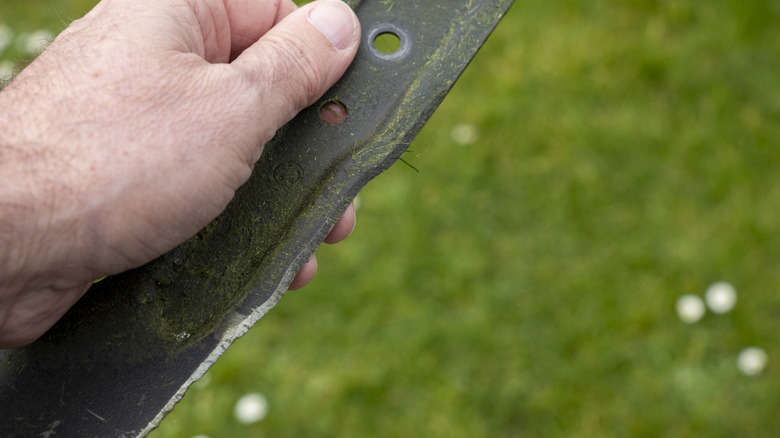
If you begin to see signs that it's time to sharpen your mower blade, take action immediately. These include the aforementioned issues – ragged or unevenly cut grass, excessive vibration, and/or your mower struggling to cut through grass. Even if you don't see any of these signs, you should sharpen your mower blade at least once per every 25 or so hours of use. At that point, gather all the tools necessary to sharpen your blades. You can use a bench grinder, angle grinder, or hand file. If you are not using a bench grinder, you should also have a bench vise, like the Yost LV-4, to hold the blade in place. You will also need a socket or wrench to remove the blade.
Next, disconnect the spark plug to prevent accidental starting of the mower, then remove the blade. Clean it with a stiff-bristled brush and inspect it for damage. If it is cracked or bent, just purchase a replacement blade. Additionally, if it has been sharpened repeatedly and the metal has become thin, it should be replaced.
Sharpening is a matter of grinding the cutting edge along the established angle. If using a bench grinder, hold the blade with gloved hands and pass the front of the cutting edge across the grinding wheel. If using either a hand file or angle grinder, clamp the blade in the vise, then push the file or move the grinder in one direction over the cutting edge. Repeat until the blade is slightly sharp. Be sure not to over-sharpen the blade, which can lead to premature dulling and other damage.