

The First Aid Kit Essential That'll Help Protect Your Younger Trees From Frost
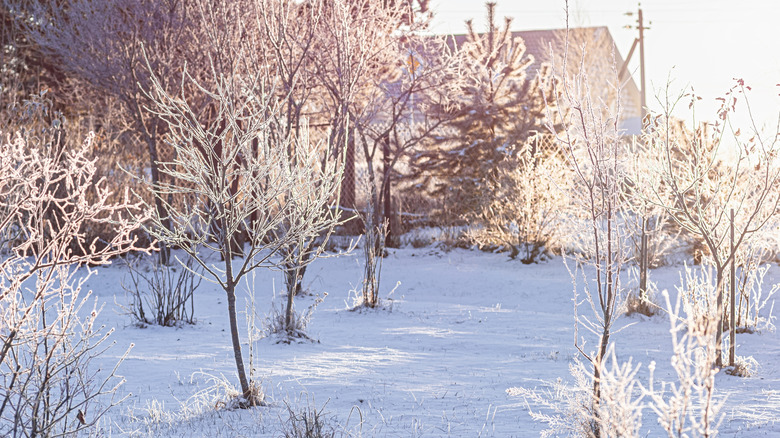
Young trees need a little extra TLC to stay healthy and protected from their environment, especially as temperatures drop below freezing. In the first few years after its planting, a tree really hasn't had a very long time to develop strong roots or thick bark. Fruit trees are particularly susceptible to damage from the frosty freezing weather during their first few years due to their thin bark, so any extra help you give them means a better chance of them thriving as they grow. An opaque wrap such as tree wrap or an Ace elastic bandage protects them from sun and frost damage during their first 4 years or so, and is one way to protect your trees and other plants from snow damage. Think of it as a sweater for new trees.
That thin, young bark is more susceptible to damage such as frost cracks,caused by wide temperature swings from day to night. Similarly, it can also suffer from sunscald when the warmth of the sun brings some of the tree's tissue out of dormancy, only for it to face the shock of freezing weather again at night, killing tender tissue beneath the bark, and causing large sunken areas on the tree. And of course any stress on the trunk can stress those early buds, affecting the fruit you get the following year.
Bandages and other methods will get your trees through winter.
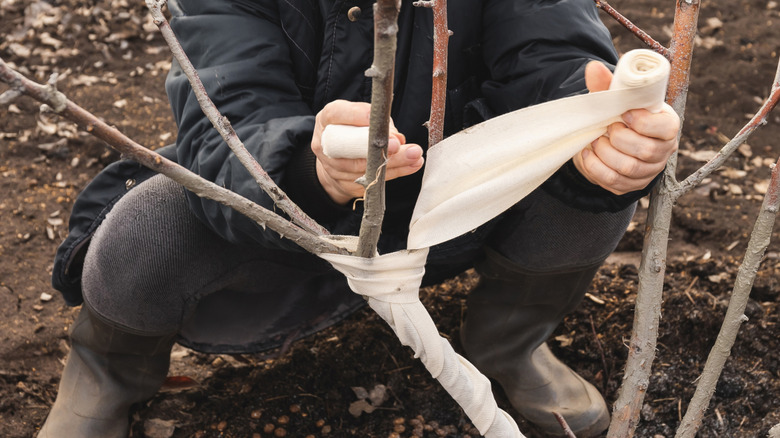
To use an elastic bandage on a young tree, wrap the tree starting at ground level, overlapping the previous bandage layer about an inch with each pass. Wrap all the way to the lowest branches. You can keep the bandage in place with garden twine. The beauty of Ace elastic bandages is that you probably already have some (used, washed bandages are fine), they stretch and wrap around unusual surfaces, and cling to themselves. They're also breathable, where something like plastic wrap isn't. If you prefer, pick up a dedicated product like Dalen protective tree wrap.
That said, you can also use burlap or strips of cloth as an affordable alternative. Wrap it in much the same manner, using twine or duct tape to secure it. Another option is to put 3 or 4 stakes a few inches out from and around the tree, then wrap the those with the burlap to create, essentially, a cloth fence that may also deter deer from nibbling. If deer are a problem, this simple installation protects your trees this winter.
Another way to protect the trees in your yard from frost is using what's called a frost cloth. This is a woven material that lets light and air through, but keeps the tree itself warmer than it would be without it. Drape it over a young tree like a blanket during the day when there's still some warmth on the ground, then use garden staples or heavy rocks to keep it in place, or tie it tight around the base of the tree's trunk. The goal is a tent-like structure that creates a warmth dome over the tree. You don't want any openings allowing cold air to come in.