

A Colorful Annual That'll Help Protect Your Garden Soil During The Winter Months
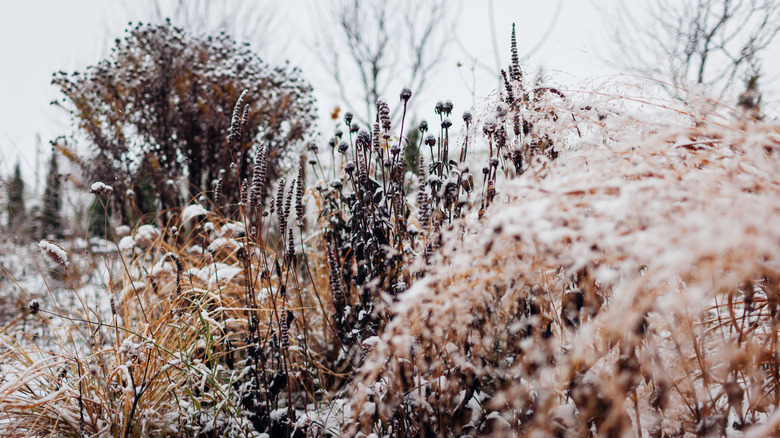
Your garden soil is a valuable commodity. You've invested time into its development, learning how to boost it with mulch and nutrients to help your vegetables and flowers grow to their fullest potential. So, if you live in an area that sees harsh winters, you are going to want to utilize cover crops to keep that soil healthy during the long freeze. But what grows fast enough after harvest, when the chill of autumn kicks in? We'll tell you: crimson clover.
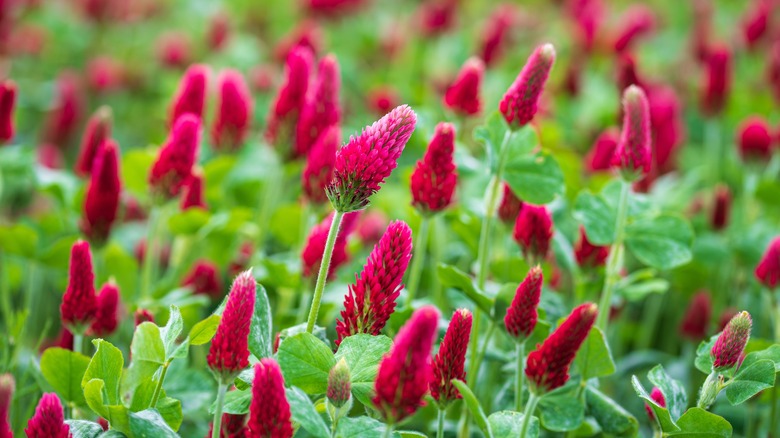
Crimson clover (Trifolium incarnatum) is a legume that makes for a wonderfully colorful annual. It will also protect your prized garden soil through the winter months. It can be sown in the cooler weather of fall, establishing itself in your garden before the harsh winter hits. Crimson clover also acts as a nitrogen fixer, meaning it will give an extra boost to any soil that may be lacking this vital nutrient.
Crimson clover is true to its name, too, in that it blooms with small, bright crimson flowers in the spring. This is hugely attractive to pollinators, especially the butterflies you want in your garden and the all-important honey bee. Yet, while crimson clover can be incredibly beneficial to your yard in a number of different ways, it needs to be planted and used correctly in order to work at its fullest.
How to plant and manage crimson clover
Crimson clover will do well in USDA hardiness zones 2 to 10, and you can seed it as a cover crop in July, August, or September. The recommended amount of seed for proper coverage is around 15 to 20 pounds per acre; crimson clover works well when sown across large areas, such as vegetable beds or fruit orchards.
As a living cover, crimson clover can suppress weed growth in between rotations of garden plots. You can even sow it into your raised beds to help keep that soil fixed with nitrogen over the winter. Then, when you need to remove it for planting, you can mow and suppress the clover with landscaping fabric or paper — or, follow author and homestead influencer Justin Rhodes' example by letting your chickens eat and scratch their way through the clover to get the beds prepared for spring planting.
Overall, crimson clover is an excellent option to sow into your garden to help protect it. It works well between corn and soybean rotations, as well as with other annual vegetables. For use as an annual, it will need to be reseeded when you use it in your next bed. However, if you intend on just using it as a living cover in an orchard or larger space, it will reseed itself and continue to grow as a perennial.