

What It Means When Your Lawn Mower Sounds Clogged (& How To Fix It)

On a normal day, running your lawn mower is as simple as starting your car and driving to work. Of course, as time goes on, and we use our mowers, the machines begin to break down and exhibit various common issues. Some may be enough to warrant calling in a professional, or signs it's time to replace the mower entirely. Other times, it allows us to get our hands greasy. If your lawn mower has been surging lately, and making a clogged, almost cough-like noise, we've got a quick diagnosis and fix for you. The number-one culprit for problems of this variety is the carburetor, which is essential to mixing fuel with air as you mow the yard. When the carburetor malfunctions, it slows acceleration, decreases fuel efficiency, and sputters as you push the machine, creating that clogged sound.
The carburetor is connected to a number of systems in the lawn mower, so untreated problems can lead to a variety of other issues. While it may sound daunting to tune up your carburetor at home, it's actually much easier than you might think. Most of these issues can be solved with some basic cleaning and maintenance of the air filter and carburetor, a few minor part replacements, and a basic functional knowledge of your machine. In order to know exactly what to look for, be sure to read ahead, as we outline most of the common issues and quick fixes for a sputtering lawn mower.
Diagnosing common carburetor problems

One of the most common issues in lawn mowers that can lead to a sputtering noise is a set of clogged fuel jets. The jets, which look similar to a large threaded screw with a few holes in the sides, are responsible for regulating fuel flow into the carburetor. From there, the carburetor mixes the fuel with air, in order to provide a safe, functional ratio into the engine. When these jets become clogged, the carburetor loses fuel, and allows an untenable amount of air to cycle through the machine.
Another frequent issue that plagues lawn mowers is a blocked air filter. Much like the fuel jets, air filters regulate the amount of air which enters the engine. As time goes on, these filters can become filled with dirt, gunk, and other lawn detritus that manages to permeate the thick outer shell of the machine. An imbalance in fuel or air intake are the main culprit when it comes to carburetor issues, so these are the best places to start. Luckily, the fuel jets and air filters are almost always located in easy-to-reach places on the mower, offering quick access to a DIY craftsman.
How to fix common lawn mower problems at home
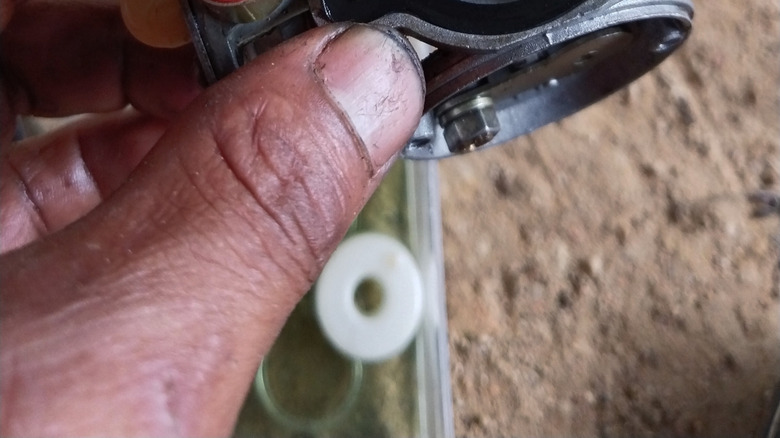
Once you've diagnosed your sputtering sound, carefully prepare your lawn mower before you work on it. This includes emptying the fuel tank, removing the lawn mower blades (as if you were going to sharpen them), removing the spark plugs, or otherwise prepping the machine as per the manufacturer's specifications. Consult your owner's manual for the specifics on where your carburetor is located, though it really shouldn't be hard to find. Pop off the outer shell of the lawn mower, and disassemble the carburetor (you may need a combination wrench and screwdriver). From there, you should be able to clean out the fuel jets using a wire brush and some WD-40. If they doesn't seem to be particularly dirty, check out the air filter, and consider replacing it with a fresh one.
If your air filter, fuel jets, and carburetor all look clean as a whistle, try double-checking your gaskets to ensure that there are no cracked or damaged seals. From there, put everything back together again and fill the mower up with a bit of fuel. Don't turn the machine on immediately after filling it, as the gas will need a moment to cycle through the bowl. If your machine has a primer bulb, be sure to press it a few times just to be sure that the fuel is flowing, then give it a hard start and see if the noise persists. If you have trouble starting the mower up, or the problem continues, you may need to throw up your hands and call in a professional. Even still, you can do so knowing that you knocked out some of the most likely culprits, and at least gave the internals a good cleaning.