

Why You Should Think Twice Before Using Cardboard Under Your Gravel Landscaping
We may receive a commission on purchases made from links.
If you spend a lot of time in the garden, you've likely read your fair share of tips, tricks, and life hacks online. Some guides, like those that help eliminate the infamous couch grass from taking over your yard or garden, recommend employing sheet cardboard, thanks to its biodegradable properties, and weed-suffocating abilities. While cardboard can certainly be a godsend when it comes to snuffing out weeds, it's not a one-size-fits-all solution. In fact, there are many instances where using it can create major problems down the line. One of the key times to avoid utilizing cardboard is when you're putting down gravel landscaping, in order to beautify a walkway, garden, or lawn boundary. As most advanced landscapers will tell you, gravel requires a good deal of maintenance to remain fresh, clean, and weed free. The cardboard box hack, while helpful in the short term, simply doesn't offer the level of support needed, as it naturally breaks down, for long-term gravel maintenance.
While cardboard can work very well in other parts of the garden, if you're looking to lay down some gravel this year, you'll want to reconsider that as the under layer. Instead, consider landscape fabric or other solutions for a weed-free and lower-maintenance gravel walkway.
Decomposing cardboard makes an unstable base for gravel
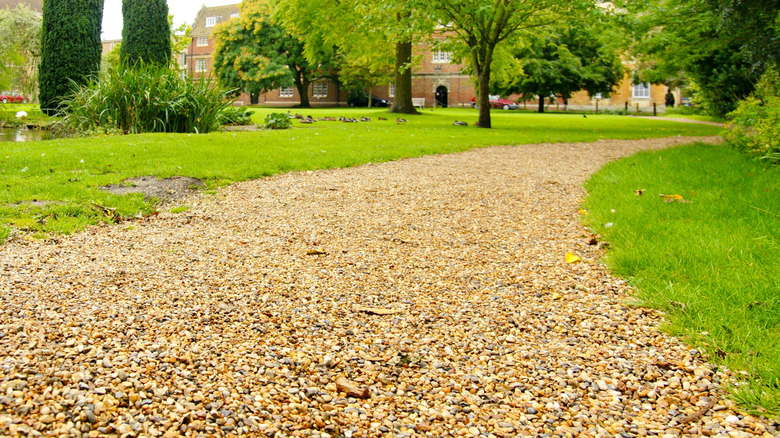
While cardboard has been touted as a premiere weed killer, the material's second major gardening trait makes it untenable in a gravel adjacent capacity. One of the key reasons why cardboard is recommended for gardeners is because it is biodegradable. Over time, cardboard effectively disappears into the earth, allowing plants and bugs to feast on its organic properties. This is a major plus in a garden bed, which needs room for large root systems to take hold, but doesn't quite work for a long-term ground cover like gravel. Placing gravel above a cardboard base could cause pebbles to destabilize and compact with time, eventually shifting and eroding into the soil. Gravel needs a base to both control weed growth and prevent the sub-base layer or gravel layer from mixing into and compacting with the soil beneath. Essentially because cardboard will decompose, unevenly, within a few months, it's as if you never set down a base layer at all.
For this reason, most professional landscapers will tell you to utilize landscape fabric when combating weeds, especially when placing gravel. This might still require some hands-on maintenance over the course of several years, but it will definitely provide more long-term stability than cardboard, and it won't decompose back into the soil. Landscape fabric — like the Vevor heavy duty weed fabric barrier — typically costs more than a standard cardboard box, but will save you time and money in the long run as it keeps the gravel stable and separate from soil and weeds underneath.
Cardboard works great elsewhere in the garden
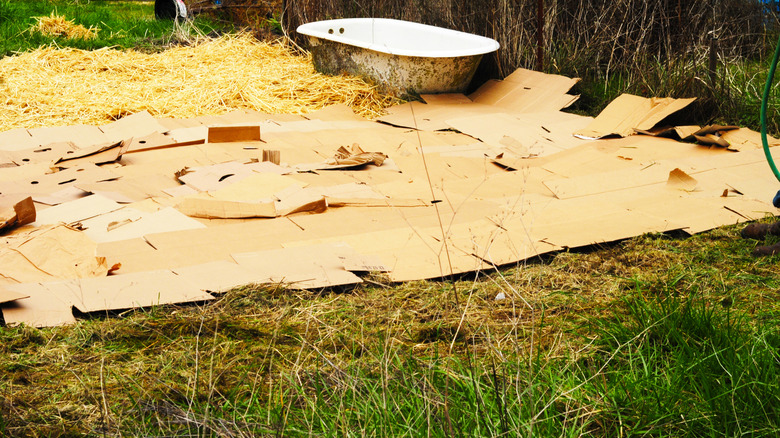
There are definitely garden situations where cardboard works as a weed-preventing base. Particularly when you're laying down biodegradable mulch in your yard or garden. The layer of cardboard helps prevent any pesky plants from pushing through and can kill of unwanted grasses also if you're upgrading a grass-free garden space. There are also many reasons why you should add cardboard to your raised garden beds, for instance. Unlike plastic sheeting or synthetic weed mats, cardboard contains organic matter that worms love and can add to the soil content. Be aware there is the risk of chemical treatments — particularly with corrugated cardboard — leaching into your soil. Also cardboard itself doesn't really add significant nutrients, and layered too thickly can inhibit oxygen and moisture movement through the soil.
While cardboard works under an organic mulch, you definitely don't want it under gravel, whether it's a trafficked area or simply decorative. Another way to think about this is picturing what happens when it rains. Gravel doesn't trap moisture but rather lets it drain right through. So now you've got a seriously soggy underneath a layer you're hoping will stay put. There's literally no benefit to breaking up those boxes when you're laying down gravel.