

Why You Should Reconsider Trying Premium Gas In Your Lawn Mower
We may receive a commission on purchases made from links.
Once you have the perfect mower for your yard, it only makes sense that you'll want to do whatever you can to maintain peak performance of your new lawn machine. You'll also likely be looking for ways to extend the life of your mower. Choosing the best fuel for your lawn mower can help with both of those things. With that in mind, the temptation might be to only buy premium gas. However, given the higher cost and low impact on performance, you should reconsider trying premium gas in your lawn mower.
While you won't harm your mower by using premium gas, you likely won't help it either. To understand why that is, you must first understand the differences between different grades of gasoline. These grades, or levels, are based on the octane of the gas. Typically, in the U.S., there are three choices, with 87 octane being the lowest. Mid-grade gas is 89 or 90 octane, while premium is anything between 91 and 94 octane.
Octane is basically the measurement of how much pressure it takes to make gasoline combust. Since smaller engines, like those found in lawn mowers, don't create much pressure, they are typically designed to run on 87 octane fuel. As a result, using gas with higher octane won't result in any better performance from your mower. Given the added cost and lack of performance boost, premium gas isn't likely to be worth it for standard mower engines.
Ethanol content does make a difference for lawn mower gas
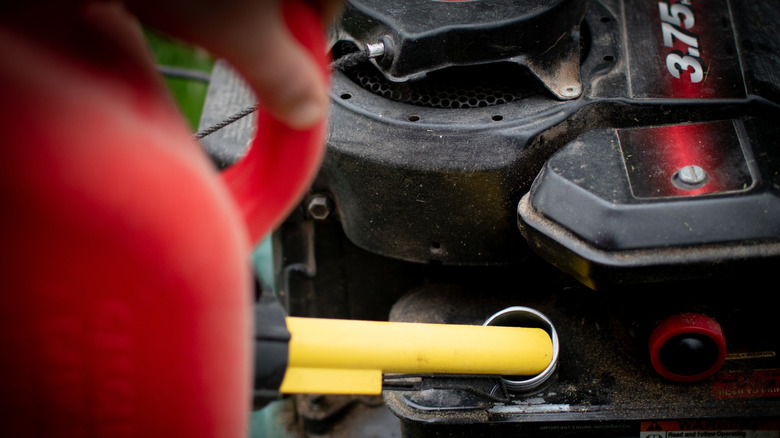
While the octane level number really doesn't matter much for lawn mowers, assuming you don't go below the recommended 87, there is another number you'll see at the gas pump that can have a huge impact on your mower's performance. That number is the percentage of ethanol which the gas contains. Ethanol is essentially a high-octane grain alcohol that is often mixed with gasoline. Most manufacturers of lawn mower motors recommend never using fuel with any more than 10 percent ethanol and advise using ethanol-free gasoline if at all possible.
Gasoline containing ethanol can actually harm small engines in a couple of ways. For one, because ethanol has a higher oxygen content, it burns hotter and leaner than pure gasoline. This excessive heat can result in damage to a variety of small engine parts. Secondly, ethanol has a tendency to separate from gas and attract moisture. This can happen rather quickly and is definitely a problem if the fuel is stored for a long period, whether that be in a gas can or in the mower's gas tank. Water in the fuel can not only negatively impact the mower's performance, but it can also cause internal rust and corrosion within the engine. As a result, it is always best to use a fuel stabilizer like Sta-Bil whenever you are using or storing gas that contains ethanol.