

A Simple Swap That'll Keep Ants Out Of Your Bird Feeder
We may receive a commission on purchases made from links.
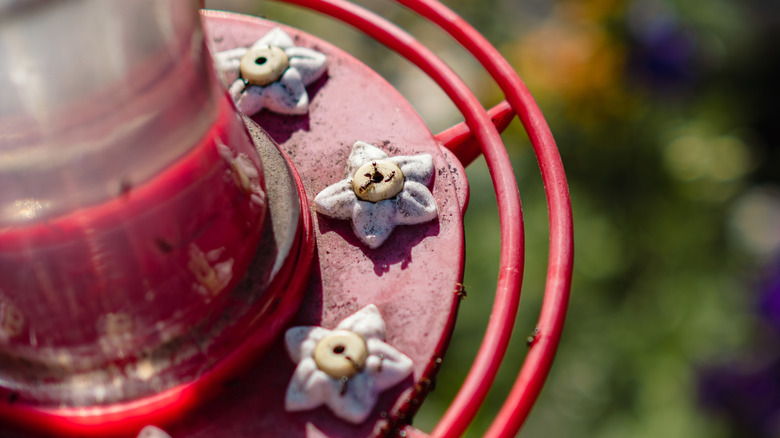
Imagine walking out on your porch and watching as hummingbirds dart across your yard. Adding a hummingbird feeder in the right spot can help turn this dream into a reality. However, if ants swarm your hummingbird feeders before the colorful birds themselves can make an appearance, you'll find that not only do ants steal the sugary nectar that draws hummingbirds near but they can even contaminate it. Both of these factors combined can deter hummingbirds from using your feeder. But don't give up your dreams of a hummingbird haven just yet — there are solutions. Without buying fancy feeders and barriers, there's an easy swap you can make to outsmart the ants raiding your bird feeder: Change the hanging string or chain out for something much harder for ants to climb down.
If your hummingbird feeder hangs down from a hook, you may notice that ants help themselves to the nectar by climbing up and down the string your feeder is attached to. Ants have hooked claws at the end of their feet that, although small, give them a powerful boost when climbing. As a result, defying gravity is no problem at all for them. However, by switching to a smaller, thinner option, you'll find that even their specialized feet can't get a grip. And that's where this clever fishing line hack comes into play.
Fishing line offers both strength and durability, making it a great choice to support a feeder heavy with nectar. However, because it offers these essential qualities without the need of a thicker string, you can also use it to keep ants from reaching your feeder.
Thin, slick lines make ant approaches tough
If you want to recreate this smart project yourself, simply remove the current hanger on your hummingbird feeder, whether that's a hook, chain, or rope. Then choose the right fishing line for this task. You want to pick an option that can stand up to the elements while avoiding line that's too thick (hence easier to climb). Because you won't be fighting mahi on the coast, you can opt for a lower line weight for this project, meaning that everything from monofilament to fluorocarbon can be used. You may want to avoid braided line here: Its knot strength is poor compared to monofilament and fluorocarbon, and by definition, the woven braiding provides tiny ridges and footholds for diligent ants.
Once you've picked the right fishing line for your hummingbird feeder, all that's left is to hang it in a spot that will catch the eye of hummingbirds. While fishing line is meant to be a deterrent for ants, you may still find that the occasional insect makes their way to the sugar-filled ports of your feeder. As a result, you may want to pair this hack with other useful strategies, such as using a saucer-shaped hummingbird feeder that most insects can't eat from. Or invest in an ant moat, like the Sewanta ant guard, that basically creates a watery grave barrier between the suspension hook and feeder.
Even with your ant problem squared away, it's important to maintain a regular hummingbird feeder cleaning routine. Feeders that are dirty, or nectar that's gone sour, can be harmful to your feathered friends' health, so you want to make sure you're always offering fresh nectar.