

Easily Test Your Garden Soil With The Help Of An Old Mason Jar
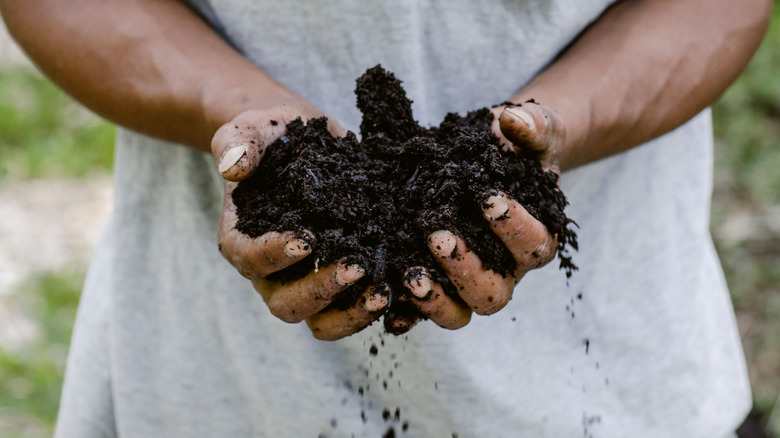
If you've ever wondered whether your garden soil is suitable for some of the vegetables you want to plant, a soil test is a good way to find out. There's a lot more going on with soil than just its pH level, which determines how acidic it is. All soil can be classified as sandy, loamy, silty, clay, peaty, or chalky, and planting your crops and flowers in their ideal type of soil will help them thrive. Loamy soil is best for your garden, as it has a healthy ratio of sand, silt, and clay, which means it retains sufficient moisture, it drains adequately, and it has nutrients that most garden plants need.
You could send soil samples off to a lab to have them professionally tested, but it's just as easy — and potentially a lot more fun — to do it yourself. A soil test requires digging down about 6 inches to get to the depth of plant roots in relatively undisturbed soil, then doing a simple sediment test with a repurposed Mason jar, water, and dish soap. This DIY Mason jar soil test shows how much clay, sand, and silt are present so you can tell which type of soil is in your garden. The same test is also helpful before any construction projects in your yard, such as building a gazebo or a DIY shed from Costco.
How to do a Mason jar soil test
Dig down to 6 inches in any area you wish to test, then scoop soil into a small bucket or a plastic sheet on the ground. Break up any chunks and discard twigs, rocks, and any other debris you come across. Repurpose a clean Mason jar such as an 8- or 16-ounce size; the 16-ounce one requires more dirt, but it will be easier to read. Transfer some of the broken-down soil in to the jar, filling it one-third to halfway. Add clean water to the jar, leaving a bit of a gap at the top for air, then add a squirt of dish soap. The dish soap helps separate the different soil components.
Tighten the lid on the jar, then shake vigorously for a couple minutes until everything looks well-blended. Set the jar down and wait 24 hours or more before touching it again. The sediment in the jar is in layers at this stage — the bottom layer is sand, silt sits above the sand, and clay is the top debris layer.
Measure the full thickness of all the sediment by holding a ruler next to the jar and write that number down. Measure the thickness of the sand layer, then the silt layer, and the clay layer, writing each number down. Convert all the numbers to decimals; for instance, if the sand is one-quarter-inch thick, the decimal equivalent is .25 inches. Divide the number of any given layer by the total depth of all layers, then multiply that by 100 to get a percentage. For instance, divide the .25-inch sand layer by a 2-inch sediment total to get .125, then multiply that by 100 to get 12.5, which means 12.5 percent.
Do this for all the layers; adding the percentages together should get a number near 100. The ideal soil is about 40 percent each of sand and silt and 20 percent clay. To assess the soil's textural composition, compare the percentages against a soil triangle, such as the one on this page from the University of Florida, which also includes instructions. And once you're done, repurpose your mason jar to make a stylish bird feeder.