

The Best Method For Changing Your Lawn Mower Oil
We may receive a commission on purchases made from links.
When it comes time to buy a new lawn mower, choosing the right model for your size lawn and type of grass is key. Just making the correct selection does not guarantee good grass cutting performance for all infinity. Lawn mowers require regular maintenance: Keeping your mower cutting smoothly requires tasks such as picking a method to sharpen your mower blades and cleaning and maintaining the air filter. One of the most critical maintenance tasks — albeit one of the more commonly overlooked — is changing the engine oil. It may sound like a complicated job, but the best method for changing your lawn mower oil is actually quite simple.
Most people realize they need regular oil changes in their car, many are either unaware or ignore the fact their lawn mower needs that same maintenance. Regularly changing the oil not only helps your mower continue to function as it should, it will help it last longer. This applies to any gas lawn mower — riding, zero turn, push or self-propelled. In other words, unless you have an electric lawn mower, you will need to change the oil. The basic process is the same for each, although there are some additional steps and tools needed for certain models.
While car engine oil change recommendations are in miles — every 5,000 miles, for instance — lawn mower engines oil changes are based on the hours run. How often that is varies by model. However, every machine needs its oil changed at least once a year, with subsequent changes every 50 hours of use being somewhat standard, although some models will call for less or more hours between changes. So, always consult the owner's manual or look up the pertinent information for your mower model online to ensure you are making timely oil changes.
How to change the oil in push and self-propelled mowers
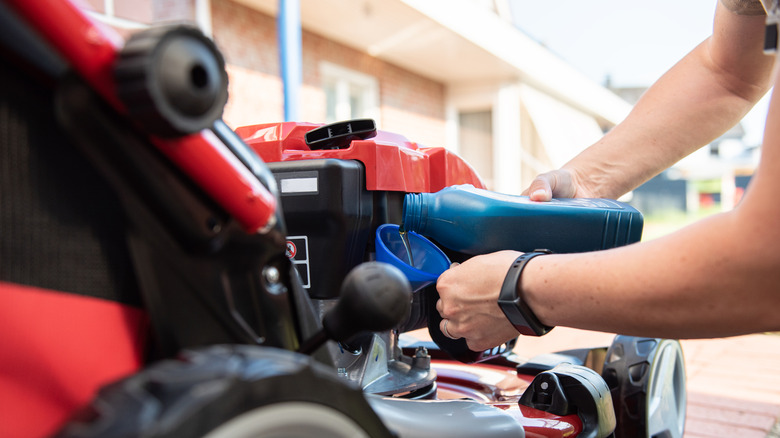
Push mowers, along with self-propelled (also called walk-behind) mowers, tend to be much simpler in terms of maintenance and oil changes. However, not every model is the same. Nor do they all have the same components. Before you begin, assess what your mower does or doesn't have so you can be properly prepared. Primarily, you need to know if it has an oil drain plug and oil filter, as not every model of these smaller engines does.
Once that has been determined, gather the necessary tools and supplies. For the most basic models, this includes new oil, a container to collect the old oil, and a rag or towel. For models with a drain plug and/or filter, you will also need a new filter, along with a wrench or pliers, and a filter wrench. Then, start the mower and let it run about 15 minutes before shutting it off and removing the spark plug wire.
For mowers without drain plugs, open the oil reservoir cap and tilt the mower over the collection pan to drain the oil. It is best to drain the gas or remove the gas tank before doing so to limit spills. You can also use an extractor, such as the Duratech fluid extractor, to remove the oil without tilting mower or draining gas. If your model has a drain plug, tilt the mower on its rear wheels, prop the front wheels on a bench or blocks, place the drain pan under the plug, then remove the plug. Once the oil is drained, remove and replace the filter if your mower has one. Next, replace the drain plug, place the mower on a level surface, and refill the oil reservoir. Then, replace reservoir cap and spark plug wire.
How to change the oil in riding mowers
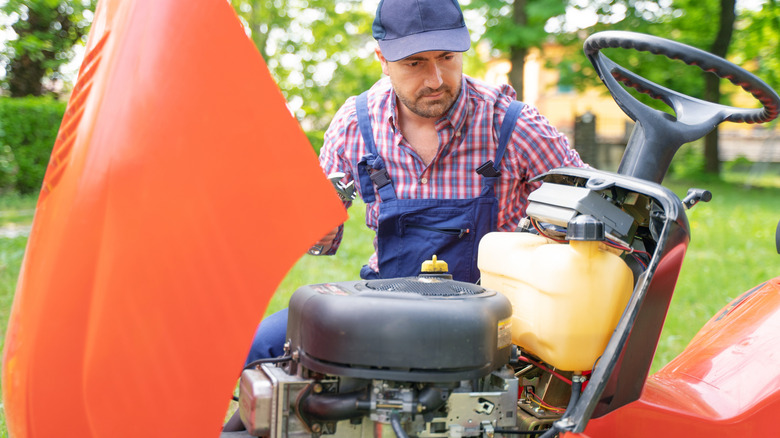
Changing the oil on a riding mower isn't all that much different from doing so on a push mower. The biggest difference is riding mowers have larger engines and almost all are equipped with drain plugs and filters. Before beginning, make sure you have plenty of new oil, a new oil filter, oil filter wrench, collection pan, funnel, and wrench or pliers. Once you have all the necessary supplies, run your mower for about 15 minutes to warm up the engine and engine oil.
At that point, make sure your mower is on a solid, level surface with plenty of room to work. Turn the engine off, remove the key, and engage the parking brake. Then, remove the spark plug wire and wipe away any dirt or debris that is near the oil fill cap, drain plug, and filter. This is done to make sure nothing contaminates the fresh oil.
Once that is done, position a collection pan under the drain plug, remove the dip stick/fill cap first, then the oil drain plug. Wait until all the old oil has drained, replace the drain plug, then remove and replace the oil filter. Next, refill with the prescribed amount of fresh oil, wipe all the surfaces around the drain plug and filter, and monitor for a few minutes, looking for any leaks. Finally, double-check the oil level with the dipstick and replace the spark plug wire.