

Why You May Want To Reconsider Using Cinder Blocks For Your Raised Garden Bed

We may receive a commission on purchases made from links.
Many gardeners prefer raised beds to in-ground gardens since their soil warms up fast and tends to drain water well. Cinder blocks are a popular choice for this style of garden because they're inexpensive and durable. You may even have some on hand if you've built a retaining wall recently. Though there are several compelling reasons to use cinder blocks as the walls of your raised garden beds, make sure you're aware of the drawbacks as well. Their main shortcomings involve weight, porosity, and the tendency to leach lime and other materials into nearby soil.
Cinder blocks are often made of coal ash, cement, and water, and they have hollow centers. They're rarely used anymore for building homes because concrete blocks are better at bearing weight. However, cinder blocks are strong enough for most landscaping projects, including raised garden beds. In fact, they're so sturdy and weather resistant that they can last for up to 100 years in ideal conditions. Though cinder blocks aren't prone to rot like untreated wood is, they can warp and crumble due to their porosity.
If you're thinking of constructing a cinder-block raised bed, keep in mind that the blocks are heavy. They usually weigh 20 to 40 pounds apiece, so hauling them around is hard work. Plus, they're not very tall. To raise crops that are roots or tubers, you have to stack blocks to create a deep enough growing space. Stacking cinder blocks is even harder work since you have to lift them. For these reasons, some gardeners prefer to use building materials that don't weigh as much — for example, pressure-treated wood or weather-resistant galvanized metal.
Their porous nature can lead to several problems
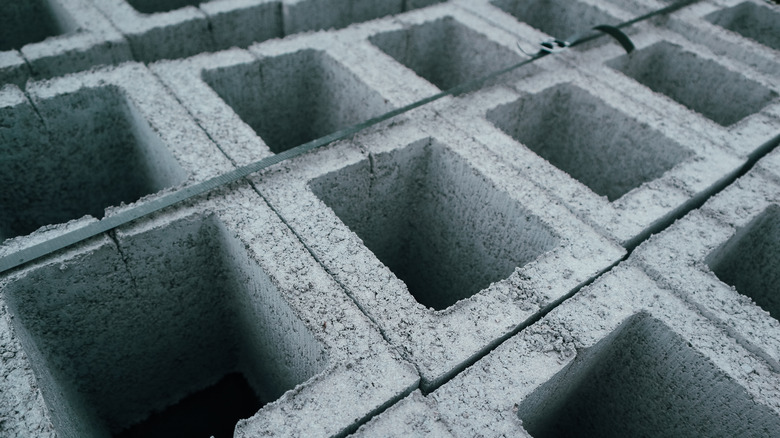
Since raised beds are essentially large containers, their soil tends to absorb and hold warmth as air temperatures rise. They also drain water so effectively that they don't experience the cooling effects as much as in-ground gardens, which can be an issue in the summer. Adding cinder blocks to the equation can be a problem because they also retain heat. Since cinder blocks' pores are small air pockets, they insulate the soil they surround. It's not uncommon for an area enclosed by these blocks to be several degrees warmer than the area outside of it. The pockets trap moisture, like a sponge, which absorbs even more heat. If the heat builds up too much, it can damage or even kill your plants, depending on what you've got growing. The likelihood of this happening is greatest in hot climates, but a prolonged heat wave in a cooler climate could also create problems.
Cinder blocks can also make your raised bed's moisture a bit tricky to regulate. Once again, this has to do with their pores, which soak up water. On the other hand, pores also promote air circulation, helping water from the raised bed evaporate quickly, but the results may be inconsistent. Since cinder blocks can't talk, it can be hard to tell where they're retaining water and where they're releasing it. This means you need to watch for signs of dehydration in your plants. If they are low on water, they're probably experiencing stress. This makes them vulnerable to growth problems as well as pests and diseases, which can cause even more stress, creating a vicious cycle.
They may add unwanted substances to your soil

Creating a soil mix that helps your raised-bed garden thrive takes effort. You won't want to compromise the healthy growing environment you've established by introducing contaminants or pH-altering substances. Unfortunately, cinder blocks are capable of adding both to your garden. For starters, they can release lime into soil, which raises pH levels. That might make your garden too alkaline for blueberries, azaleas, and other plants that need acidic conditions. Of course, for alkaline-friendly plants it can be a good thing, like adding egg shells to help your herb garden thrive. If you build a raised bed with cinder blocks, measure your soil's pH level regularly and adjust it if necessary. A product such as the GardenBag 2-in-1 soil test kit can help.
Lime isn't the only substance cinder blocks can secrete. When the blocks get too wet, they may leach heavy metals into your soil. Most of these contaminants come from coal ash, sometimes called fly ash, which can contain arsenic, cadmium, lead, mercury, selenium, or other materials that aren't safe to ingest. Some of these substances may hinder the health of your plants. Earthworms also absorb these contaminants. When other creatures eat them, the toxins can spread throughout their ecosystems.
Though the leaching potential of cinder blocks is concerning, the U.S. Environmental Protection Agency hasn't deemed it hazardous enough to require regulation. Furthermore, there's no guarantee that your cinder blocks contain toxin-filled coal ash (in fact, these days they generally don't, but you should ask when buying). The issue can also prevented by sealing the blocks or buying them sealed. All things considered, you may want to explore environment-friendly sealants and liners, as well as other budget-friendly ways to build raised garden beds.