

Not Wood Dust: The Overlooked Sign Carpenter Bees Are Lurking Around Your Home
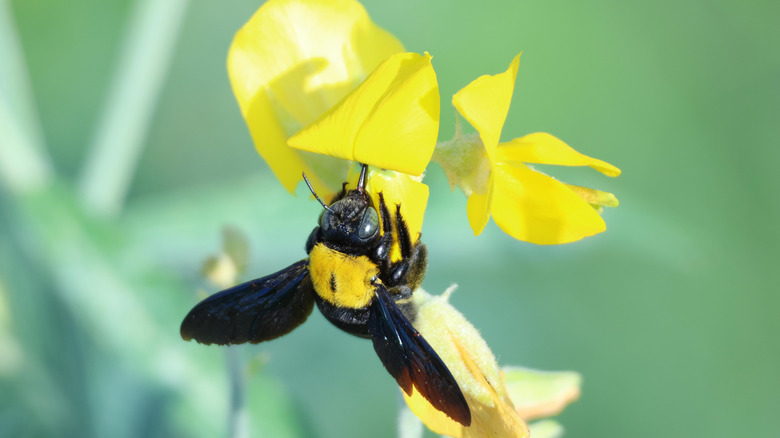
Carpenter bees are common across the entire United States. In fact, they are the most common indigenous bee genus (Xylocopa) in the U.S. These big buzzers are considered one of the most dangerous types of bees, not only for their stinging capabilities, but also because of the damage they do to wood structures, including decks, sheds, and houses. Typically, seeing perfectly cut circular holes and wood dust are what alerts homeowners that they have a carpenter bee issue. However, that's not the only visible sign: Yellowish, drip-like stains on the side of your house or other structures are an often overlooked sign that carpenter bees are at work.
Although they tunnel into boards to create their nests, carpenter bees are not eating the wood around your house. That is why wood dust often falls out of the holes in which they are digging — the queen forcibly pushes the sawdust out of her nest. Carpenter bees also excrete a sticky, yellowish waste. As this waste drips out of the hole and down a vertical surface, it often mixes with the wood dust the bee is ejecting from her nest. The result, called frass, is an acidic yellow-brown, coarse concoction that can stain wood and other surfaces. Often, this stain appears in a fan or funnel shape expanding from the burrow. If not properly taken care of early on, mold will grow and the stain blackens as a result. Not only is it unsightly, this moldy waste can discolor and damage wood, paint, and wood stain.
Dealing with carpenter bees and the stains they leave
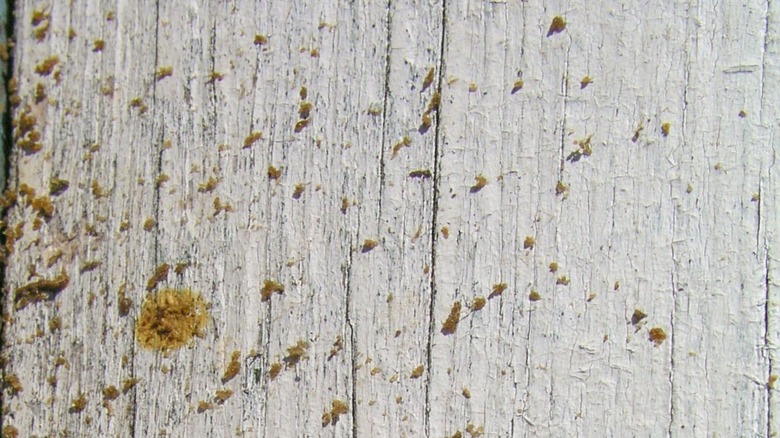
Sometimes, those perfectly circular entry holes made by carpenter bees aren't immediately visible, as they may be drilled into the underside of boards or tucked beneath eaves, overhangs, or window sills. When holes are obscured, it's the waste stains that become the most visible signs you have a bee problem. So it is important to be able to recognize these stains and correct the problem as soon as possible. If you do see fan-shaped, yellow-brown gunk, then cleaning, inspecting, repairing, eliminating, and preventing are the next steps.
Unfortunately, due to the acidic nature of these drippings, the damage is sometimes irreversible. While some people recommend using a pressure washer, this may cause even more damage when used incorrectly. Typically, presoaking the area or cleaning it after a heavy rain is helpful. Although this may make it a bit easier, you can still find yourself having to paint or stain over the area to hide the damage, even following a thorough cleaning. On the upside, a thick coat of paint is also a good way to keep carpenter bees from drilling into your deck and other wood surfaces. So, repainting can both hide the stain and help prevent further damage.
Of course, it's also necessary to deal with the bee that is already there, causing the issue in the first place. The best way to do this is by treating the tunnel inside the wood with pesticide, then plugging the entry hole. If the tunneling is extensive or the nest is well-established, it may be necessary to replace that section of wood. Cover any fresh wood in a thick coat of paint as well so as not to invite more carpenter bees in the future.