

What To Know Before Using Quikrete Gravel In Your Driveway
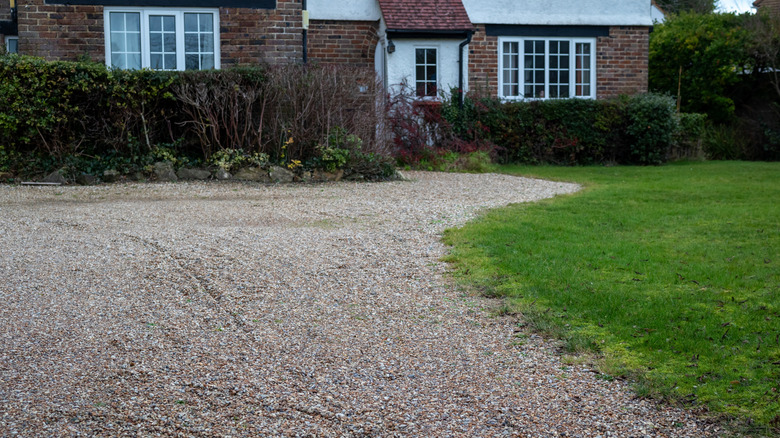
We may receive a commission on purchases made from links.
Quikrete is a readily recognizable name to most home improvement DIYers. The brand is best known for its fast-drying concrete, which is perfect for projects such as setting fence posts like a pro or adding botanical flair to your yard with DIY stepping stones. But Quikrete doesn't just sell concrete — it also has a line of gravel products. So, it's only natural that those familiar with the company's concrete may be tempted to grab several bags of Quikrete gravel to spread across their driveway. However, there are some things you need to know first.
To begin with, Quikrete sells a number of different gravel products. These include Quickrete all-purpose gravel, crushed stone, Hardscapes river pebbles, and more. Each of these products are sold in 50-pound bags. Essentially, the Quikrete line of gravel products is geared to target specific gravel landscape projects. To that end, some are suitable for driveway use while others are not. Additionally, some are suitable for a specific purpose within gravel driveway construction, but may not be the best choice for the entirety of the driveway.
Choosing the right Quikrete gravel for your driveway
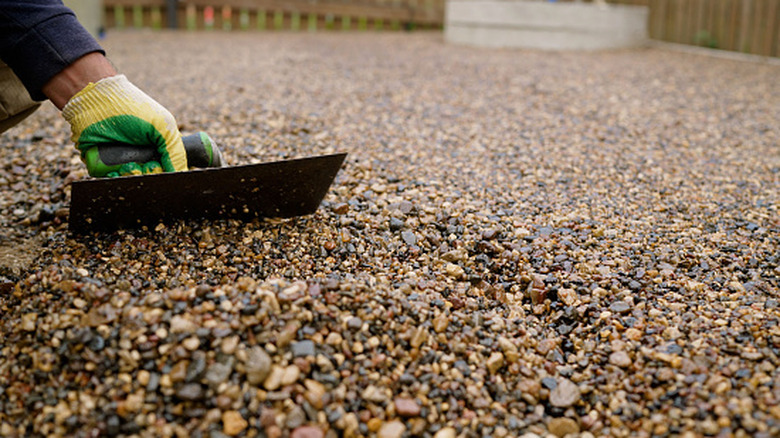
When it comes to picking the right Quikrete gravel product, the general rules for gravel driveway construction apply. The basic premise for creating a lasting driveway is to use a three-level method, with large, irregular stones for the base, smaller rocks and fines in the middle, and sorted, even gravel for the top or upper layer. With that in mind, the most important thing to do is look at the description of the product and not simply the name.
Following this three-tier system, the base layer should be comprised of stones an inch or two in size. So, it is really the middle and top layers where gravel comes into play. The industry standard for all-around driveway gravel is ¾-inch angular-edged (as opposed to round) rocks. This allows these rocks to interlock naturally, helping them stay in place when driven over. However, the best mid (or transition) layer should be a mix of crushed rock and fines to provide structure and drainage. So, Quikrete ¾-inch gravel is best used for the surface layer.
While the top layer might be comprised of ¾-inch gravel, some homeowners then top their driveway with an aesthetically pleasing veneer, that's often easier to walk on. For that purpose, gravel in the ⅜-inch range works well. If you are looking for such a top-dressing for your driveway, either the Quikrete all-purpose gravel or Hardscape river pebbles would be appropriate. In this situation, the choice will typically come down to the specific look you want, and your budget. Typically, river pebbles are more expensive of the two, selling for about $75 per bag, compared with about $33 per bag for all-purpose gravel.