

The Ancient Trick That Can Transform A Spider Plant Into Living Art
We may receive a commission on purchases made from links.
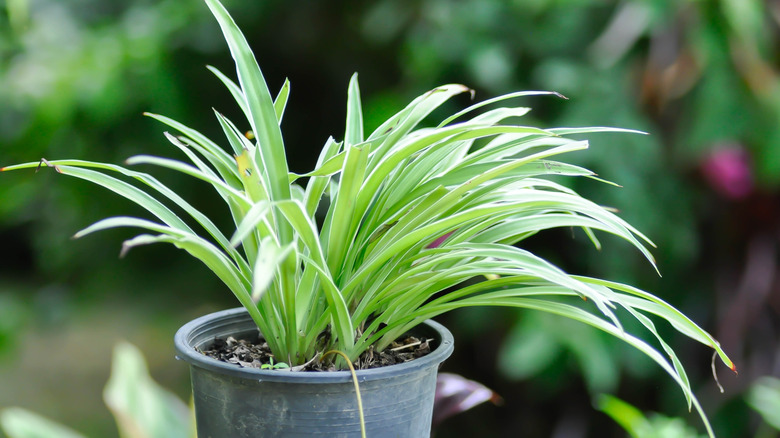
If you're interested in beautifying your patio, porch, or gazebo, you might consider a nice potted plant, such as chlorophytum comosum, AKA spider plant. These fuss-free plants are a favorite for beginning gardeners, thanks to their adaptability and resistance, low maintenance, and bright, verdant hue. Though spider plants are beloved in their standard potted form, many DIYers have taken to employing kokedama to reinvent how these houseplants are displayed. Kokedama is a centuries-old Japanese technique, roughly translating to "moss ball." The method replaces traditional pots with a compact sphere of soil wrapped in moisture-absorbing moss, creating a hanging display that feels equal parts plant care and living artwork.
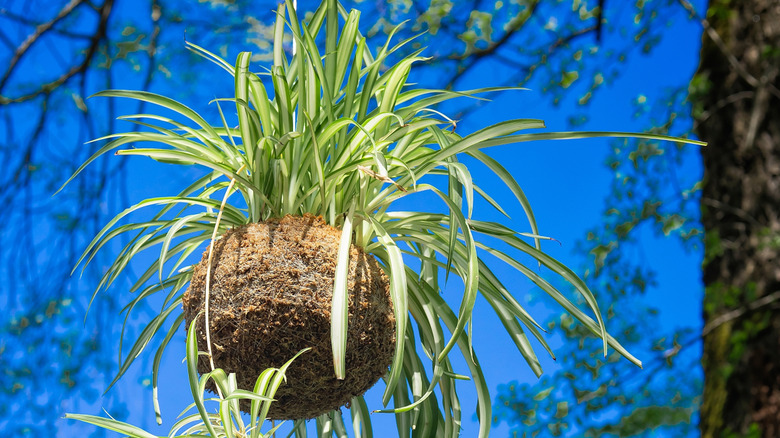
When transformed, the everyday spider plant takes on an entirely different personality, as a beautiful hanging decoration, whether suspended on its own or displayed among other cute hanging planters in outdoor seating areas. Part of the appeal of kokedama is that it combines gardening with DIY creativity. The process involves shaping soil around the plant's roots, securing it with moss and string, and creating a self-contained, planter-free orb that can be hung or displayed almost anywhere. Plus, spider plants are particularly well-suited for this technique thanks to their resilience and fast-growing root systems.
Since spider plants are traditionally indoor plants, you'll want to place your spider kokedama somewhere with plenty of shade, and dunk it in water once a week to maintain proper moisture. It's perfect for shaded balconies or beneath tree branches or the eaves of a gazebo. Hailing from western Africa, spider plants thrive in USDA zones 9 through 11, especially when they're brought indoors for the winter. With the right upkeep, some solid weather, and a bit of DIY ingenuity, you could easily display a row of stunning kokedama outside on your patio or balcony all summer long.
How to make your own kokedama at home
Though it may seem daunting, creating a kokedama at home is easier than you'd think. To begin, take your potted spider plant, remove it from the pot, and carefully extract the root systems out of the soil. Add fresh potting soil to a separate bowl and add a little water, kneading it into a firm ball. Split this soil ball in halves, reintroduce your plant, and form the soil in a taught ball around the root system. Be careful not to damage the roots during this process, but don't be afraid to add water and soil until the ball holds firm.
Once you've spherified the base of your plant, set it aside and prepare some sheet moss — like LuckyRunes Real Live hypnum moss — in a bowl of cold water. This will make the moss pliable, so that you can more easily apply it to the exterior of your soil ball. After squeezing out any excess water, wrap the moss around the soil, keeping the green side out, until you've got an attractive kokedama sphere. The moss should hold its shape on its own, but it's worth providing extra support by wrapping it in an elegant, overlapping pattern of twine.
@kristysketolifestyle How to make a Kokedama! I have been wanting to make one of these for awhile! I have one that I bought from a local greenhouse and love it. That one has a Pilea plant in it and hangs upright. I decided to make an upside down one with a spider plant. It turned out soooo cute!! I had some help from my oldest daughter. She recorded this video and re-wrapped my twine job. lol. ♥️♥️ 1. Remove soil from plant. 2. Put soil in a bowl and add water. 3. Mix soil and water to combine and then form a ball. 4. Break the ball in half and place roots of the plant between both sides. 5. Squeeze! 6. Soak sheet moss in water and then squeeze excess water out. 7. Lay moss out on work surface and place the ball in the middle. 8. Wrap moss around the ball and squeeze! 9. Wrap ball with twine. 10. Turn upside down and tie a piece of fishing wire onto it. 11. Hang and enjoy!! 12. Soak ball in water one time per week for 15 minutes. #plant #kokedama #plants #spiderplant #howto #diy #kristyslifestyle
By the time you're finished, the plant will more closely resemble a pineapple than a standard spider plant, though it will retain those unmistakable sprawling leaves. At this point, you're free to decorate with your kokedama as you please. String it up from your porch roof with fishing line, or give your patio a unique and personalized look by using kokedama as a dashing centerpiece atop a patio table or sidetable.