

Hummingbirds (And Other Birds) Can See These Colors That We Can't
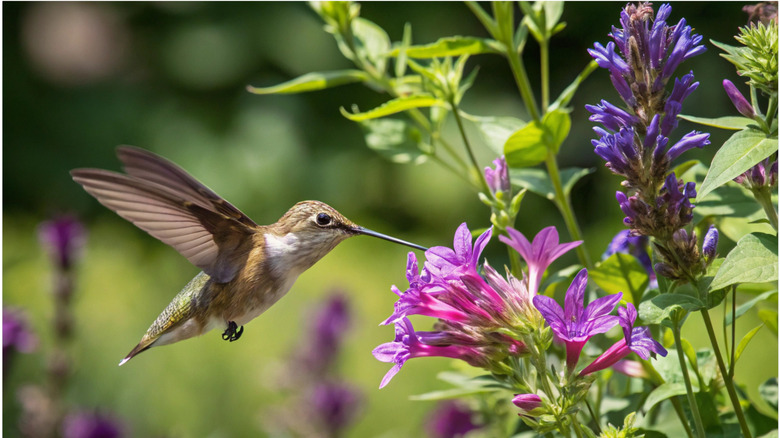
It's pretty commonly known that certain colors and plants attract hummingbirds. However, as you are adding more red and other favorite hummingbird hues — they also love orange and yellow — to draw them in, consider that you may not even know all the colors they like. Why? Simply put, because you can't see them. None of us can. That's because hummingbirds (and other birds) actually see colors that we don't.
Basically, all types of hummingbirds, as well as other avians, can perceive ultraviolet light. This is a spectrum of color humans cannot see, at least not fully. Of the non-spectral colors — those which are not specific parts of the spectrum of visible light — purple is the only one most humans can detect. Birds, on the other hand, can detect nearly half a dozen specific non-spectral colors.
In addition to purple, which humans don't actually see but imagine since our brain blends the visible blue and red wavelengths, birds also see combinations of ultraviolet with red, green, or yellow, creating unique colors, invisible to use. Some assert that birds can also see ultraviolet+purple.
Why hummingbirds are non-spectral sensations
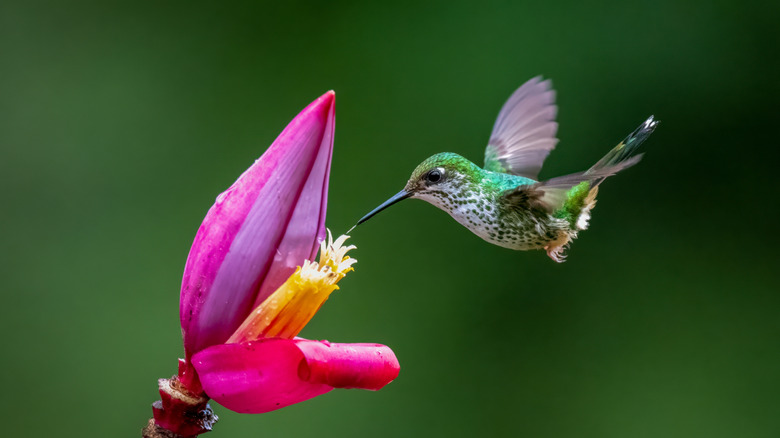
The key to hummingbirds seeing these non-spectral colors are the cones in their eyes. Humans have three types of cones, which correlate to the colors red, green, and blue. Hummingbirds have a fourth cone, allowing them to see ultraviolet light. Specifically, these cones are stimulated by the various wavelengths of different portions of the electromagnetic spectrum. Long waves stimulate the red cone, mid-range waves the green cone, and short waves stimulate the blue cone. Ultra-violet light has an even shorter wavelength. Therefore, it is not on the visible scale nor detected by the blue cone. Hence, the need for the fourth cone utilized by birds. In fact, these remarkable creatures actually possess a fifth cone, which detects achromatic motion (or minor changes in lightness and darkness indicating movement).
So, what do birds do with this super vision? Essentially, the same thing we do with three cones, only better. Contrary to popular myth, hummingbirds have a sense of smell, but they depend heavily on vision. This means they utilize their heightened sense of sight while finding a food source, mate, or migration route. It also comes in handy to help them avoid predators. Given that we cannot see all the colors that hummingbirds can, we are unable to truly know how various plants, animals, and birds appear to them. However, it does help explain why they find some flowering plants more attractive than others: Like bees, they may see extra "landing strips" or bullseyes of invisible (to us) colors on a flower's petals or pollen, drawing the nectar-loving birds in. This is something to keep in mind as you're preparing your garden for migrating hummingbirds.