

This Bright Flower Has Invisible Colors Bees Can See (But We Can't)
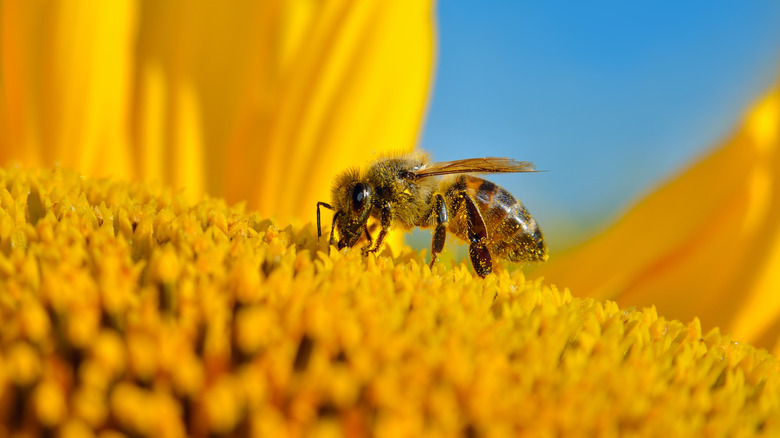
If you've ever wondered how bees are so good at finding sunflowers and other flowers that contain pollen, a lot of it comes down to their vision. To that end, some flowers present themselves to pollinators in ways we can't see. Bees can see colors and patterns of color in the ultraviolet spectrum that humans can't detect. It may be one reason they're especially drawn to sunflowers. Numerous varieties of sunflowers (Helianthus annuus) naturally display a bold circle or bullseye pattern that guides bees directly to the good stuff: Pollen and nectar. That's a good thing for us — adding sunflowers will help keep the bees buzzing around your garden.
The ultraviolet colors — we don't know exactly how they look to a bee's eyes — appear on parts of the flower's inflorescence, or flower clustering, which looks to us like masses of bright yellow flower petals. In contrast, a bee sees stripes, dots, and many colors on the petals, stamen, and, importantly, the pollen grains. The ultraviolet hues appears towards the center of the sunflower head, while the outer areas are still yellow. These UV areas look a bit like landing zones from a bee's perspective.
Researchers suspect it's the flowers that adapted to what bees can see, rather than bees adapting to see more of the flower. If viewed as a relationship between plant and pollinator, however, it's interesting that sunflowers stand out, because they're highly beneficial to a bee's life. Compared to the pollen of other plants, sunflower pollen offers a huge boost to bee health, protecting the bees from harmful pathogens. Besides benefiting bees, sunflowers can remove contaminants from garden soil, so it's all the more reason to plant some in your garden.
How flowers use ultraviolet hues
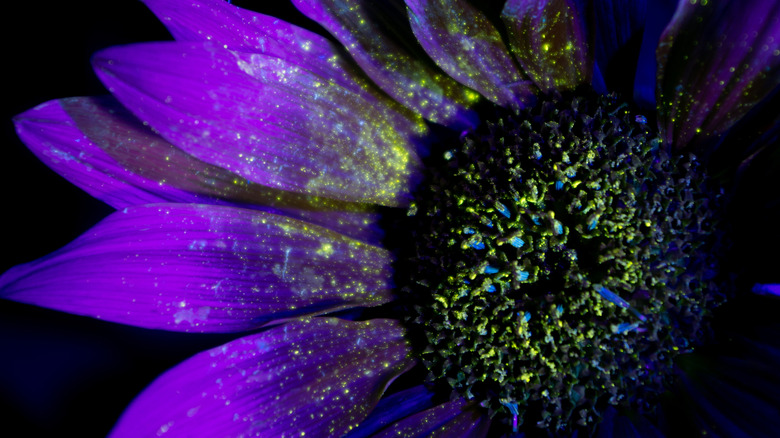
Different sunflower varieties look different to our eyes, and the same is true for bees. The ultraviolet portions of sunflower inflorescence may be large or fairly small, but they're extremely obvious to bees buzzing around nearby. The larger the ultraviolet "bullseye" area, the more bees seem to prefer the flower, according to the University of British Columbia Botanical Garden. In some cases, the bullseye covers almost the entire inflorescence. There is evidence that UV fluorescence varies and changes on any given flower over time. It's possible that they broadcast more UV light at peak pollenating times, or due to other factors like nutrients or moisture.
In fact, this design also seems to help sunflowers in areas with low humidity, perhaps regulating water loss, the UBC notes. Flowers grown in arid regions have larger bullseye coverage than those in humid areas, and seemed to retain water more effectively. Think of it as a plant's sunscreen during critical bloom cycles. Since different species grow well in basically all parts of the continental U.S., plant sunflowers to add color to your garden, pretty much wherever you live.
Sunflowers aren't the only flowering plant to display ultraviolet patterns: Roses, foxglove, and violets are all more visually complex under UV light. Hibiscus blooms (Hibiscus spp.) also use ultraviolet hues to draw bees near, and these UV patterns appear to grow and expand as the flower matures. As with the sunflowers, bees preferred hibiscus with larger ultraviolet areas.