

What A Slow-Release Fertilizer Really Means
We may receive a commission on purchases made from links.
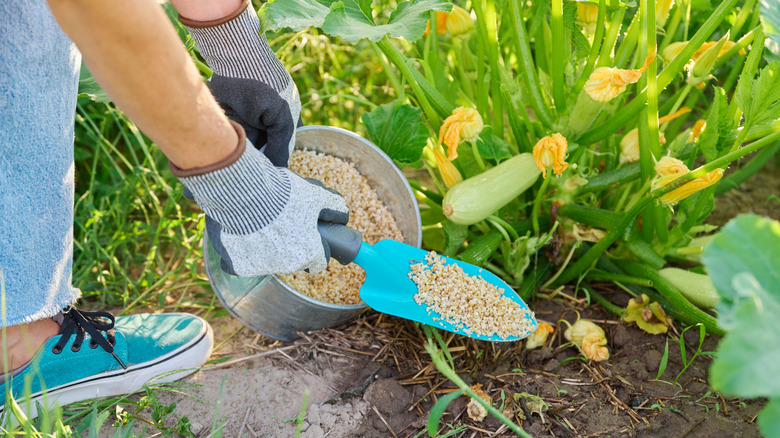
A slow-release fertilizer can revitalize your garden, but what is it, exactly? As the name implies, a slow-release fertilizer releases its nutrients over time, rather than all at once. By contrast, a quick-release fertilizer, which is often applied in liquid form, packs a full punch of nutrients, instantly offering it to the plants in the surrounding soil. Both types of fertilizers are available for lawns and gardens. They may even contain an equal amount of nutrients, but they work in completely different ways. Slow-release fertilizers, sourced from natural ingredients and often delivered as a pellet or coated granule, are designed to slowly, evenly release nutrients such as nitrogen, phosphorus, and potassium (NPK). However, the delivery method of those nutrients is not the same from product to product.
Many commercial slow-release fertilizers have a semi-permeable synthetic coating that allows nutrients to diffuse over time, dispensing small doses of nutrition to the soil. Other coatings take advantage of osmosis, using water as the mechanism that allows a slow breakdown. Still others rely on microbes in the soil to help decompose the fertilizer's outer coating. There are also natural materials, such as worm castings and egg shells, that behave like slow-release fertilizers. By any mechanism, the goal of any slow-release fertilizer is to help ensure nearby plants don't receive too much fertilizer at once.
Why slow-release fertilizer matters
A quick-release fertilizer serves an important function: It can be a quick fix for a lawn (or patches of a lawn) in need of some TLC, allowing for quick repair and new growth. But it can also be too much of a good thing. Too much fertilizer at once can burn lawn grasses and other plants. They also need to be reapplied often. By contrast, a slow-release fertilizer ensures nitrogen burn doesn't happen, provided you apply it according to package directions.
The slow-release process also means you won't have to apply the fertilizer as often. For instance, a product like Milorganite all-purpose slow-release nitrogen 6-4-0 fertilizer can last almost three months before the next application is required, according to the company. The continual nutrient supply means there's less likely to be too few or too many nutrients reaching plants at any given time. A slow-release fertilizer applied in late fall or early spring helps keep trees healthy and thriving for this reason.
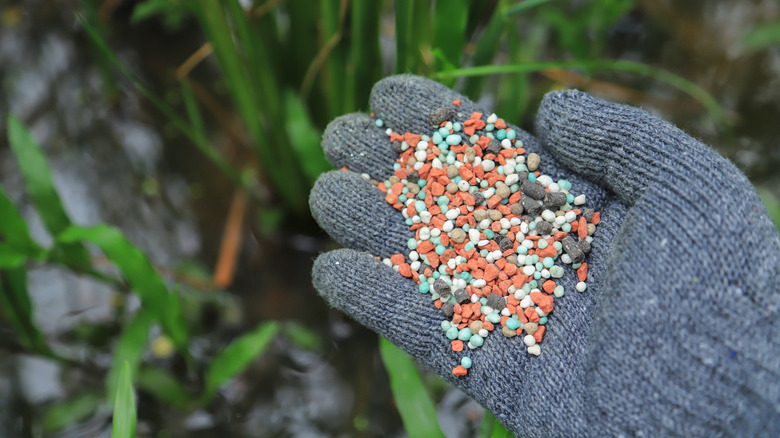
Slow-release fertilizers do have a couple of drawbacks. It can take longer to achieve the desired results with your plants than when using a quick-release fertilizer. This is particularly important when dealing with ailing lawns. But even when you're trying to improve your garden soil on a budget, a slow-release fertilizer may not be the right answer: Slow-release fertilizers can cost more than similar quick-release versions. Commercial versions are also synthetic or partially synthetic, despite being derived from natural materials, as the coatings are usually made of some sort of polymer. This coating may also be tinted with colors to make them more visible.