

An Eco-Friendly Ant Control Hack You'll Want To Try In Your Garden

We may receive a commission on purchases made from links.
Although there is an argument to be made that some ant hills can benefit your garden, by aerating soil through tunneling, it is safe to say the vast majority of gardeners would just as soon not have ants crawling through their plots. While there are a myriad of commercially available pesticides that can help control or eliminate ant populations, many of those have negative environmental impacts beyond killing ants. This can range from soil and water contamination to killing or repelling beneficial garden insects such as pollinators. With that in mind, if you're looking for an eco-friendly ant control method, you may want to try this orange oil and molasses hack.
This trick, commonly found on the internet and social media, involves a concoction of orange oil, molasses, dish soap, and water. Some alternative methods suggest utilizing compost tea in addition to or in lieu of water. Like a good number of natural remedies, there isn't a lot of hard science to verify the effectiveness of this hack. However, there have been some scientific trials, such as those conducted by the Department of Entomology and Plant Pathology at Oklahoma State University, that have had positive results. That, coupled with a good deal of anecdotal evidence provided by sources ranging newspaper columnists and television shows to gardeners and landscapers suggest the mixture may be worth trying.
It is significant to note that the vast majority of conversations regarding this hack are directed toward controlling fire ants. Of course, given that they are among the more dangerous types of ants, fire ants are a real concern for gardeners. Additionally, although less common, there are reports that indicate this can be an effective solution for other types of ants as well.
Using the orange oil and molasses hack to control ants
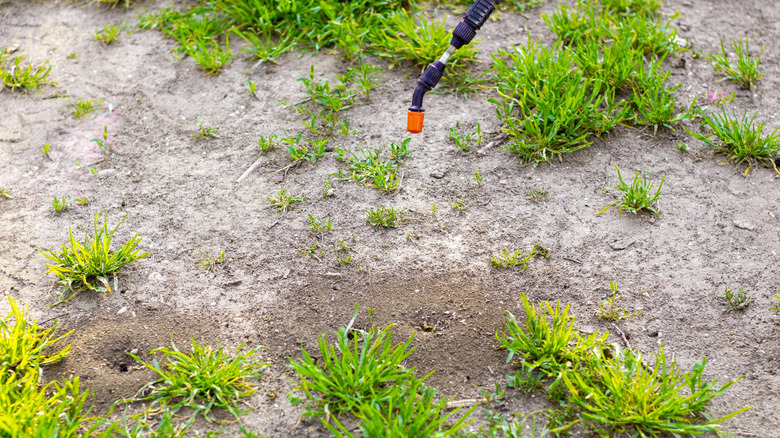
Utilizing the orange oil and molasses hack to control ants is a relatively simple process. For the basic version, you will need a bottle of orange oil, like Medina orange oil, molasses, dish soap, water, and a bucket. Alternately, you can add something like TPS Nutrients liquid compost tea in place of water. When you're ready to mix everything together, there are again options. Recipes that rely more heavily on orange oil call for around 6 ounces of orange oil and a teaspoon of molasses for every gallon of water, along with a few drops of dish soap. Other recipes call for equal parts of each active ingredient — essentially 1 ounce each of orange oil, molasses, and dish soap per gallon of water.
Whichever recipe you whip up, once it is mixed together, you can deploy it to deter ants in a couple of different ways. The most direct, and common, method is to pour the contents directly onto/into the ant hill or colony. For big mounds, pour the entire gallon onto the ant pile. If you are dealing with a series of smaller mounds, you can treat several with a gallon or two of the mixture. Just be sure to completely douse each mound.
Another way to utilize this natural ant repellent is to pour the mixture into a handheld sprayer. Spray the area around the mound, as well as the mound itself and any ant trails you may see. You can also spray the mix throughout your garden, pay particular attention to the ground around plants that may be attracting ants to your garden, such as fruit trees and various flowering plants.
Does the orange oil and molasses hack really work?
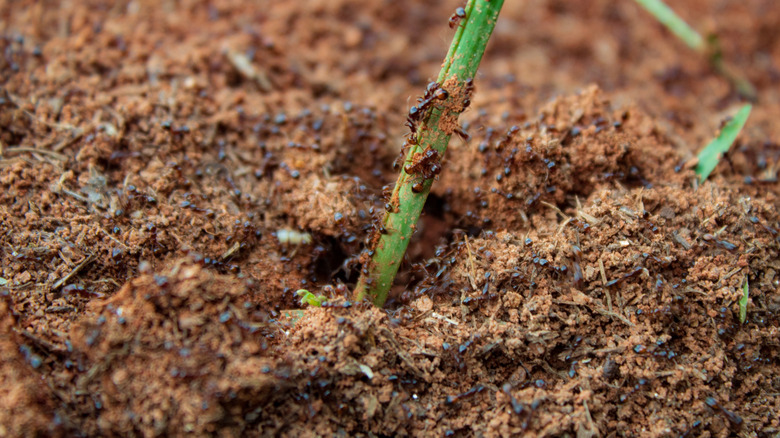
Before going through the effort of mixing up an orange oil and molasses cocktail and deploying it on ant mounds, you may want to know if it actually works. Again, there is far from a plethora of scientific studies to verify claims. The aforementioned Oklahoma State University research trial does indicate results that range from partial to complete success. Additionally, a number of both master and hobbyist gardeners have provided anecdotal evidence that suggest it works quite well.
It is worth noting that both the OSU study and some anecdotal cases indicate that in certain situations the mix acts more as a repellent or deterrent, as opposed to a pesticide. This is evidenced by the fact new ant mounds would appear relatively close to treated mounds. But, there are also many instances where it had a lethal impact on ants, evidenced by piles of ant carcasses left behind. But one useful conclusion which can be drawn is that all ant colonies treated with this concoction were impacted, with effects ranging from deterrence to death.
Why does this mix affect ants in this way? The answer lies in the individual components, which, incidentally, are often used as stand-alone ant treatments as well. Molasses doesn't directly affect the ants, but rather deters them by improving the microbial content of the soil. Orange oil, however, appears to have pesticidal qualities. Many claim orange oil works by dissolving the ant's exoskeleton. The OSU study makes no claim. It does, however, state the orange oil resulted in a "significant" drop in activity in the mound and anywhere from a 30% to 80% reduction in ants. The study cautions, however, the effects are limited to mounds directly treated and are not long lasting, as reinfestation can occur.