

Skip The Salt - You Can Prevent Ice Buildup On Your Driveway With A More Eco-Friendly Alternative
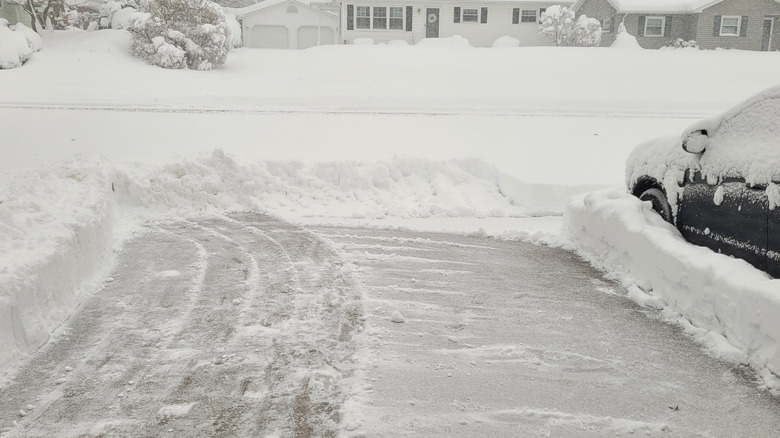
Ice on your driveway can be a slipping and falling hazard, but if you don't want to spend time and energy shoveling and scraping it up, you're likely considering a de-icing product. Choosing the best ice melt for your home means balancing effectiveness with eco-friendliness. Rock salt works well, but can be harmful for the environment. The good news is, you may be able to avoid spreading as much deicer by preventing the ice from forming in the first place. Beet brine is an all-natural, low-salt solution that's a useful anti-ice agent. It's so promising, that many U.S. and Canadian cities have test programs replacing traditional salt treatments with beet brine.
Sugar beets are cold hardy plants, and the natural sugar in the root vegetable's juice is an effective way to prevent ice from forming. Like salt, sugar lowers the freezing point of water. This means the temperature needs to drop well below 32 degrees Fahrenheit — as much as 7 to 14 degrees more depending on the concentration — before becoming ice. To increase the effectiveness, beet juice is often mixed with salt brine, although the juice can also be used on its own. Combined with salt brine, it can prevent ice forming until the temperature drops as low as -10 degrees F, according to the Missouri Department of Transportation.
The exact ratio of juice to salt can vary, but one commercial version used by the transportation department in Alberta, Canada is 65% salt brine. That may sound like a lot, but salt brine is only 23% salt (the rest is water). So beet brine (about 17% salt total) can be significantly less corrosive than rock salt on its own. However, beet juice needs to be applied as a preparation before freezing weather arrives, meaning it can't completely replace rock salt or other chloride solutions, which more effectively melt existing ice.
Downsides to beet juice as an anti-ice solution
One major downside to using beet juice is that it can't melt ice well on its own. If ice has already formed on your driveway, you'll still need rock salt or a chemical ice melt to get rid of it. If you're relying solely on beet juice or beet brine, you may be left with an icy driveway if a storm surprises you before you can apply it. Another issue is that, while beet brine does contain less salt, sugar still isn't that great for the environment. As it washes down drainage systems into water sources, it feeds bacteria, which can lead to lower oxygen levels in the water. This harms fish and other aquatic creatures. At the moment, sugar seems like a safer alternative to salt, but additional studies on the long-term impacts will help us better understand all the risks and benefits.
There are also a few minor downsides. The sugar in the juice makes it quite sticky. The good news is this helps it stay where you pour it (it may even be helpful through multiple storms as a result). Avoid walking through your driveway after applying beet brine, or your shoes could end up with an unpleasant layer of sticky juice on the bottom. The smell and brown color of beet juice can also make for a less than lovely application process, and regular use on light-colored surfaces or untreated concrete could potentially stain them. Knowing how to effectively clean your driveway might be helpful if you plan on using beet juice frequently.