

Why Aerating And Overseeding May Not Work To Fill Lawn Patches
We may receive a commission on purchases made from links.
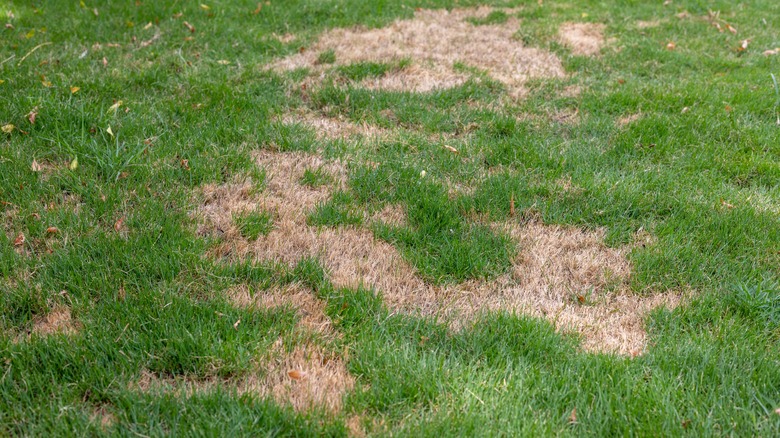
If your grass is growing in patchy, you may have attempted a couple of common practices for fixing it: aerating and overseeding. While these measures quite often fix the problem and help you regain a solid covering a green grass, there are also times when they don't. For instance, there may be underlying issues that these methods can't fix, or they may have been done incorrectly or at the wrong time.
As for diagnosing the problem, there are a myriad of reasons your lawn may be filled with brown patches. For example, compacted soil, which aeration is intended to correct, is just one of the possibilities. However, if this is not the underlying reason your lawn is developing brown patches — or if it is just one of the many causes — the reality is that aerating alone won't resolve the issue. Instead, the root cause of the problem, whether that be fungal infection, thatch, or any other issue, must be properly addressed in order to make those pesky brown spots go away.
Similarly, overseeding — which is basically introducing more grass to your lawn by way of adding new grass seed — is also not a sure-fire solution if there are other issues at play. For instance, if heavy thatch is causing the brown spots, it will likely prevent any new seeds from reaching the soil and properly germinating — making the entire task ineffective. Additionally, fungus-affected grass will spread to the new sprouts if it is not eradicated, which means overseeding could unintentionally propagate the problem.
Best practices for successful aerating and overseeding
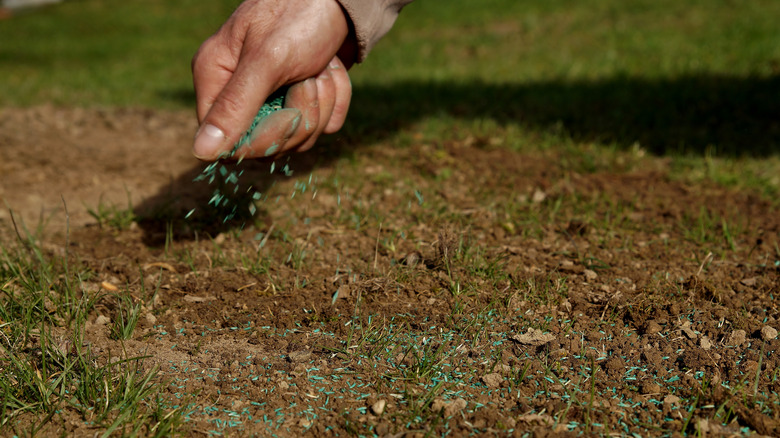
In order to successfully fix your brown patches with aerating and overseeding, you'll first need to identify if there are any other underlying causes and address them properly. Once that is done, you can focus on the next step. Determining the best time to overseed. Even if you are only working with relatively small, patchy portions of your lawn, it is always important to determine these factors, which will primarily depend on the type of grass and where you live. The same goes for finding the best time to aerate.
Typically, these two times tend to overlap, as the ideal growing conditions for newly planted seeds are also beneficial for helping any existing grass cope with the stress that results from aerating. For warm-season grass, this is usually in late spring or early summer. Meanwhile, cool-season grass is best aerated and overseeded in early spring or fall. This means that you may have to deal with bare spots for a bit until it's the proper time of year, as attempting to do either of these tasks at the wrong time can exacerbate the problem.
Once you're ready to work, be sure you use the right equipment. Small areas can typically be handled with a manual aerator — like the GoPlus 18-inch Rolling Lawn Aerator — and a handheld spreader. If it's small enough, you can even scatter the seeds by hand. After the aerating and overseeding is completed, it's important to keep the ground moist while the seeds germinate, but be careful not to overwater. Additionally, you'll also want to hold off on mowing the area until the new grass is at least 3 inches tall. Otherwise, your mower may uproot all of your new grass.