

How To Turn Your PVC Pipe Into A Simple DIY Tree Trimming Tool

Trimming branches is one way to keep the trees looking their best. Unlike pruning, which means removing dead growth or benefits the health of the tree over all, trimming is more about aesthetic. It could mean cutting back branches that hang too low over the driveway, or that are about to rub against the garage walls and roof.
Trimming is fairly simple when the branches are thin and within reach, but what if they're too high and you don't have a pole saw? While you could use a ladder, they're cumbersome and could be dangerous to use in some situations. It's also awkward figuring out how to set up a ladder on uneven ground in some situations, such as on hills, slopes, or in a rocky area.
Instead, there's a simple solution that requires nothing more than PVC pipe, an eye bolt, some sturdy twine or clothesline, and your favorite pruning and trimming tool. Bypass pruners, which are one of the must-have tools for beginning gardeners (and every gardener, really), work well for thinner, twig-like branches, while bypass loppers are their larger sibling that cuts through thicker wood. Both tools can be modified with PVC pipe to make short work of high, out-of-reach branches that could use a trim. With either one, ensure they're sharp and clean first. If you want to disinfect them first, this household staple makes disinfecting garden tools a breeze.
How to DIY a long PVC tree trimmer
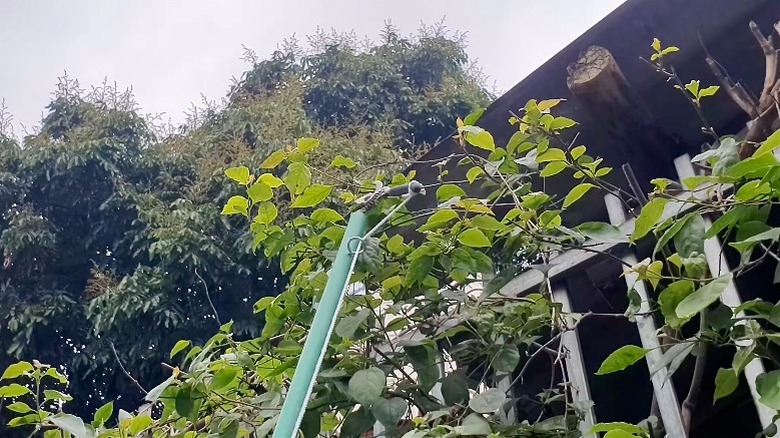
To make a DIY extension handle for your bypass pruners, you'll need a long piece of PVC pipe that's wide enough to fit around one of the handles from your pruners. Aim for about 5 feet of sturdy PVC; an exact measurement isn't necessary. Mark one end 5 inches down, then drill a hole at that spot through both sides of the PVC. Use a drill bit slightly narrower than the threads of the eye bolt, then twist the eye bolt into place so you're left with a loop protruding from one side of the PVC pipe. Push the bottom handle of your pruning shears into the PVC so the eyebolt is on the side where the top handle closes when squeezed. If the shears spin too easily in the pipe, jam something alongside them inside the pipe to stop the movement, such as a small wad of tape.
Cut a length of clothesline or similar rope or twine 2 to 3 feet longer than the pipe. Tie one end of the twine securely around the top handle from the pruners, somewhat close to the open end of the handle, for leverage. Run the rope through the eyebolt, then tug on it to ensure the pruners close every time you tug. To use the pruners, just hold the pipe, place the open jaws of the pruners over a branch, then tug the rope to cut the branch off. Fall is a good time to trim branches to keep things tidy; it's usually cooler outside and many of the pesky insects are no longer around.
For a larger device that works with bypass loppers, get two pieces of 5-foot PVC pipe with about a 1.25-inch inner diameter, or a diameter that fits the handles of your particular loppers. Place one handle in each pipe, then use the pipes as extension handles, lifting the loppers as high as needed to cut branches well over your head, no ladder or tree saw necessary.