

Add A Luxurious Look And Feel To Your Outdoor Space With A Sleek Patio Upgrade
We may receive a commission on purchases made from links.
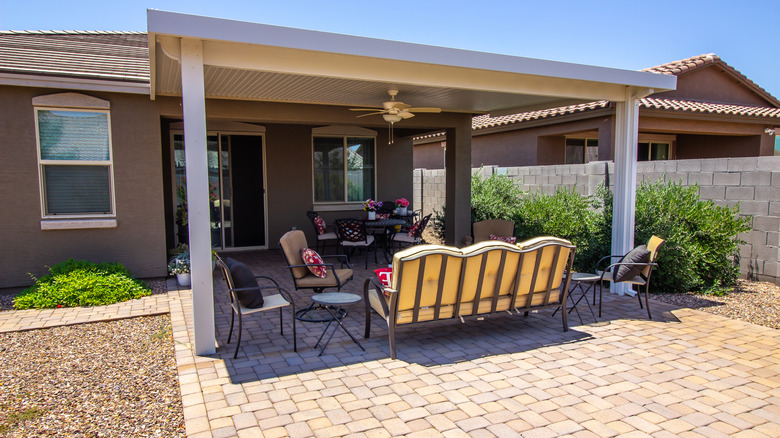
Your patio should be a comfortable space for you to relax or gather with friends and family. When designing it, your first thoughts might go to furniture, and that is a good option when upgrading or customizing a patio: You can make a stylish DIY wooden chair that will take your patio to the next level. But if it still feels like it's missing something, the answer may be more foundational. If your plain poured concrete patio is feeling a bit bland, it might be time for a sleek upgrade by installing patio pavers.
Interlocking patio pavers are designed to fit tightly together in a pattern, without mortar. They can be arranged in a wide variety of patterns, making them both easy to customize and impressive to look at. Whether you prefer something sleek and modern or something luxe like installing heat-resistant pavers, interlocking pavers are a good fit. They're held in place by a special sand rather than mortar or grout: Polymeric sand includes special polymers that harden when the sand is moistened. This combined with the interlocking shapes help them disperse weight more effectively. You don't need to worry about mortar cracking, interlocking pavers are also generally less likely to break than brick, and they're easier to replace (one by one) than a whole cracked concrete patio.
However, there are two potential downsides. While interlocking pavers are easier for some people to DIY than poured concrete patios, they still take quite a bit of effort to install. If you'd rather hire a professional to install them, you'll run into the second downside — cost. Poured concrete patios are certainly more affordable than interlocking pavers (though long-term, the durability of pavers may mitigate the higher upfront costs).
How to install interlocking patio pavers
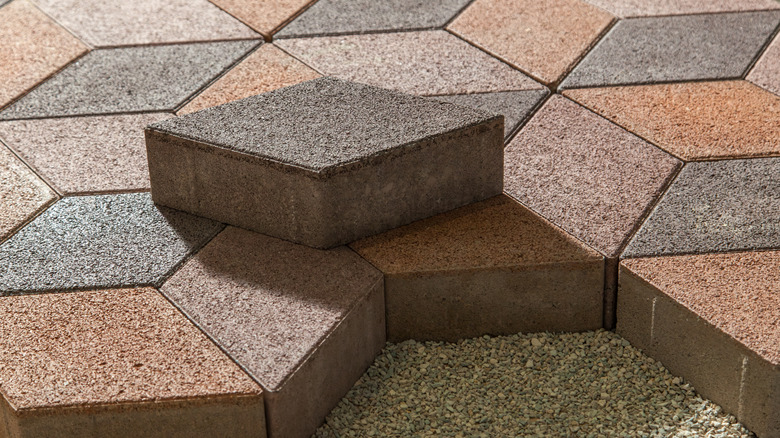
Before you begin installation, carefully consider what the best material for your patio will be, especially on a budget. Interlocking patio pavers are commonly made out of stone, concrete, or brick, but there may be other options at your local home improvement store or online. The first step is to dig the base or foundation. If you're replacing an existing patio, this part may be squared away, depending on the type of patio you're replacing. The base should be dug to a depth of between six and nine inches to properly hold the base layers and support the pavers.
Add a 3- to 5- inch layer of sand or fine gravel to the bottom to suppress weeds, improve drainage, and keep your pavers stable. Smooth it out as much as possible, then add an edge restraint, which can be metal, plastic, or concrete. This is essentially a frame that keeps pavers at the edges from sliding out of place. Arrange your pavers in the pattern you want them to follow. Make any adjustments you want at this stage! While you can always remove the patio if you don't like the way it looks, it's much easier to change things up before the pavers are locked in place. Try to lay down pavers as level as possible to keep the base layer underneath them level. Once the pavers are all in place and you're satisfied, pour polymeric sand — or an alternative jointing sand like Joint-It Simple — over the patio, brushing it in so that it seeps into the cracks between the pavers to lock everything into place. You won't need expansion joints, and nothing needs to cure. Once the sand has hardened (give it a couple of sunny days), you're ready to enjoy your stylish patio!