

11 Best Flowers For Planting In Pots And Containers
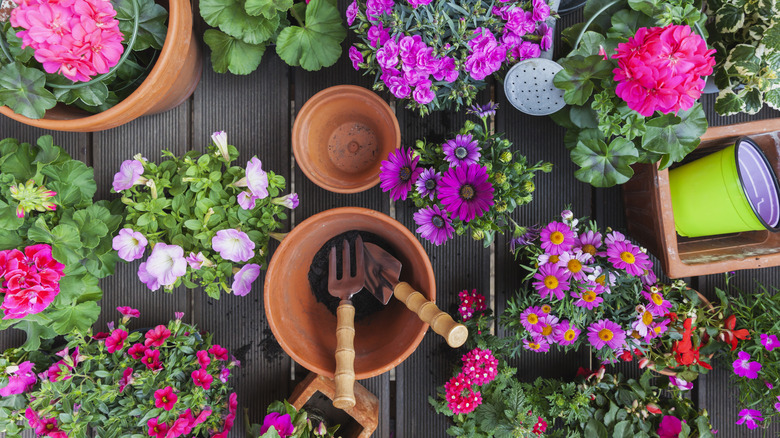
Pots and containers offer a superb alternative to planting in the ground. This is especially true in areas of your garden that have little or no soil, like wooden decks, concrete patios, and small, shallow gardens where space is limited. It's also a boon when you want to plant perennials that wouldn't otherwise survive the winter, or need to be moved around the yard as sun and shade patterns change. There are plenty of colorful flowers that can easily be grown in pots and planters, allowing you to add visual interest to otherwise neglected parts of your patio. You can even combine some species to help layer your planting scheme.
But before you go ahead and start choosing flowers to grow in your pots and planters, there are a few important considerations you should bear in mind. Which colors do you want to add to your space? Which times of the year do you want your garden to be flush with color? How much sun do your plants need, and are they particularly fussy about soil type? Finally, which hardiness zone do you live in?
Answering these questions will help discern the best flowers for pots in your garden. Don't worry — if you're stuck for inspiration, or don't know where to start your search, this guide will cover more than a few options that, depending on the conditions of your garden, can easily be grown in pots and planters.
Impatiens (Impatiens walleriana)
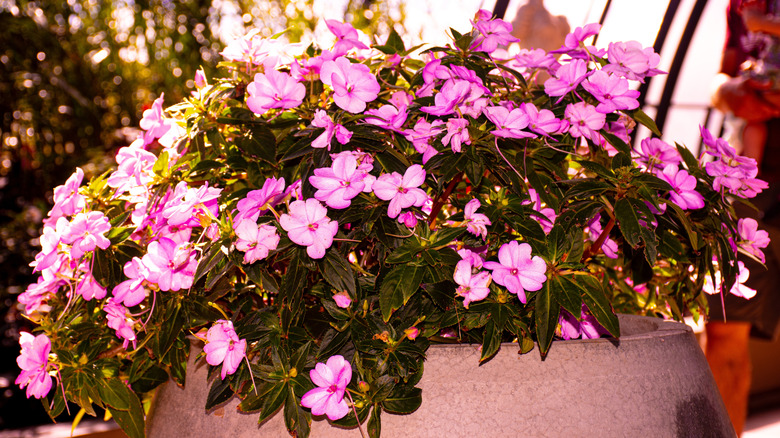
Bringing floral displays in rainbow hues of pink, red, purple, white, and orange — with some species whose flowers are even multicolored — impatiens (Impatiens walleriana), or bizzy Lizzy, are some of the best flowers for pots, especially for gardeners who want to maximize the spring, summer, and fall seasons. In fact, impatiens will flower throughout all three.
If you live in zones 10 or 11, you'll find that your impatiens will happily grow back each season. Since impatiens don't fare well against frost, grown outside these zones, you'll probably have to grow these particular flowers as annuals. Go for spots with partial shade, and don't be afraid to mix up how closely together you plant them. Those planted closer together will grow tall, while those with more space around them will tend to bush out, giving you the chance to create depth and structure to your planter with just one beautiful species.
Impatiens like some sunshine, but too much can scorch their leaves. Fill your pots with rich, well-draining soil, ideally with a neutral-to-acidic pH. Finally, make sure the soil is regularly watered. They are not drought tolerant, so in warmer weather you may need to water your impatiens daily (but avoid overwatering).
Petunias (Petunia spp.)
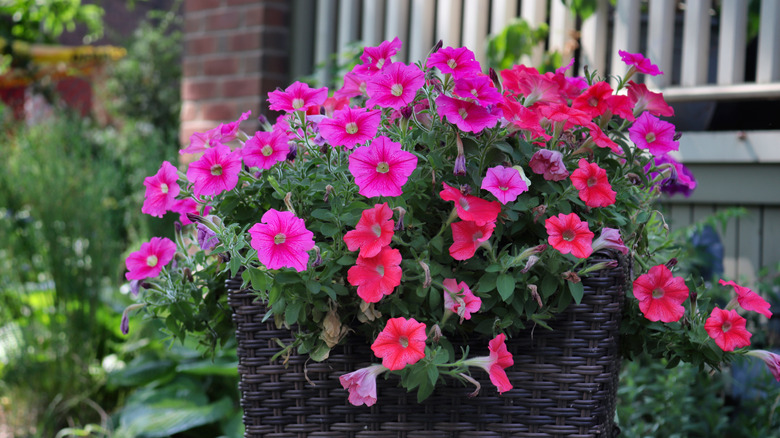
If bright, trumpet-shaped flowers in pink, purple, red, white, or yellow sound like your idea of horticultural heaven, then add petunias (Petunia spp.) to your potted planting scheme. Flowering from summer until the first frost, this multi-season blooming tendency makes them popular among growers hoping to keep their gardens awash with color into the cooler months. Planting them around your outdoor living space is also one of the ways to make your garden repel ticks and fleas, since they both seem to hate petunias!
Petunias are some of the best perennial flowers for pots in hardiness zones 9 or 10 to 11. Elsewhere, they can easily be grown as annuals. Just ensure your pots are placed in a position with full sun, and that they contain fertile, moist, well-draining soil. Tick these boxes, and you'll find that these pretty bloomers are actually quite easy to grow.
In order to get the most out of your petunias, aim to prune them a few times in the summer, and don't be afraid to deadhead spent flowers to encourage further blooming. You'll need to water them regularly in the summer, too, as soil in pots is liable to dry out more quickly than that in the ground. Feed them regularly to encourage continued blooming. Finally, if you'd like to layer them into a low-maintenance planter combo, consider planting them alongside sweet potato vines (Ipomoea batatas). Both thrive in similar conditions, and their differing appearances complement each other wonderfully — the abundant, lush green vines harmonizing with varicolored blooms of petunias.
Marigolds (Tagetes ssp.)
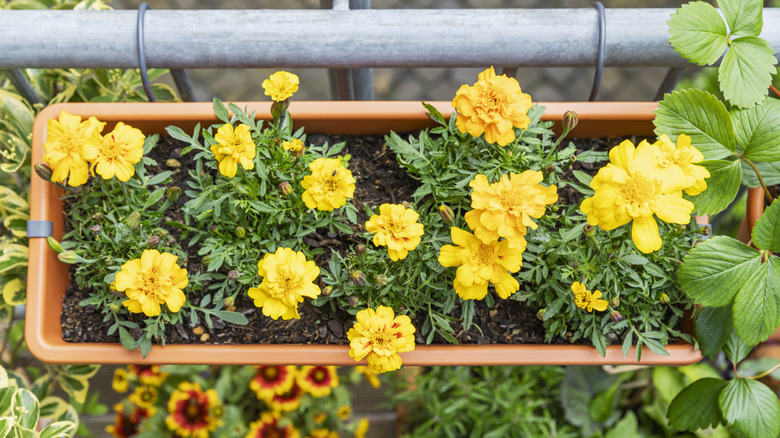
Blooming from spring until the first frost with vibrant flowers of orange and yellow — often tinted with red — marigolds (Tagetes ssp.) are some of the most beautiful flowers to grow in pots. They're also fairly easy; provided you provide them well-drained, moderately-fertile soil and plant them in a position with full sun, these flowers will thrive in most hardiness zones. The only drawback is that they're generally annuals, so you'll need to plant them again each season. Then again, you probably won't mind taking the time to do so, especially since marigolds can ward off pests for good like aphids and mosquitoes.
There are plenty of varieties to choose from, making it easy to suit different plants to the size of your pots. French marigolds (Tagetes patula), for example, which range between 6 and 12 inches in mature size, have a compact growth pattern, making them some of the best flowers for planting in pots of smaller sizes. On the other hand, if you have plenty of space to play with, you could consider African marigolds (Tagetes erecta), which can grow up to 4 feet tall and bloom with pom-pom flowers as large as five inches in diameter. Just know that you may need to stake such varieties to avoid them falling over.
To get the most out of your marigolds, give them plenty of room to breathe. Larger pots can help with this, as can ensuring that you don't plant multiple plants too closely together. This latter tip is especially important: Marigolds are fast growers (often blooming just eight weeks after sowing), meaning they can quickly overcrowd a pot.
Trailing begonias (Bogonia boliviensis)
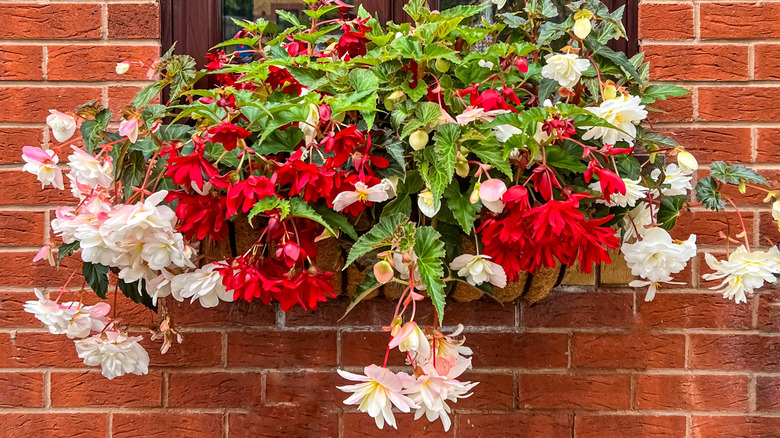
With lustrous green, bronze, and even burgundy foliage and abundant clusters of vibrant, multi-colored flowers, trailing begonias (Begonia boliviensis) are staggeringly beautiful. They're also some of the best flowering plants for pots, especially in zones 10 and 11, where they'll return year after year. If you live outside of these zones, you'll either need to pot new plants the following season, or dig up the tubers ahead of your area's first frost and store them for next year.
You'll get to enjoy this plant's honeysuckle-esque blooms from late spring and into the summer, provided you give your plants a pot with moist, well-drained soil. Try not to over-expose them to sunshine, and ideally keep them in a spot that's sheltered from the heat of the midday sun. These plants are particularly well-suited to hanging baskets or as an accent to mixed container planting schemes, and liven semi-shady corners with colorful blooms. They can even form part of a hummingbird-friendly planter combination with other species like canna lily (Canna spp) and fuchsia (Fuchsia spp).
To keep your flowers in ship-shape, keep the soil moist, but not saturated. Aim for a spot that provides the plant with plenty of air circulation, otherwise you might start to notice a build-up of powdery mildew. Finally, don't be afraid to cut away spent flowers. Doing so will help encourage the plant to continue blooming.
Zinnias (Zinnia ssp.)
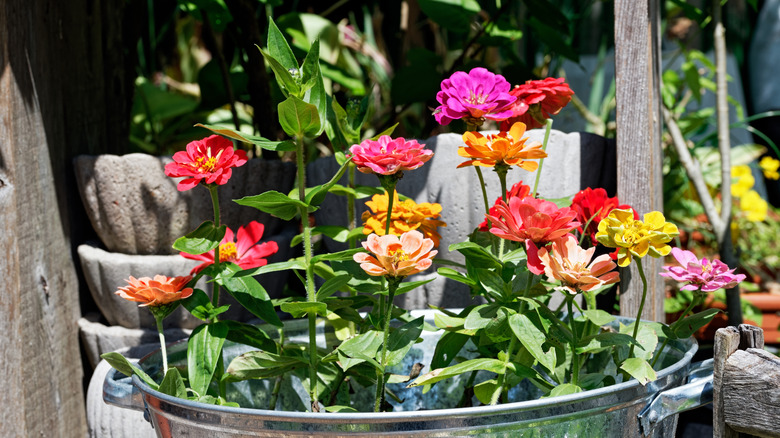
Depending on the variety you choose to grow, you can expect your zinnias (Zinnia elegans) to produce gorgeous blooms of red, orange, white, pink, purple, or even green flowers. Flowers can be round, pointed, or quilled, and as for height, there are those that grow up to 6 inches and a few that max out at around 4 feet. In other words, depending on your particular pots, you're sure to find a zinnia that'll bring zen to your garden.
In all cases, zinnias tend to bloom from early summer until the first frost. During this time, they are a boon to an array of friendly pollinators, whose presence will only serve to diversify the colors in your garden. Grown as annuals in zones 2 to 11, zinnias prefer a position with full sun if it's not too hot, and soil that's rich and well-drained.
As for how to get the most out of them, since you're planting them in pots, you're already halfway there. Zinnias are known as one of the best flowers for planting in pots. In fact, they thrive in containers in gardens where the soil doesn't match their specific requirements. In the right conditions, they make great border plants. So you'll need to choose the right variety for the situation. More compact pinwheel (Zinnia elegans) and 'Profusion' cultivars (Zinnias marylandica) types, which won't require stakes for support. Deadhead spent flowers, and feed the plant regularly during the blooming season. Both these activities will promote continued and colorful growth.
Nasturtiums (Tropaeolum majus)
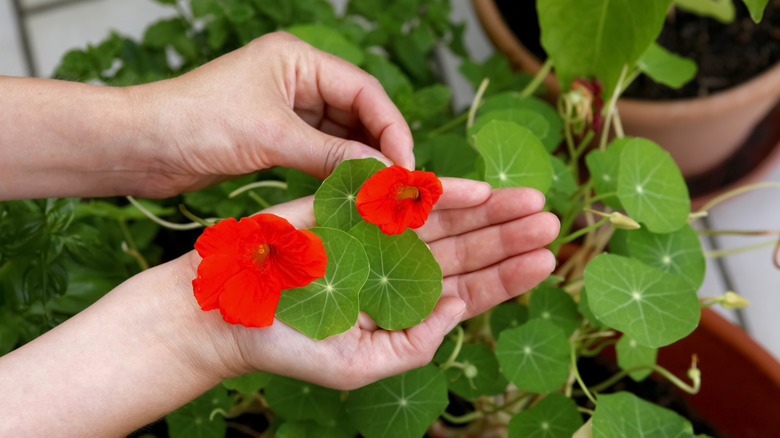
Flooding your pot or container garden with flushes of white, orange, yellow, and sometimes red, nasturtiums (Tropaeolum majus) are some of the easiest flowers to grow, and can enliven your outdoor space with color from summer all the way through to the first frost. Precisely when they'll begin and end their blooming season depends on which zone you're in, as does whether or not they'll grow back the following season. In zones 9 to 11, they'll thrive as perennials. Elsewhere, you'll probably need to replant them each season, as nasturtiums don't stand up well to the winter temperatures of cooler climates.
Putting aside the beauty of their flowers, considering nasturtiums for potting has many benefits. One, as mentioned, is that they're very easy to grow from seeds. Another is that they are one of many companion plants that impact your garden and can support its whole health. Since their flowers are so attractive to pests like aphids, nasturtiums serve brilliantly as trap crops, effectively pre-occupying nuisance insects and saving other, more vunerable plants from their voracious appetites.
Aim to plant nasturtiums in poor-quality soil, in full sun, and in a pot with a capacity of between 3 and 4 gallons. The more soil that you can give them, the longer it'll stay moist, thus reducing the amount you need to water. It can also be a good idea to add some expanded clay or gravel to the bottom of the pot to assist with drainage. Nasturtiums are prone to root rot when overwatered, so ensuring excess water is able to drain away is crucial.
Asters (Aster spp.)
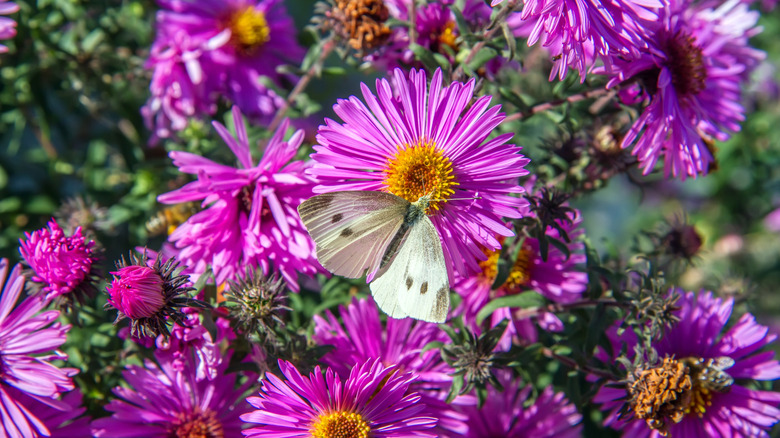
Adding varied and vibrant colors to your garden from late summer and into fall, Aster (Aster spp.) flowers often have a yellow, pollen-rich heart, with petals ranging from white and pink to blue and red. They thrive as perennials in hardiness zones 4 to 8, and given their summer-fall blooming season, are a great choice for planting alongside other species that flower earlier in the year. What's more, since they're adaptable to a multitude of soil conditions (acidic, neutral, and alkaline are all fine), you can combine them with a superb array of complementary flowers.
Well-drained and moderately-fertile soil is usually a good bet for asters. And while they'll cope with partial shade, sunshine is the key to abundant blooms — the more of it, the better. As for the size of the pot, you'll need to give your plants enough space for the roots to grow, while avoiding pots that are too big. Asters prefer their soil on the dry side of moist, and large amounts of substrate can lead to excess water retention, which in turn can lead to root rot. To help with this, opt for potting mixture over more compact garden soil, and plan to transplant and repot as needed. Finally, to help encourage continued and plentiful blooms, aim to feed your plant monthly during the growing season, and remove any spent flowers as and when you spot them.
Pansies (Viola tricolor var. wittrockiana)
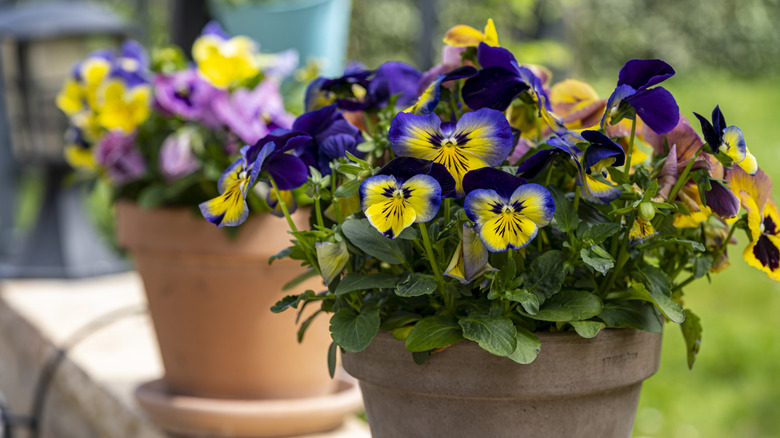
Growing into compact, tidy, and gloriously colorful mounds, pansies (Viola tricolor var. wittrockiana) are one of the very best flowers for container planting. The flowers themselves typically grow between 1 and 3 inches, but can bloom in an array of colors, ranging from red, purple, and blue to orange, yellow, white, and even black. Oh, and they're attractive to friendly pollinators, meaning you'll also enjoy the colors of various bees, butterflies, and other beneficial insects.
Precisely when your pansies will bloom depends on your local climate. They actually prefer cooler climates, thriving as perennials in hardiness zones 6 to 10, and growing as annuals only in warmer areas. In most cases, they'll flower from early spring until it becomes too hot for them to continue.
If planting multiple pansies in a single pot or container, aim for a spacing of at least 6 inches between each plant. As they begin blooming, trim away spent flowers to encourage new growth. Given pansies' sometimes-short growing season, is to plant them in containers alongside flowers that bloom longer, or at different times of the year. Alternatively, you could go all out for spring with similar-season bloomers like primroses and daffodils, whose equally vibrant displays are sure to work wonders alongside the varicolored petals of your pansies. Either way, pansies' tendency to clump rather than spread makes them an excellent companion plant. Just be sure that your chosen companions also enjoy full sun and moist, moderately-fertile soil.
Cosmos (Cosmos bipinnatus)
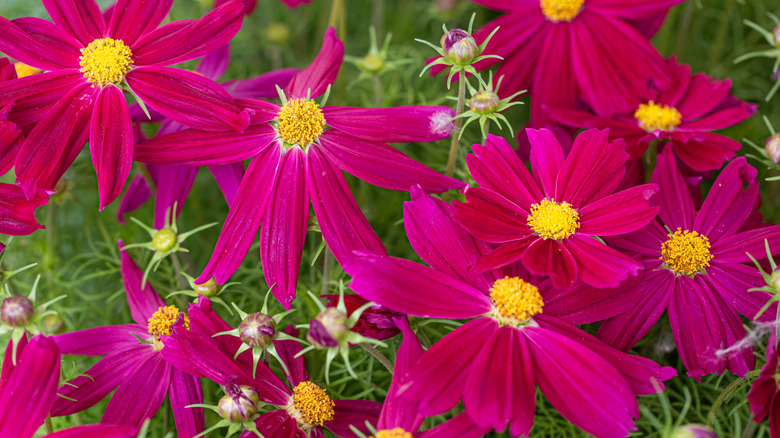
Perfect for pot or container gardens whose other residents tend to stop blooming at the end of spring or summer, cosmos (Cosmos bipinnatus) start flowering late in the summer and continue well into the fall. They tend to prefer hardiness zones 8 to 11, and even then are generally only grown as annuals. Don't worry, though — you're unlikely to mind the effort it takes to replant them each year.
In fact, cosmos are one of Martha Stewart's favorite outdoor plants. True to their name, cosmos bloom in seemingly infinite shades of white, pink, gold, purple, and red. Some also have multi-colored flowers, many of which have astonishing yellow, pollen-rich pistils in the center.
To ensure you get to enjoy these most beautiful of blooms, aim to plant your cosmos in full sun. While they'll also grow in partial shade, such conditions risk your plants becoming leggy as they strive to find more sunlight. For the most abundant blooms, give them as much sunshine as you can, and plant them in soil that's well-drained and moderately fertile (you don't want the soil too rich).
Check the soil regularly to ensure it hasn't dried out, but avoid overwatering. Given cosmos' full-sun requirements, the soil is likely to dry out, especially in pots where the amount of soil is necessarily limited. As for nutrients, a light feed with a slow-release fertilizer in the spring should be sufficient for the entire growing season. Over-fertilizing can mean fewer blooms. When your plant finally starts to flower, keep your snips to hand. The more spent flowers and faded leaves you can deadhead, the healthier your plant will be and the more it'll be inclined to continue blooming.
Cockscomb (Celosia argentea v cristata)
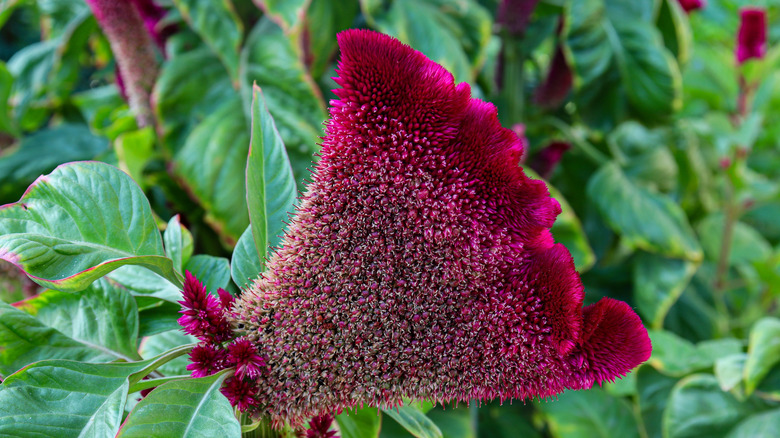
Cockscomb (Celosia argentea v cristata) has to be one of the most vibrant flowers you can plant in pots. The curled, velvety flowers are reminiscent of a rooster's comb, giving the plant its name, and can bloom in fiery displays of red, pink, purple, orange, gold, and sometimes white. It tends to bloom through the summer and into fall, and while it will happily reseed itself and grow as a perennial in zones 10 to 11, it doesn't like the cold, so is generally only grown as an annual elsewhere.
Given the colors of its plumage, it's perhaps no surprise that cockscomb enjoys plenty of sun. With that in mind, aim to place your pot in a position with at least six to eight hours of sunlight per day, and fill it with well-fertilized, free-draining soil. It can pay to fold sand or compost into heavier substrates to improve drainage — the last thing you want to do with cockscomb is allow it to sit in soggy soil. Doing so risks exposing it to ailments like root rot and flower-drop. Fortunately, cockscomb is fairly drought-tolerant, which means that if you're unsure how much to water it, you can confidently err on the side of less.
As for whether or not you should deadhead this searing celosia, it's up to you. On one hand, deadheading will encourage the plant to continue producing fiery new flowers, which is certainly no bad thing. On the other hand, you could argue that faded celosia flowers are every bit as beautiful as their fresh brothers and sisters, adding further depth to your pot or planter's palette. It also helps reduce reseeding if, for some reason, you want to control that.
Hebe (Hebe speciosa)
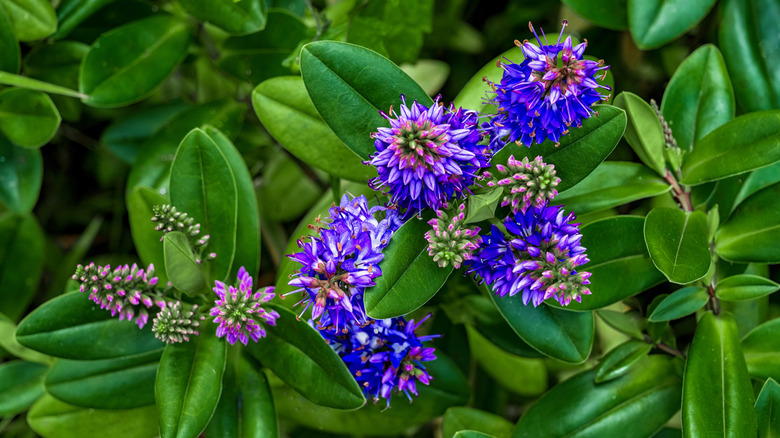
With pink, purple, red, and sometimes white spiked flowers, Hebe (Hebe speciosa) usually blooms all the way from June until October, providing your garden with a wash of color throughout the summer and autumn. In milder climates, you can expect this season to extend well into December.
This flower is especially popular because it's also an evergreen. In other words, while you might not have flowers through the worst of the winter and spring, neither will you have to stare at sparse stems until the temperatures start to warm. It thrives on heat and sun (though it doesn't mind partial shade), so the warmer your area the better.
Hebe grows perennially in hardiness zones 7 to 11. It prefers free-draining soil, and don't worry if you only have poor-quality soil — this beautiful bloomer actually prefers it. Just be sure to place your pot in a spot with as much sun as you can, and make sure you provide ample drainage. Hebe plants — especially younger ones — are prone to root rot if allowed to sit for too long in soggy conditions, particularly in winter, so it can be a good idea to incorporate a layer of gravel in the bottom of your pot to further aid with drainage.