

If You Have A Small Yard, This Evergreen Pine Variety Is A Great Choice
If you're looking to plant a tree in your yard but lacking on space, finding the perfect sapling can be quite a challenge. You'll want something that adds structure and year-round interest without overwhelming your space, or creating unwieldy landscaping needs. Luckily, there is one tree perfect to take your small yard to the next level. The Japanese umbrella pine (Sciadopitys verticillata), is a slow-growing evergreen offering visual beauty and elegance in a relatively manageable shape and size. This is especially true of the dwarf varieties, which are ideal in smaller gardens.
Even if you're not familiar with umbrella pines, you've surely seen these distinctive trees in your travels (they even have one in Manhattan's Madison Square Park). They feature whorled needles, resembling clusters of green umbrellas (hence the name). They're an evergreen conifer, but not a true pine, and this Triassic-era survivor actually predates the dinosaurs. The umbrella pine brings unique textural and visual appeal, making it perfect for front yards, back yards, and along the sides of garden paths.
The coarse, glossy needles of the umbrella pine remain vibrant throughout the year, offering perennial greenery that shifts bronze in winter. As the tree matures, it also develops a rich, reddish bark that adds even more character. It's important to take the time to learn the ideal planting and maintenance conditions for successfully raising a mature tree (which can take decades), but your compact yard will thank you.
How to grow and care for umbrella pine
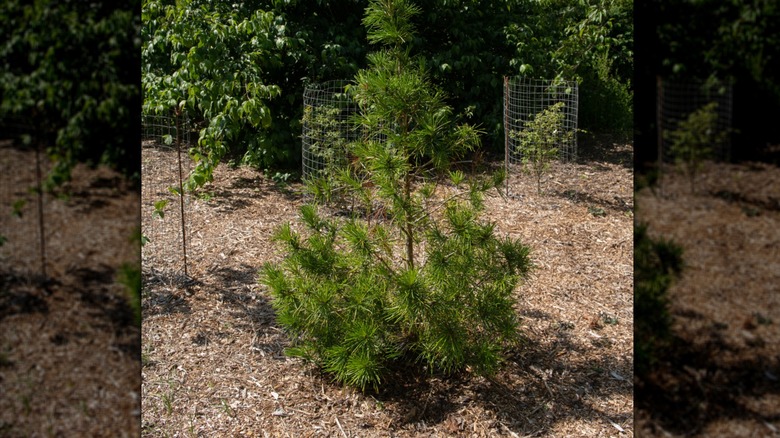
If you're reconsidering planting fast-growing tree varieties, you're in luck: The umbrella pine is naturally slow-growing, giving you ample time to design your yard around one. While the regular Sciadopitys can exceed heights of 100 feet, the dwarf variety might reach 5 feet in a couple decades, and top out at 40 feet or so in a century. The tree doesn't tend to outgrow its space, and rarely overwhelms a landscape with sprawling roots and branches.
Begin by finding a nice sunny place for the sapling to grow (shady afternoons help in zones 7 and 8). Proper exposure to sunlight helps to encourage healthy pine needle growth, giving the tree its signature layered structure. Ensure that the soil surrounding the tree is consistently moist, well-drained, particularly early on, and clocking in at a slightly acidic pH balance of 5 to 6.5. The tree is known to thrive best in USDA Zones 5 through 8. Once your umbrella pine is in the ground, it will require a slow and steady watering schedule, especially early on as it establishes its root system.
From there, you should have little trouble keeping up with the demands of the tree, as umbrella pines are known to be quite low maintenance. It's generally insect and disease resistant, and sturdy once established. You can optionally spread mulch or fertilizer with a basic evergreen formula around the base each spring to give the tree a bit of a nutrient boost, but it's by no means a requirement. Pruning is rarely needed for these trees, as the foliage doesn't tend to shed and leave a mess like many comparable conifers. Fun fact: It's not just the tree that's slow-growing, cones take about to years to reach full size and drop seeds.