

The Common Color-Changing Hydrangea Myth You Should Stop Believing
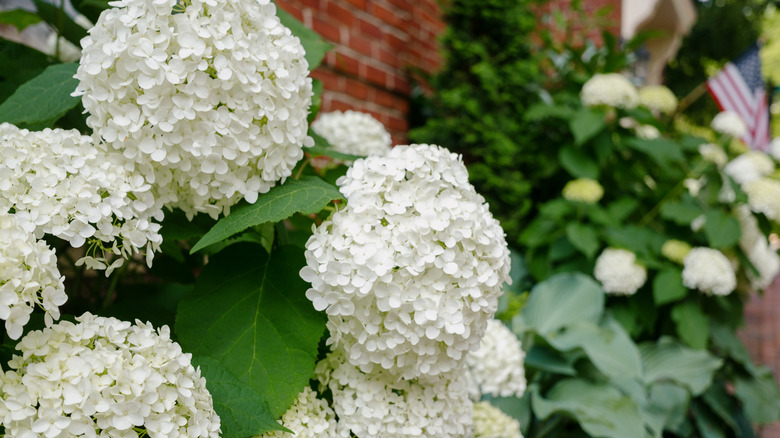
The bold, bushy hydrangea, with its large clusters of colorful flowers, makes a statement in any garden. Hydrangeas make a great privacy hedge or a stunning stand-alone backyard feature. These sturdy perennials do well in a variety of light, with some species brightening even the shaded areas of your garden. Hydrangeas come in a variety of colors, from whites and pinks to deep blues and purples, and people love the fact that some varieties can actually change color. However, it is a myth that you can trigger this color change in any kind of hydrangea by simply adding things to your soil. Only a few species of hydrangea can be manipulated in this way, and these color-changing effects may not be quick or long-lasting.
There are only two types of hydrangeas that can actually change color: the bigleaf or French hydrangea (Hydrangea macrophylla) and its close cousin, the Mountain hydrangea (Hydrangea serrata). The specific colors of blooms on these two species are dependent upon the pH of their soil. If you buy a white or cream-colored hydrangea, chances are you won't have any luck turning it pink or blue. The only changes you'll see in common white hydrangeas, like the Oakleaf hydrangea (Hydrangea quercifolia) or Smooth hydrangea (Hydrangea arborescens), are flowers that naturally turn greener as the plants age.
How pH affects the color of some hydrangea blooms
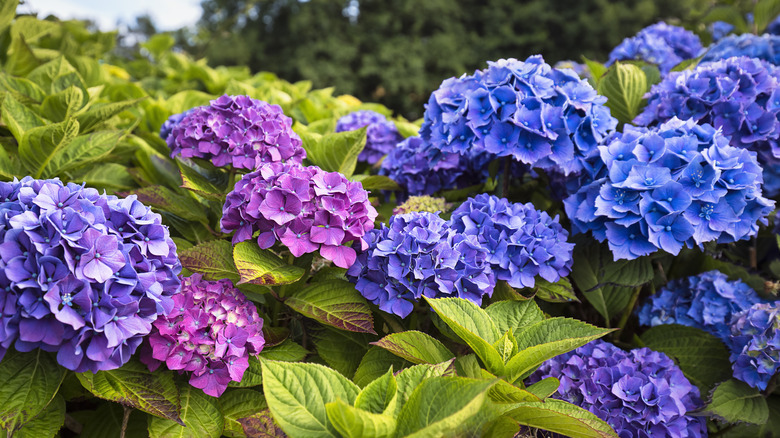
For bigleaf and mountain hydrangeas, blooms turn a deeper blue or purple as the soil's pH decreases (or as it becomes more acidic). Blooms on the very same plant can even be different shades of plum and blue if the roots that feed them extend into different pockets of soil. If you like these darker blooms, you can try adding sulfur in the fall to lower their pH. Meanwhile, soil with a higher pH (which is more alkaline) will produce red and pink blossoms, becoming paler as the pH is increased. If pink is your pleasure, use limestone to raise the pH when fertilizing your hydrangeas in the spring.
If you bring home one color of hydrangea and its blooms start to change in ways you don't enjoy, you can test your soil to see why. For a more accurate understanding of your soil pH, send a sample to your local extension office or use a highly-rated home soil tester. Note that, while raising your soil's pH can be pretty straightforward, lowering it is harder and can take a lot longer, depending on your soil type.
Changing your pH is also not a one-and-done thing, and could take many seasons of treatment to see your hydrangea colors change. Also, the color change is unlikely to be permanent. Soil pH changes naturally over time from rainfall and the impacts of other nearby plants, so you can expect your bigleaf or mountain hydrangeas to produce different shades of blooms through time.