

Why You May Want To Reconsider Planting Walnut Trees In Your Yard
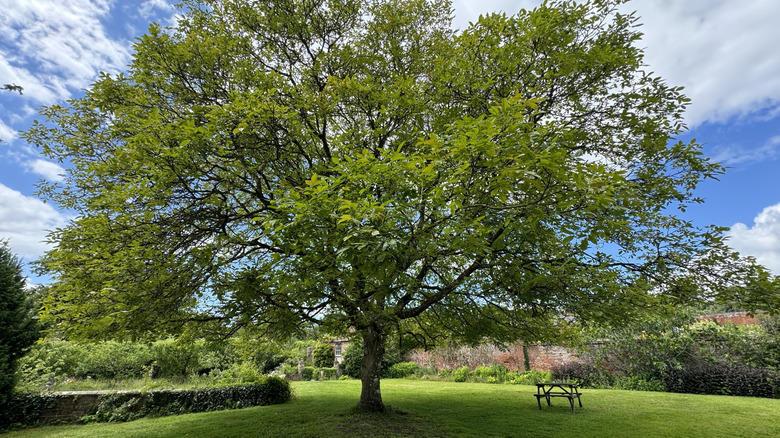
Growing massive trees for shade is an easy way to keep your garden safe from the hot sun, but some trees come with more drawbacks than others. Walnut trees are gorgeous, native, and provide excellent shade for yards and gardens. Their branches and nuts provide support for wildlife, and they're hardy trees that can adapt to many conditions. However, walnuts are not perfect trees, and there are a few factors you need to consider before planting one.
Firstly, walnut trees can be quite messy. While their nuts are an important food source for local critters, they can also damage things if they fall on them. Any that aren't eaten or cleaned up will rot, leaving dark stains on the pavement. If you were thinking about planting a walnut tree next to your patio, you might want to choose a different tree, and you certainly wouldn't want one planted over something that could be damaged by falling nuts.
There's also the issue of walnut toxicity. Walnut trees produce a chemical called juglone, which can leave certain plants stunted and discolored. Some gardeners struggle to grow anything underneath them, while others have no issues at all. Scientific studies into the effects of juglone have also had mixed results. Lab tests where juglone was introduced directly to seeds did show a negative impact on plants. Field tests are more complicated, and it's difficult to tell which plants might be impacted by the chemical and which might be struggling due to other issues. Many gardeners would rather avoid the risk by skipping walnut trees entirely. If you're still interested, though, there are simple ways to grow these trees safely.
Growing walnut trees safely
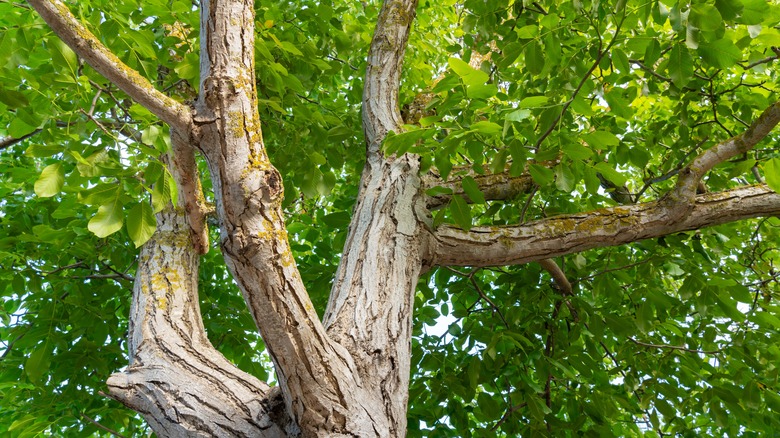
The mess and potential damage of walnut trees are the easiest problems to remedy. If you want to grow a walnut tree, give it plenty of room. If you don't have enough space, consider planting a smaller native tree, such as a hawthorn or serviceberry. For gardeners who are set on planting a walnut tree, stains can be prevented by moving nuts off the pavement as soon as they fall. Walnut toxicity is trickier to deal with. Start by eliminating as many other issues as you can. Walnut trees cast a lot of shade, so make sure that adjacent plants are shade-loving perennials or something that will thrive without much sun. Take note of each plant's needs to ensure they're getting enough water, and watch for signs of pests.
Consult a list of juglone-tolerant plants to further lower the risk; most perennials are good, as are many shrubs like barberry, juniper, holly, forsythia, and honeysuckle. Again, it's important to note that these lists are based on observation. Whether juglone is the problem or not, many gardeners have struggled to grow plants like azaleas and tomatoes underneath walnut trees, while asters and beets tend to have better luck.
Ensure your soil is healthy and space your plants appropriately. Because it's not too water-soluble, studies show that juglone does not move very well in soil. Healthy, rich, well-draining, and properly aerated soil will limit the spread of juglone and speed up the rate at which it breaks down. If the earth around your walnut tree is healthy and there's space between other plants and the tree, they're not likely to come into contact with the potentially dangerous chemical, and your burgeoning walnut tree shouldn't cause a problem.