

How To Use Your Riding Lawn Mower To Spread Salt During Winter
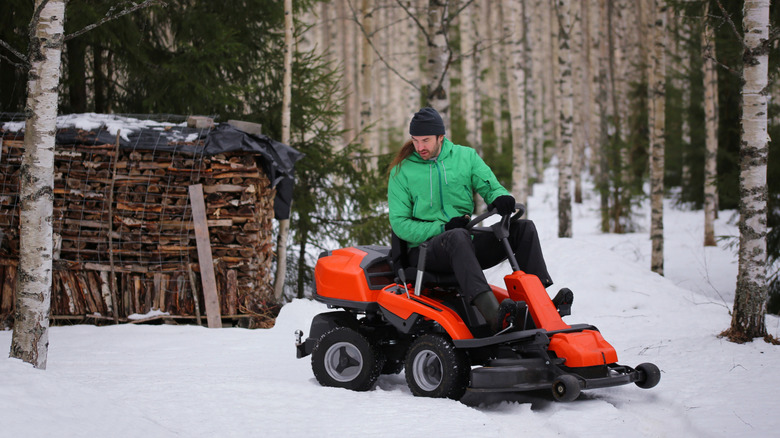
There's no point in leaving your riding lawn mower untouched outside to get covered in snow all winter when it could be put to good use during cold-weather months. In this case, it may be a good thing if you forgot to prepare your lawn mower for winter storage. A riding mower makes it a lot easier to spread salt over a large area without having to walk along the entire driveway and walkways to spread it by hand. The key to spreading salt with your mower is a versatile attachment: a salt spreader. A towable salt spreader hitches to the back of your riding lawn mower; some work with all-terrain vehicles, too. It's a simple device that doubles as one of those clever hacks to make snow and ice removal easier than ever.
The tow-behind spreaders typically have a larger salt capacity than walk-behind salt spreaders; some hold close to 200 pounds of salt. While they're similar to fertilizer spreaders that broadcast fertilizer and seeds, the seed and fertilizer-specific ones are not designed to withstand salt all the time. On the other hand, some salt-specific spreaders can handle salt, fertilizer, or grass seeds as needed, such as the Agri-Fab 85-lb Capacity Broadcast Tow-Behind Spreader. These typically have controls that let you turn the device on or off as you ride the mower, and the hopper often has spray settings to select the appropriate broadcast width so you don't spray the salt beyond the sides of the pavement.
Before purchasing any tow-behind spreader for your riding lawn mower or lawn tractor, make sure it has a compatible hitch connector. Some such as the Agri-Fab models have a universal hitch that connects to any mower brand.
Tips for spreading salt easily with your riding mower
When it comes to salt spreaders for your mower, size matters — or it could, anyway, if you need to spread salt over a large area. A large-capacity salt spreader means less refilling is needed while you work. Expect to use about 6 pounds of snow melt for every 2,000 square feet of coverage. Before you fill the hopper with your chosen ice-melting material, make sure the broadcast setting is appropriate for the width of your driveway or walkways. Some of them have variable broadcast settings; the aforementioned Agri-Fab model spreads a band 4 to 8 feet wide, on average. Some spray even farther out, so you'll have to choose a narrower band when treating walkways because too much rock salt can kill lawn grass.
Check your tow-behind spreader's manual to determine which ice-melting material works best in its hopper. Though rock salt is relatively inexpensive, it can clog some spreaders. It's worth spending a little more to get a different ice melter, such as magnesium chloride to avoid the issue. Magnesium chloride also works at lower temperatures than rock salt; it's still able to melt ice in below-zero weather, while rock salt typically isn't very effective below 15 degrees Fahrenheit.
Once you've attached the spreader and filled the hopper, you may be able to do double duty and use your riding mower for snow removal, too, as long as you have a plow attachment for it.